Claim · model-written summary
Only A. discolor larvae avoid feeding on the single cacalol treatment.
- Taxon
- Adenostyles alpina
 Adenostyles alpinat0
- Treatment
- single ST treatmente1
- Interactor
- A. discolor
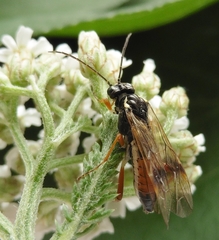 Aglaostigma discolore1herbivore
- Outcome
- feedinge0
- Direction
- avoidede1
Not reportedComparator
Verbatim
t0“Adenostyles alpina”
e0“All specialist species Aglaostigma discolor (Hymenoptera, Tenthredinidae), Oreina cacaliae (Coleoptera, Chrysomelidae) and O. speciosissima avoided feeding when confronted with the combination of compounds”
e1“Only larvae of A. discolor avoided the single ST treatment as well”
Title
Hägele; Rowell-Rahier Journal of Evolutionary Biology 1999. doi:10.1046/j.1420-9101.2000.00145.x
Other claims from this paper (18)
- Intervention effect Specialist Aglaostigma discolor larvae avoid feeding on the combination of cacalol and seneciphylline.
- Intervention effect Specialist Oreina cacaliae larvae avoid feeding on the combination of cacalol and seneciphylline.
- Intervention effect Specialist O. speciosissima larvae avoid feeding on the combination of cacalol and seneciphylline.
- Intervention effect Callimorpha dominula larvae generally avoid feeding on the PA, ST and PAST treatments.
- Intervention effect Cylindrotoma distinctissima larvae generally avoid feeding on the PA, ST and PAST treatments.
- Intervention effect Miramella alpina larvae generally avoid feeding on the PA, ST and PAST treatments.
- Observation Naive Callimorpha dominula caterpillars are indiscriminate towards PA.
- Observation Callimorpha dominula caterpillars that have experienced PA prefer to feed on the PA treatment.
- Intervention effect Growth of Oreina cacaliae larvae is not different between treatments in no-choice tests; avoidance had no obvious effect on growth when forced to feed.
- Intervention effect Growth of O. speciosissima larvae is not different between treatments in no-choice tests; avoidance had no obvious effect on growth when forced to feed.
- Intervention effect The high-concentration combination treatment (PAST) reduces Callimorpha dominula larval growth because consumption decreases.
- Intervention effect Cylindrotoma distinctissima larval growth is reduced in all treatments except PA3%.
- Mechanism Poor growth of Cylindrotoma distinctissima is due to postingestive physiological effects of all treatments and, for high-dose ST, reduced consumption.
- Observation Broad-sense heritability of growth performance is not significant in Oreina cacaliae.
- Observation Broad-sense heritability of growth performance is 0.46 in O. speciosissima.
- Observation Broad-sense heritability of growth performance is 0.64 in Callimorpha dominula.
- Observation Broad-sense heritability of growth performance is 0.84 in Cylindrotoma distinctissima.
- Association Genetic variability of herbivore growth performance varies with the specialization degree of the species.