Abstract
Resistant annual and herbaceous perennial plant species were identified as key hosts which allow Phytophthora cinnamomi to persist on severely impacted black gravel sites within the Eucalyptus marginata (jarrah) forest of southwest Western Australia. Of the annual and herbaceous perennial plant species present on black gravel sites, 15 out of 19 species were found to be hosts of P. cinnamomi, and 10 of these were symptomless hosts. In particular, the native annual Trachymene pilosa and the two native herbaceous perennials Stylidium diuroides and Chamaescilla corymbosa were commonly found to be hosts of the pathogen. Species from 12 new genera including three from new families (Crassulaceae, Droseraceae and Primulaceae) are reported for the first time to be hosts of P. cinnamomi. The species from which P. cinnamomi was recovered were the native species: Chamaescilla corymbosa, Crassula closiana, Drosera erythrorhiza, Hydrocotyle callicarpa, Levenhookia pusilla, Paracaleana nigrita, Podotheca angustifolia, Pterochaeta paniculata, Rytidosperma caespitosum, Siloxerus multiflorus, Stylidium diuroides and Trachymene pilosa, and the introduced annual weeds Hypochaeris glabra, Lysimachia arvensis and Pentameris airoides.
Abstract from the paper’s OpenAlex record, shown for indexing and research. Copyright remains with the authors or the publisher. Read at the source ↗
The text the model read, with the source record’s inline markup (italics, sub- and superscripts) rendered and its character entities decoded; quote offsets refer to the raw text.
Claims 8
Claim · model-written summary
Fifteen of 19 species on black gravel sites hosted P. cinnamomi.
- Taxon
- annual and herbaceous perennial plant speciese0
- Interactor
- P. cinnamomi
 Phytophthora cinnamomie0pathogen
- Outcome
- hosts of P. cinnamomie0
- Value
- 15 out of 19 speciese0
- Setting
- black gravel sitese0
Organisms pictured · Representative pictures of the matched species, not figures from the paper.

Verbatim
e0“Of the annual and herbaceous perennial plant species present on black gravel sites, 15 out of 19 species were found to be hosts of P. cinnamomi”
Claim · model-written summary
Ten host species were symptomless.
- Taxon
- annual and herbaceous perennial plant speciese0
- Interactor
- P. cinnamomiPhytophthora cinnamomie0pathogen
- Outcome
- symptomless hostse0
- Value
- 10e0
Organisms pictured · Representative pictures of the matched species, not figures from the paper.
Verbatim
e0“Of the annual and herbaceous perennial plant species present on black gravel sites, 15 out of 19 species were found to be hosts of P. cinnamomi, and 10 of these were symptomless hosts.”
Claim · model-written summary
Trachymene pilosa was commonly a host of the pathogen.
- Taxon
- Trachymene pilosa
 Trachymene pilosae0
- Interactor
- the pathogene0pathogen
- Outcome
- hosts of the pathogene0
Organisms pictured · Representative pictures of the matched species, not figures from the paper.

Verbatim
e0“the native annual Trachymene pilosa and the two native herbaceous perennials Stylidium diuroides and Chamaescilla corymbosa were commonly found to be hosts of the pathogen”
Claim · model-written summary
Stylidium diuroides was commonly a host of the pathogen.
- Taxon
- Stylidium diuroides
 Stylidium diuroidese0
- Interactor
- the pathogene0pathogen
- Outcome
- hosts of the pathogene0
Organisms pictured · Representative pictures of the matched species, not figures from the paper.
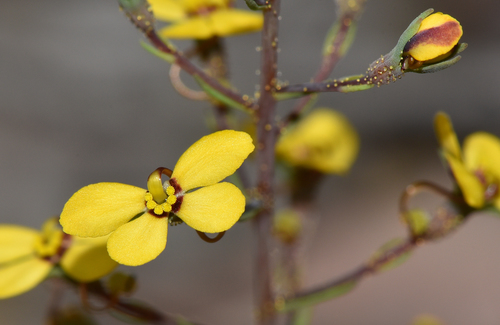
Verbatim
e0“Stylidium diuroides and Chamaescilla corymbosa were commonly found to be hosts of the pathogen”
Claim · model-written summary
Chamaescilla corymbosa was commonly a host of the pathogen.
- Taxon
- Chamaescilla corymbosa
 Chamaescilla corymbosae0
- Interactor
- the pathogene0pathogen
- Outcome
- hosts of the pathogene0
Organisms pictured · Representative pictures of the matched species, not figures from the paper.

Verbatim
e0“Chamaescilla corymbosa were commonly found to be hosts of the pathogen”
Claim · model-written summary
Species from 12 new genera and three new families were reported as hosts.
- Taxon
- Species from 12 new generae0
- Interactor
- P. cinnamomiPhytophthora cinnamomie0pathogen
- Outcome
- hosts of P. cinnamomie0
- Value
- 12 new generae0
Organisms pictured · Representative pictures of the matched species, not figures from the paper.
Verbatim
e0“Species from 12 new genera including three from new families (Crassulaceae, Droseraceae and Primulaceae) are reported for the first time to be hosts of P. cinnamomi”
Claim · model-written summary
The listed native species yielded P. cinnamomi.
- Taxon
- native speciese0
- Interactor
- P. cinnamomiPhytophthora cinnamomie0pathogen
- Outcome
- P. cinnamomi was recoverede0
Organisms pictured · Representative pictures of the matched species, not figures from the paper.
Verbatim
e0“The species from which P. cinnamomi was recovered were the native species: Chamaescilla corymbosa, Crassula closiana, Drosera erythrorhiza, Hydrocotyle callicarpa, Levenhookia pusilla, Paracaleana nigrita, Podotheca angustifolia, Pterochaeta paniculata, Rytidosperma caespitosum, Siloxerus multiflorus, Stylidium diuroides and Trachymene pilosa”
Claim · model-written summary
The listed introduced weeds yielded P. cinnamomi.
- Taxon
- introduced annual weedse1
- Interactor
- P. cinnamomiPhytophthora cinnamomie0pathogen
- Outcome
- P. cinnamomi was recoverede0
Organisms pictured · Representative pictures of the matched species, not figures from the paper.
Verbatim
e0“The species from which P. cinnamomi was recovered”
e1“the introduced annual weeds Hypochaeris glabra, Lysimachia arvensis and Pentameris airoides”