Abstract
Bryophyte community as well as individual moss species characteristics on soil were examined to determine relationships with proximity to three coal-fired power plants emitting SO2 and a ferroalloy plant emitting chromium among their emission products. Woody vascular plant communities were relatively uniform, whereas bryophyte coverage was halved (from 3.36% to 1.47%) when comparing locations relatively distant from the plants with those closer. Other common community indices varied little with locality. Three moss species which showed the most consistent relationship to distance from the power plants, Dicranum scoparium, Leucobryum albidum, and Polytrichum ohioense, were mapped for presence or absence on 68 similar hillside habitats. D. scoparium and L. albidum consistently were absent in the area most influenced by the emission sources, while P. ohioense was less consistent in its absence. Presence or absence of indicator moss species proved more useful than community characteristics for indicating relative air quality.
Abstract from the paper’s OpenAlex record, shown for indexing and research. Copyright remains with the authors or the publisher. Read at the source ↗
The text the model read, with the source record’s inline markup (italics, sub- and superscripts) rendered and its character entities decoded; quote offsets refer to the raw text.
Claims 6
Claim · model-written summary
Bryophyte coverage was halved at locations relatively distant from the coal-fired power plants compared with closer locations.
Verbatim
e1“Bryophyte community as well as individual moss species characteristics on soil were examined to determine relationships with proximity to three coal-fired power plants emitting SO2”
e2“bryophyte coverage was halved (from 3.36% to 1.47%) when comparing locations relatively distant from the plants with those closer”
Claim · model-written summary
Woody vascular plant communities were relatively uniform across localities.
Not reportedDirection
Verbatim
e2“Woody vascular plant communities were relatively uniform, whereas bryophyte coverage was halved”
Claim · model-written summary
Other common community indices varied little with locality.
Not reportedDirection
Verbatim
e1“Bryophyte community as well as individual moss species characteristics on soil were examined”
e3“Other common community indices varied little with locality”
Claim · model-written summary
Dicranum scoparium and Leucobryum albidum were consistently absent in the area most influenced by the emission sources.
- Taxon
- D. scoparium and L. albidum
 Dicranum scoparium
 Leucobryum albidume4
- Outcome
- absente4
- Setting
- the area most influenced by the emission sourcese4
Not reportedDirection
Organisms pictured · Representative pictures of the matched species, not figures from the paper.


Verbatim
e4“D. scoparium and L. albidum consistently were absent in the area most influenced by the emission sources”
Claim · model-written summary
Polytrichum ohioense was less consistently absent than the other two indicator moss species.
- Taxon
- P. ohioense
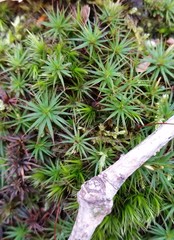 Polytrichastrum ohioensee5
- Outcome
- absencee5
- Qualifier
- less consistente5
Not reportedDirection
Organisms pictured · Representative pictures of the matched species, not figures from the paper.
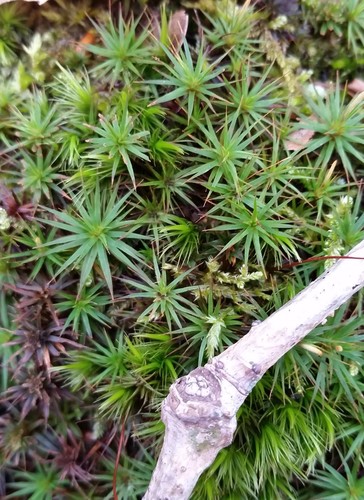
Verbatim
e5“P. ohioense was less consistent in its absence”
Claim · model-written summary
Presence or absence of indicator moss species was more useful than community characteristics for indicating relative air quality.
Verbatim
e6“Presence or absence of indicator moss species proved more useful than community characteristics for indicating relative air quality”