Abstract
Diseased barley plants (Hordeum vulgare) were noticed in the area ofKumanovo at the beginning of March, 2008. The plants were highly diseased,probably in the stage of germination, dwarfed with necrotic leafs and very lowdeveloped root. We noticed a rot root collar in some plants and we were ableto dig them out of the soil very easily. Plants diseased in a later stage begin tobecome yellow from the top of the leaf and many brown to olivaceous ovalshape lesions were noticed. Conidia from Cochliobolus sativus (Ito. i Kurib)Drechsler ex Dastur. sin. Bipolaris sorokinianа (Sacc.) Shoen. were isolatedfrom symptomatic lesions. Pseudothecia with ascuses and ascospores fromtelemorfi c stage Helminthosporium sativum Pammel; King & Bakke werefound on the wheat straw from the previous year, in the same fi eld.
Abstract from the paper’s OpenAlex record, shown for indexing and research. Copyright remains with the authors or the publisher. Read at the source ↗
The text the model read, with the source record’s inline markup (italics, sub- and superscripts) rendered and its character entities decoded; quote offsets refer to the raw text.
Claims 5
Claim · model-written summary
Diseased barley plants were dwarfed with necrotic leaves and poorly developed roots.
- Taxon
- Hordeum vulgare
 Hordeum vulgaree0
- Outcome
- dwarfed with necrotic leafs and very lowdeveloped roote0
- Setting
- area ofKumanovoe0
Organisms pictured · Representative pictures of the matched species, not figures from the paper.

Verbatim
e0“Diseased barley plants (Hordeum vulgare) were noticed in the area ofKumanovo at the beginning of March, 2008. The plants were highly diseased,probably in the stage of germination, dwarfed with necrotic leafs and very lowdeveloped root.”
Claim · model-written summary
Some diseased barley plants had root collar rot.
- Taxon
- plantsViridiplantaee0
- Outcome
- rot root collare0
Verbatim
e0“We noticed a rot root collar in some plants”
Claim · model-written summary
Barley plants diseased later showed leaf yellowing and brown to olive oval lesions.
- Taxon
- PlantsViridiplantaee0
- Outcome
- yellow from the top of the leaf and many brown to olivaceous ovalshape lesionse0
Verbatim
e0“Plants diseased in a later stage begin tobecome yellow from the top of the leaf and many brown to olivaceous ovalshape lesions were noticed.”
Claim · model-written summary
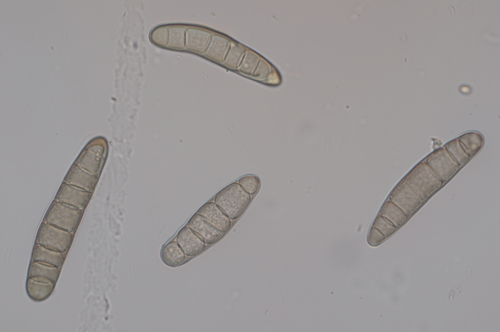
Cochliobolus sativus conidia were isolated from symptomatic barley lesions.
- Interactor
- Cochliobolus sativus
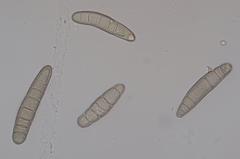 Bipolaris sorokinianae0pathogen
- Outcome
- were isolatedfrom symptomatic lesionse0
Not reportedTaxon
Organisms pictured · Representative pictures of the matched species, not figures from the paper.
Verbatim
e0“Conidia from Cochliobolus sativus (Ito. i Kurib)Drechsler ex Dastur. sin. Bipolaris sorokinianа (Sacc.) Shoen. were isolatedfrom symptomatic lesions.”
Claim · model-written summary
Teleomorphic fungal structures were found on wheat straw in the same field.
- Taxon
- wheat
 Triticum aestivume0
- Interactor
- Helminthosporium sativume0pathogen
- Outcome
- Pseudothecia with ascuses and ascosporese0
Organisms pictured · Representative pictures of the matched species, not figures from the paper.

Verbatim
e0“Pseudothecia with ascuses and ascospores fromtelemorfi c stage Helminthosporium sativum Pammel; King & Bakke werefound on the wheat straw from the previous year, in the same fi eld.”