Abstract
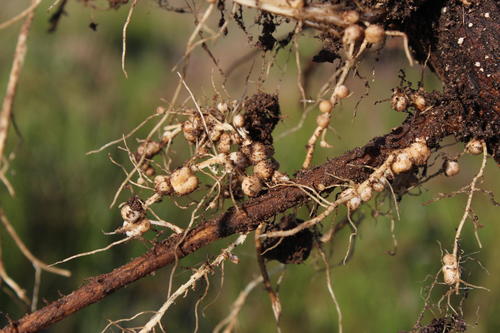
Azorhizobium caulinodans employs both cytochrome bd (cytbd; quinol oxidase) and cytcbb3 (cytc oxidase) as terminal oxidases in environments with very low O2 concentrations. To investigate physiological roles of these two terminal oxidases both in microaerobic culture and in symbiosis, knockout mutants were constructed. As evidenced by visible absorbance spectra taken from mutant bacteria carrying perfect gene replacements, both the cytbd- and cytcbb3- mutations were null alleles. In aerobic culture under 2% O2 atmosphere, Azorhizobium cytbd- and cytcbb3- single mutants both fixed N2 at 70 to 90% of wild-type rates; in root nodule symbiosis, both single mutants fixed N2 at 50% of wild-type rates. In contrast, Azorhizobium cytbd- cytcbb3-double mutants, which carry both null alleles, completely lacked symbiotic N2 fixation activity. Therefore, both Azorhizobium cytbd and cytcbb3 oxidases drive respiration in environments with nanomolar O2 concentrations during symbiotic N2 fixation. In culture under a 2% O2 atmosphere, Azorhizobium cytbd- cytcbb3- double mutants fixed N2 at 70% of wild-type rates, presumably reflecting cytaa3 and cytbo (and other) terminal oxidase activities. In microaerobic continuous cultures in rich medium, Azorhizobium cytbd- and cytcbb3- single mutants were compared for their ability to deplete a limiting-O2 sparge; cytbd oxidase activity maintained dissolved O2 at 3.6 microM steady state, whereas cytcbb3 oxidase activity depleted O2 to submicromolar levels. Growth rates reflected this difference; cytcbb3 oxidase activity disproportionately supported microaerobic growth. Paradoxically, in O2 limited continuous culture, Azorhizobium cytbd oxidase is inactive below 3.6 microM dissolved O2 whereas in Sesbania rostrata symbiotic nodules, in which physiological, dissolved O2 is maintained at 10 to 20 nM, both Azorhizobium cytbd and cytcbb3 seem to contribute equally as respiratory terminal oxidases.
Abstract from the paper’s OpenAlex record, shown for indexing and research. Copyright remains with the authors or the publisher. Read at the source ↗
The text the model read, with the source record’s inline markup (italics, sub- and superscripts) rendered and its character entities decoded; quote offsets refer to the raw text.
Claims 12
Claim · model-written summary
Both bacterial oxidase mutations were null alleles.
- Taxon
- Azorhizobium caulinodans
 Azorhizobium caulinodanst0
- Gene
- cytbd- and cytcbb3-e0
- Outcome
- null allelese0
Organisms pictured · Representative pictures of the matched species, not figures from the paper.
Verbatim
e0“As evidenced by visible absorbance spectra taken from mutant bacteria carrying perfect gene replacements, both the cytbd- and cytcbb3- mutations were null alleles.”
t0“Azorhizobium caulinodans”
Claim · model-written summary
The cytbd single mutant fixed nitrogen at 70 to 90% of wild-type rates under 2% oxygen.
- Taxon
- AzorhizobiumAzorhizobiume0
- Treatment
- cytbd-e0
- Outcome
- fixed N2e0
- Direction
- lowerinferrede0
- Value
- 70 to 90%e0
- Qualifier
- 2% O2 atmospheree0
- Comparator
- wild-typee0
Organisms pictured · Representative pictures of the matched species, not figures from the paper.
Verbatim
e0“In aerobic culture under 2% O2 atmosphere, Azorhizobium cytbd- and cytcbb3- single mutants both fixed N2 at 70 to 90% of wild-type rates”
Claim · model-written summary
The cytcbb3 single mutant fixed nitrogen at 70 to 90% of wild-type rates under 2% oxygen.
- Taxon
- AzorhizobiumAzorhizobiume0
- Treatment
- cytcbb3-e0
- Outcome
- fixed N2e0
- Direction
- lowerinferrede0
- Value
- 70 to 90%e0
- Comparator
- wild-typee0
Organisms pictured · Representative pictures of the matched species, not figures from the paper.
Verbatim
e0“In aerobic culture under 2% O2 atmosphere, Azorhizobium cytbd- and cytcbb3- single mutants both fixed N2 at 70 to 90% of wild-type rates”
Claim · model-written summary
Double mutants completely lacked symbiotic nitrogen fixation.
- Taxon
- AzorhizobiumAzorhizobiume0
- Treatment
- cytbd- cytcbb3-double mutantse0
- Interactor
- Sesbania rostrataSesbania rostratae1host
- Outcome
- symbiotic N2 fixation activitye0
- Direction
- completely lackede0
Not reportedComparator
Organisms pictured · Representative pictures of the matched species, not figures from the paper.
Verbatim
e0“Azorhizobium cytbd- cytcbb3-double mutants, which carry both null alleles, completely lacked symbiotic N2 fixation activity.”
e1“Sesbania rostrata symbiotic nodules”
Claim · model-written summary
Both oxidases drive respiration during symbiotic nitrogen fixation at nanomolar oxygen.
- Taxon
- AzorhizobiumAzorhizobiume0
- Interactor
- Sesbania rostrataSesbania rostratae1host
- Gene
- cytbd and cytcbb3 oxidasese0
- Outcome
- respiratione0
Organisms pictured · Representative pictures of the matched species, not figures from the paper.
Verbatim
e0“both Azorhizobium cytbd and cytcbb3 oxidases drive respiration in environments with nanomolar O2 concentrations during symbiotic N2 fixation.”
e1“Sesbania rostrata symbiotic nodules”
Claim · model-written summary
Double mutants fixed nitrogen at 70% of wild-type rates in culture under 2% oxygen.
- Taxon
- AzorhizobiumAzorhizobiume0
- Treatment
- cytbd- cytcbb3- double mutantse0
- Outcome
- fixed N2e0
- Direction
- lowerinferrede0
- Value
- 70%e0
- Comparator
- wild-typee0
Organisms pictured · Representative pictures of the matched species, not figures from the paper.
Verbatim
e0“In culture under a 2% O2 atmosphere, Azorhizobium cytbd- cytcbb3- double mutants fixed N2 at 70% of wild-type rates”
Claim · model-written summary
Residual nitrogen fixation presumably reflects other terminal oxidase activities.
- Taxon
- AzorhizobiumAzorhizobiume0
- Gene
- cytaa3 and cytboe0
- Outcome
- fixed N2e0
- Qualifier
- presumablye0
Organisms pictured · Representative pictures of the matched species, not figures from the paper.
Verbatim
e0“Azorhizobium cytbd- cytcbb3- double mutants fixed N2 at 70% of wild-type rates, presumably reflecting cytaa3 and cytbo (and other) terminal oxidase activities.”
Claim · model-written summary
cytbd oxidase maintained dissolved oxygen at 3.6 microM.
- Taxon
- AzorhizobiumAzorhizobiume0
- Gene
- cytbd oxidasee0
- Outcome
- dissolved O2e0
- Direction
- maintainede0
- Value
- 3.6 microMe0
Organisms pictured · Representative pictures of the matched species, not figures from the paper.
Verbatim
e0“Azorhizobium cytbd- and cytcbb3- single mutants were compared for their ability to deplete a limiting-O2 sparge; cytbd oxidase activity maintained dissolved O2 at 3.6 microM steady state”
Claim · model-written summary
cytcbb3 oxidase depleted oxygen to submicromolar levels.
- Taxon
- Azorhizobium caulinodansAzorhizobium caulinodanst0
- Gene
- cytcbb3 oxidasee0
- Outcome
- O2e0
- Direction
- depletede0
- Value
- submicromolar levelse0
Organisms pictured · Representative pictures of the matched species, not figures from the paper.
Verbatim
e0“cytcbb3 oxidase activity depleted O2 to submicromolar levels.”
t0“Azorhizobium caulinodans”
Claim · model-written summary
cytcbb3 activity disproportionately supported microaerobic growth.
- Taxon
- Azorhizobium caulinodansAzorhizobium caulinodanst0
- Gene
- cytcbb3 oxidasee0
- Outcome
- microaerobic growthe0
Organisms pictured · Representative pictures of the matched species, not figures from the paper.
Verbatim
e0“Growth rates reflected this difference; cytcbb3 oxidase activity disproportionately supported microaerobic growth.”
t0“Azorhizobium caulinodans”
Claim · model-written summary
cytbd oxidase was inactive below 3.6 microM dissolved oxygen in oxygen-limited culture.
- Taxon
- AzorhizobiumAzorhizobiume0
- Gene
- cytbd oxidasee0
- Outcome
- inactivee0
- Qualifier
- below 3.6 microM dissolved O2e0
Organisms pictured · Representative pictures of the matched species, not figures from the paper.
Verbatim
e0“in O2 limited continuous culture, Azorhizobium cytbd oxidase is inactive below 3.6 microM dissolved O2”
Claim · model-written summary
Both oxidases seem to contribute equally in Sesbania nodules at 10 to 20 nM oxygen.
- Taxon
- AzorhizobiumAzorhizobiume0
- Interactor
- Sesbania rostrataSesbania rostratae0host
- Gene
- cytbd and cytcbb3e0
- Outcome
- contribute equally as respiratory terminal oxidasese0
- Qualifier
- 10 to 20 nMe0
Organisms pictured · Representative pictures of the matched species, not figures from the paper.
Verbatim
e0“in Sesbania rostrata symbiotic nodules, in which physiological, dissolved O2 is maintained at 10 to 20 nM, both Azorhizobium cytbd and cytcbb3 seem to contribute equally as respiratory terminal oxidases.”