Abstract
Chromosome numbers are reported for 12 native North American species of Salix and one natural hybrid. The arctic species Salix alaxensis var. alaxensis, S. fuscescens, S. ovalifolia var. ovalifolia, S. phlebophylla, and S. reticulata and the boreal species S. arbusculoides are diploids, 2n = 38. Tetraploid counts, 2n = 76, are reported for the arctic S. planifolia ssp. pulchra. Taxa with more than one chromosome number include S. planifolia ssp. planifolia and S. pedicellaris, each of which has tetraploid and triploid levels; S. arctica s.l., which is tetraploid in the eastern American arctic and hexaploid in the Alaska and Eurasian arctic; and S. athabascensis with triploid, tetraploid, and hexaploid levels. Intra-population variation in chromosome number is reported for S. glauca in which tetraploids, pentaploids, and hexaploids occur in a single Alaskan population.
Abstract from the paper’s OpenAlex record, shown for indexing and research. Copyright remains with the authors or the publisher. Read at the source ↗
The text the model read, with the source record’s inline markup (italics, sub- and superscripts) rendered and its character entities decoded; quote offsets refer to the raw text.
Claims 9
Claim · model-written summary
Salix alaxensis var. alaxensis, S. fuscescens and S. ovalifolia var. ovalifolia are diploids (2n = 38).
- Taxon
- Salix alaxensis var. alaxensis, S. fuscescens, S. ovalifolia var. ovalifolia
 Salix fuscescens
 Salix ovalifolia
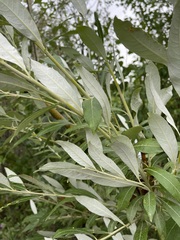 Salix alaxensis var. alaxensise0
- Outcome
- diploidse0
- Value
- 2n = 38e0
Organisms pictured · Representative pictures of the matched species, not figures from the paper.


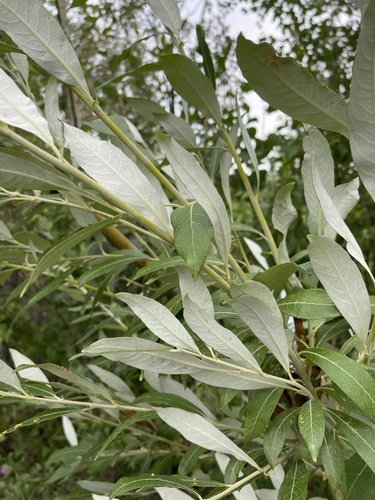
Verbatim
e0“The arctic species Salix alaxensis var. alaxensis, S. fuscescens, S. ovalifolia var. ovalifolia, S. phlebophylla, and S. reticulata and the boreal species S. arbusculoides are diploids, 2n = 38”
Claim · model-written summary
S. phlebophylla and S. reticulata are diploids (2n = 38).
- Taxon
- S. phlebophylla, and S. reticulata
 Salix reticulata
 Salix phlebophyllae0
- Outcome
- diploidse0
- Value
- 2n = 38e0
Organisms pictured · Representative pictures of the matched species, not figures from the paper.


Verbatim
e0“The arctic species Salix alaxensis var. alaxensis, S. fuscescens, S. ovalifolia var. ovalifolia, S. phlebophylla, and S. reticulata and the boreal species S. arbusculoides are diploids, 2n = 38”
Claim · model-written summary
S. arbusculoides is a diploid (2n = 38).
- Taxon
- S. arbusculoidesSalix arbusculoidese0
- Outcome
- diploidse0
- Value
- 2n = 38e0
Verbatim
e0“The arctic species Salix alaxensis var. alaxensis, S. fuscescens, S. ovalifolia var. ovalifolia, S. phlebophylla, and S. reticulata and the boreal species S. arbusculoides are diploids, 2n = 38”
Claim · model-written summary
Salix planifolia ssp. pulchra is tetraploid (2n = 76).
- Taxon
- S. planifolia ssp. pulchra
 Salix planifoliae1
- Outcome
- Tetraploid countse1
- Value
- 2n = 76e1
Organisms pictured · Representative pictures of the matched species, not figures from the paper.

Verbatim
e1“Tetraploid counts, 2n = 76, are reported for the arctic S. planifolia ssp. pulchra”
Claim · model-written summary
S. planifolia ssp. planifolia and S. pedicellaris have tetraploid and triploid levels.
- Taxon
- S. planifolia ssp. planifolia and S. pedicellaris
 Salix pedicellarisSalix planifoliae2
- Outcome
- tetraploid and triploid levelse2
Organisms pictured · Representative pictures of the matched species, not figures from the paper.

Verbatim
e2“Taxa with more than one chromosome number include S. planifolia ssp. planifolia and S. pedicellaris, each of which has tetraploid and triploid levels”
Claim · model-written summary
S. arctica s.l. is tetraploid in the eastern American arctic.
- Taxon
- S. arctica s.l.
 Salix arcticae3
- Outcome
- tetraploid in the eastern American arctice3
- Value
- tetraploide3
- Setting
- eastern American arctice3
Organisms pictured · Representative pictures of the matched species, not figures from the paper.

Verbatim
e3“S. arctica s.l., which is tetraploid in the eastern American arctic and hexaploid in the Alaska and Eurasian arctic”
Claim · model-written summary
S. arctica s.l. is hexaploid in the Alaska and Eurasian arctic.
- Taxon
- S. arctica s.l.Salix arcticae3
- Outcome
- hexaploid in the Alaska and Eurasian arctice3
- Value
- hexaploide3
- Setting
- Alaska and Eurasian arctice3
Organisms pictured · Representative pictures of the matched species, not figures from the paper.
Verbatim
e3“S. arctica s.l., which is tetraploid in the eastern American arctic and hexaploid in the Alaska and Eurasian arctic”
Claim · model-written summary
S. athabascensis has triploid, tetraploid and hexaploid levels.
- Taxon
- S. athabascensisSalix athabascensise4
- Outcome
- triploid, tetraploid, and hexaploid levelse4
Verbatim
e4“and S. athabascensis with triploid, tetraploid, and hexaploid levels”
Claim · model-written summary
Within one Alaskan population of S. glauca, tetraploids, pentaploids and hexaploids occur.
- Taxon
- S. glauca
 Salix glaucae5
- Outcome
- Intra-population variation in chromosome numbere5
- Qualifier
- tetraploids, pentaploids, and hexaploidse5
- Setting
- a single Alaskan populatione5
Organisms pictured · Representative pictures of the matched species, not figures from the paper.

Verbatim
e5“Intra-population variation in chromosome number is reported for S. glauca in which tetraploids, pentaploids, and hexaploids occur in a single Alaskan population”