Abstract
Abstract Examination of fruit‐size and shape in the circumpolar C. glareosa complex shows that there is continuous variation between the long, fusiform fruits of C. glareosa Wahlenb. and the short, broad fruits of plants which are commonly referred either to C. marina Dewey or C. glareosa var. amphigena Fernald. It is suggested that Fernald's varietal treatment is the more appropriate. C. glareosa appears only to occur in two areas: Fennoscandia and adjacent northwest European Russia, and eastern Canada and southwest Greenland. Possible explanations of the pronounced fruit variation within the complex are considered.
Abstract from the paper’s OpenAlex record, shown for indexing and research. Copyright remains with the authors or the publisher. Read at the source ↗
The text the model read, with the source record’s inline markup (italics, sub- and superscripts) rendered and its character entities decoded; quote offsets refer to the raw text.
Claims 3
Claim · model-written summary
Fruit shape varies continuously between C. glareosa and the plants called C. marina or C. glareosa var. amphigena.
- Taxon
- C. glareosa
 Carex glareosae0
- Organ / stage
- fruitse0
- Outcome
- continuous variatione0
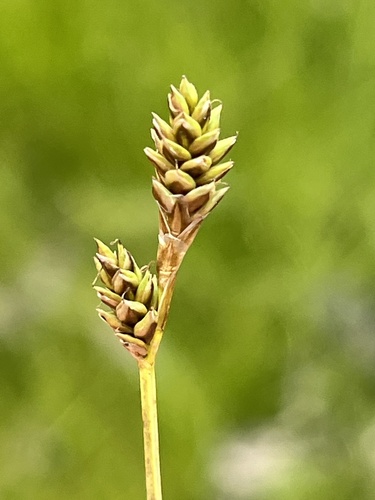
Organisms pictured · Representative pictures of the matched species, not figures from the paper.
Verbatim
e0“continuous variation between the long, fusiform fruits of C. glareosa Wahlenb. and the short, broad fruits of plants which are commonly referred either to C. marina Dewey or C. glareosa var. amphigena Fernald”
Claim · model-written summary
The authors favor Fernald’s varietal treatment.
- Taxon
- Carex glareosaCarex glareosat0
- Outcome
- Fernald's varietal treatment is the more appropriatee0
Organisms pictured · Representative pictures of the matched species, not figures from the paper.
Verbatim
e0“Fernald's varietal treatment is the more appropriate”
t0“Carex glareosa”
Claim · model-written summary
C. glareosa appears restricted to two geographic regions.
- Taxon
- C. glareosaCarex glareosae0
- Outcome
- only to occur in two arease0
- Setting
- Fennoscandia and adjacent northwest European Russia, and eastern Canada and southwest Greenlande0
Organisms pictured · Representative pictures of the matched species, not figures from the paper.
Verbatim
e0“C. glareosa appears only to occur in two areas: Fennoscandia and adjacent northwest European Russia, and eastern Canada and southwest Greenland”