Abstract
The expectations that shade-tolerant forest species show 1) a population structure composed by a high amount of small individuals, and 2) biomass allocation for diameter higher than for height growth, were tested for Rudgea parquioides, a typical shrub in Southern Brazil. We described the size structure (height and stem diameter) and allometrical relations of a R. parquioides population by counting and measuring all the individuals in a 725m(2) area in the municipality of Curitiba (25°25'S; 49°19'W). A total of 916 individuals (12,634 ind.ha(-1)) were recorded in the area. The first expectation was supported, since distribution by height and diameter classes showed a predominance of small individuals (skewness coefficients > 1). On the other hand, the regression between height and stem base diameter showed slope β < 1, which indicates that growth in height is higher than in diameter, not supporting the second expectation. These results show that life strategies in shade-tolerant species may imply in more trade-off combinations than previously described.
Abstract from the paper’s OpenAlex record; open copy licensed cc-by-nc. Read at the source ↗
The text the model read, with the source record’s inline markup (italics, sub- and superscripts) rendered and its character entities decoded; quote offsets refer to the raw text.
Claims 4
Claim · model-written summary
The surveyed Rudgea parquioides area contained 916 individuals at 12,634 ind.ha(-1).
- Taxon
- Rudgea parquioides
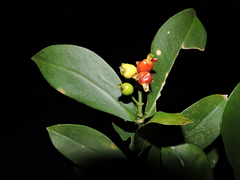 Rudgea parquioidest0
- Outcome
- individualse0
- Value
- 12,634 ind.ha(-1)e0
- Setting
- Curitibae1
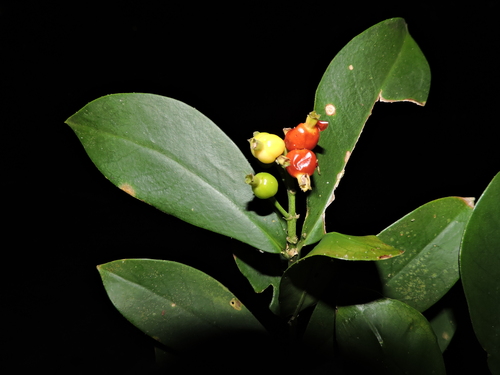
Organisms pictured · Representative pictures of the matched species, not figures from the paper.
Verbatim
e0“A total of 916 individuals (12,634 ind.ha(-1)) were recorded in the area”
t0“Rudgea parquioides”
e1“municipality of Curitiba”
Claim · model-written summary
Height and diameter classes were dominated by small Rudgea parquioides individuals.
- Taxon
- Rudgea parquioidesRudgea parquioidest0
- Outcome
- predominance of small individualse0
- Value
- skewness coefficients > 1e0
Organisms pictured · Representative pictures of the matched species, not figures from the paper.
Verbatim
e0“distribution by height and diameter classes showed a predominance of small individuals (skewness coefficients > 1)”
t0“Rudgea parquioides”
Claim · model-written summary
Height growth exceeded diameter growth in Rudgea parquioides.
- Taxon
- Rudgea parquioidesRudgea parquioidest0
- Organ / stage
- stem basee0
- Outcome
- growth in heighte0
- Direction
- highere0
- Value
- slope β < 1e0
- Comparator
- diametere0
Organisms pictured · Representative pictures of the matched species, not figures from the paper.
Verbatim
e0“the regression between height and stem base diameter showed slope β < 1, which indicates that growth in height is higher than in diameter”
t0“Rudgea parquioides”
Claim · model-written summary
Shade-tolerant species may have more combinations of life-history tradeoffs than previously described.
Verbatim
e0“life strategies in shade-tolerant species may imply in more trade-off combinations than previously described”