Abstract
Variation for virulence was investigated in two populations of Erysiphe fischeri , the cause of powdery mildew of the common annual weed Senecio vulgaris (groundsel). Infection types were recorded on detached leaf segments from 50 inbred lines of S. vulgaris following inoculation with 24 single‐conidial‐chain isolates of E. fischeri (12 each from two UK sites; one, at Glasgow, located about 480 km north of the other, at Wellesbourne). Mean infection types for each isolate/line combination were categorized by applying several upper limits below which combinations were considered to be incompatible. Regardless of the limit applied, numerous specific virulence and resistance phenotypes could be discriminated. Virulence phenotypes were complex and all isolates were capable of colonizing and reproducing on the majority of groundsel lines. However, all isolates were completely avirulent (no reproduction) on at least one groundsel line, so no isolate was universally virulent. Plants of several groundsel lines exhibiting different resistance phenotypes were exposed to natural infection at Wellesbourne to act as mildew traps, to examine the virulence characteristics of the pathogen population. Common components of the fungus population colonized groundsel lines exhibiting resistance to only a few or none of the single‐conidial‐chain isolates. Rarer components of the pathogen population colonized groundsel lines with resistance to the majority or all of the isolates previously tested. These latter components of the fungus population also detected resistance in groundsel lines previously recorded as susceptible to all isolates.
Abstract from the paper’s OpenAlex record, shown for indexing and research. Copyright remains with the authors or the publisher. Read at the source ↗
The text the model read, with the source record’s inline markup (italics, sub- and superscripts) rendered and its character entities decoded; quote offsets refer to the raw text.
Claims 6
Claim · model-written summary
Several specific virulence and resistance phenotypes were distinguishable regardless of the incompatibility cutoff.
- Taxon
- Senecio vulgaris
 Senecio vulgarist0
- Interactor
- Erysiphe fischeri
 Golovinomyces fischerit0pathogen
- Outcome
- specific virulence and resistance phenotypese0
- Qualifier
- Regardless of the limit appliede0
Organisms pictured · Representative pictures of the matched species, not figures from the paper.

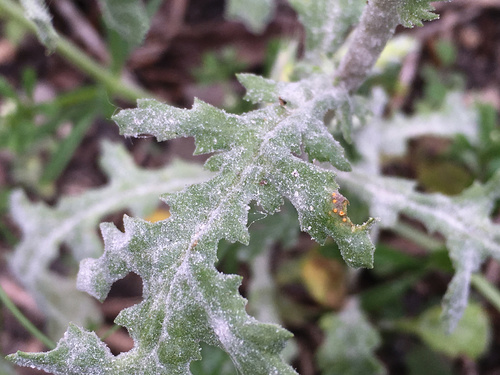
Verbatim
e0“Regardless of the limit applied, numerous specific virulence and resistance phenotypes could be discriminated.”
t0“Erysiphe fischeri from Senecio vulgaris”
Claim · model-written summary
All mildew isolates colonized and reproduced on most groundsel lines.
- Taxon
- Senecio vulgarisSenecio vulgarist0
- Interactor
- Erysiphe fischeriGolovinomyces fischerit0pathogen
- Outcome
- colonizing and reproducing on the majority of groundsel linese0
Organisms pictured · Representative pictures of the matched species, not figures from the paper.
Verbatim
e0“Virulence phenotypes were complex and all isolates were capable of colonizing and reproducing on the majority of groundsel lines.”
t0“Erysiphe fischeri from Senecio vulgaris”
Claim · model-written summary
Every isolate failed to reproduce on at least one groundsel line.
- Taxon
- Senecio vulgarisSenecio vulgarist0
- Interactor
- Erysiphe fischeriGolovinomyces fischerit0pathogen
- Outcome
- no reproductione0
- Qualifier
- at least one groundsel linee0
Organisms pictured · Representative pictures of the matched species, not figures from the paper.
Verbatim
e0“However, all isolates were completely avirulent (no reproduction) on at least one groundsel line, so no isolate was universally virulent.”
t0“Erysiphe fischeri from Senecio vulgaris”
Claim · model-written summary
Common pathogen components colonized groundsel lines resistant to few or none of the tested isolates.
- Taxon
- Senecio vulgarisSenecio vulgarist0
- Interactor
- Erysiphe fischeriGolovinomyces fischerit0pathogen
- Outcome
- colonized groundsel linese0
- Qualifier
- resistance to only a few or none of the single‐conidial‐chain isolatese0
Organisms pictured · Representative pictures of the matched species, not figures from the paper.
Verbatim
e0“Common components of the fungus population colonized groundsel lines exhibiting resistance to only a few or none of the single‐conidial‐chain isolates.”
t0“Erysiphe fischeri from Senecio vulgaris”
Claim · model-written summary
Rare pathogen components colonized lines resistant to most or all previously tested isolates.
- Taxon
- Senecio vulgarisSenecio vulgarist0
- Interactor
- Erysiphe fischeriGolovinomyces fischerit0pathogen
- Outcome
- colonized groundsel linese0
- Qualifier
- resistance to the majority or all of the isolates previously testede0
Organisms pictured · Representative pictures of the matched species, not figures from the paper.
Verbatim
e0“Rarer components of the pathogen population colonized groundsel lines with resistance to the majority or all of the isolates previously tested.”
t0“Erysiphe fischeri from Senecio vulgaris”
Claim · model-written summary
The rare components also revealed resistance in lines previously judged susceptible to all isolates.
- Taxon
- Senecio vulgarisSenecio vulgarist0
- Interactor
- Erysiphe fischeriGolovinomyces fischerit0pathogen
- Outcome
- detected resistance in groundsel linese0
- Qualifier
- previously recorded as susceptible to all isolatese0
Organisms pictured · Representative pictures of the matched species, not figures from the paper.
Verbatim
e0“These latter components of the fungus population also detected resistance in groundsel lines previously recorded as susceptible to all isolates.”
t0“Erysiphe fischeri from Senecio vulgaris”