Abstract
We developed 31 sets of melon (Cucumis melo L.) microsatellite markers in this study. Primers for these markers were designed from clones containing simple sequence repeats (SSRs) of (GA/CT)n or (GT/CA)n isolated from a melon genomic library. These microsatellite loci were examined for the detection of alleles among twelve lines and cultivars from six varieties of C. melo. A total of 28 marker loci showed polymorphism by 2.0 % agarose TBE gel separation. And these markers were also examined for cross-species amplification applicable to nine other species in Cucurbitaceae. Among them, 13 marker loci were commonly detected within the major cucurbit crops, cucumber, pumpkin and watermelon using the present primer sets. The species to which the melon microsatellite markers would be most applicable was Momordica charantia (24 markers), followed by Cucumis sativus (20 markers) and Cucurbita maxima (18 markers). These conserved microsatellite loci could be used as anchor markers in studies on synteny in Cucurbitaceae.
Abstract from the paper’s OpenAlex record, shown for indexing and research. Copyright remains with the authors or the publisher. Read at the source ↗
The text the model read, with the source record’s inline markup (italics, sub- and superscripts) rendered and its character entities decoded; quote offsets refer to the raw text.
Claims 6
Claim · model-written summary
The study developed 31 melon microsatellite marker sets.
- Taxon
- melon
 Cucumis meloe0
- Outcome
- microsatellite markerse0
- Value
- 31 setse0
Organisms pictured · Representative pictures of the matched species, not figures from the paper.

Verbatim
e0“We developed 31 sets of melon (Cucumis melo L.) microsatellite markers in this study”
Claim · model-written summary
Twenty-eight melon marker loci were polymorphic.
- Taxon
- melonCucumis melot0
- Outcome
- marker loci showed polymorphisme0
- Value
- 28 marker locie0
Organisms pictured · Representative pictures of the matched species, not figures from the paper.
Verbatim
e0“A total of 28 marker loci showed polymorphism by 2.0 % agarose TBE gel separation”
t0“Melon”
Claim · model-written summary
Thirteen marker loci were commonly detected across cucumber, pumpkin and watermelon.
Verbatim
e0“13 marker loci were commonly detected within the major cucurbit crops, cucumber, pumpkin and watermelon using the present primer sets”
Claim · model-written summary
The markers applied to Momordica charantia at 24 markers.
- Taxon
- Momordica charantia
 Momordica charantiae0
- Outcome
- markerse0
- Value
- 24 markerse0
Organisms pictured · Representative pictures of the matched species, not figures from the paper.

Verbatim
e0“Momordica charantia (24 markers)”
Claim · model-written summary
The markers applied to Cucumis sativus at 20 markers.
- Taxon
- Cucumis sativus
 Cucumis sativuse0
- Outcome
- markerse0
- Value
- 20 markerse0
Organisms pictured · Representative pictures of the matched species, not figures from the paper.

Verbatim
e0“Cucumis sativus (20 markers)”
Claim · model-written summary
The markers applied to Cucurbita maxima at 18 markers.
- Taxon
- Cucurbita maxima
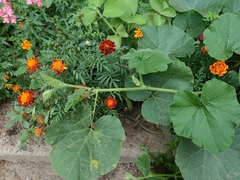 Cucurbita maximae0
- Outcome
- markerse0
- Value
- 18 markerse0
Organisms pictured · Representative pictures of the matched species, not figures from the paper.

Verbatim
e0“Cucurbita maxima (18 markers)”