Abstract
Analysis of nuclear rDNA variation within and between populations of Salicornia from the salt marsh at Stiffkey, Norfolk has detected new patterns of genetic differentiation. Individual plants may have alternative 10.5 and 12 kb repeat units. A strong association between the frequency of particular genetic variants and the environmental gradient of tidal inundation was evident. Salicornia dolichostachya Moss from sandy flats on the lowest parts of the marsh, near to the seaward edge, and S. fragilis Ball & Tutin from deep creeks were both monomorphic for the 12 kb variant; in contrast, S. pusilla J. Woods, characteristic of the highest parts of the tidal range, was monomorphic for the 10-5 kb variant. The more phenotypically variable S. europaea L. and S. ramosissima J. Woods populations that are found in large areas of lower and upper marsh, respectively, were heterogeneous for rDNA variant type. Nevertheless, the frequency of the 12 kb variant was significantly higher in plants from the lower marsh than in those from upper marsh, and in plants from low-lying pans than in those from raised interfluves; the 10.5 kb variant had the converse distribution. Variation in rDNA was not obviously associated with variation in morphology, or with variations in isozyme frequency established previously. Comparison of these results with those for populations from an extensive study, ranging from Anglesey (N. Wales) to S.W. Spain and the Gulf coast of Saudi Arabia, suggested that the rDNA variation and its association with environmental variation are complex and site-dependent. Plants from Anglesey had 10.5 and 11.5 kb variants, whereas only a 10-75 kb variant was detected in material from Spain and Saudi Arabia. rDNA variants were used as genetic markers in order to test the hypothesis that Salicornia is predominantly an inbreeder; conventional breeding experiments have been hampered by its highly specialized morphology and this represents the first direct, sensitive test of an idea that has been suggested mainly on morphological and phenological grounds. Analysis of rDNA in 38 maternal plants from Stiffkey and 2112 of their progeny provided no evidence for out-crossing.
Abstract from the paper’s OpenAlex record, shown for indexing and research. Copyright remains with the authors or the publisher. Read at the source ↗
The text the model read, with the source record’s inline markup (italics, sub- and superscripts) rendered and its character entities decoded; quote offsets refer to the raw text.
Claims 16
Claim · model-written summary
Individual Salicornia plants may have alternative 10.5 and 12 kb rDNA repeat units.
- Taxon
- Salicornia
 Salicorniat0
- Outcome
- alternative 10.5 and 12 kb repeat unitse0
Organisms pictured · Representative pictures of the matched species, not figures from the paper.

Verbatim
e0“Individual plants may have alternative 10.5 and 12 kb repeat units.”
t0“Salicornia L.”
Claim · model-written summary
The frequency of Salicornia genetic variants was strongly associated with the tidal inundation gradient.
- Taxon
- SalicorniaSalicorniat0
- Outcome
- frequency of particular genetic variantse0
- Setting
- environmental gradient of tidal inundatione0
Not reportedDirection
Organisms pictured · Representative pictures of the matched species, not figures from the paper.
Verbatim
e0“A strong association between the frequency of particular genetic variants and the environmental gradient of tidal inundation was evident.”
t0“Salicornia L.”
Claim · model-written summary
Salicornia dolichostachya from low sandy flats was monomorphic for the 12 kb variant.
- Taxon
- Salicornia dolichostachya Moss
 Salicornia dolichostachyae0
- Outcome
- monomorphic for the 12 kb variante0
- Setting
- sandy flats on the lowest parts of the marshe0
Organisms pictured · Representative pictures of the matched species, not figures from the paper.

Verbatim
e0“Salicornia dolichostachya Moss from sandy flats on the lowest parts of the marsh, near to the seaward edge, and S. fragilis Ball & Tutin from deep creeks were both monomorphic for the 12 kb variant”
Claim · model-written summary
S. fragilis from deep creeks was monomorphic for the 12 kb variant.
- Taxon
- S. fragilis Ball & Tutin
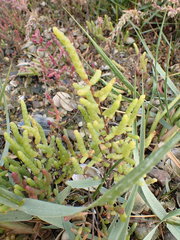 Salicornia fragilise0
- Outcome
- monomorphic for the 12 kb variante0
- Setting
- deep creekse0
Organisms pictured · Representative pictures of the matched species, not figures from the paper.
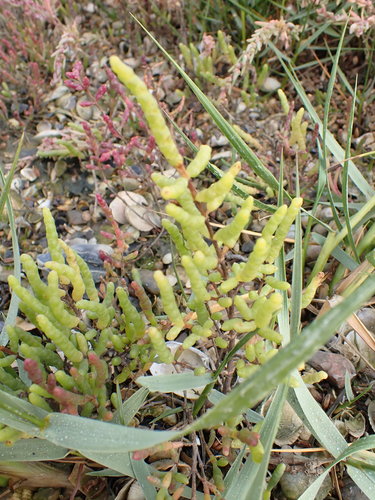
Verbatim
e0“S. fragilis Ball & Tutin from deep creeks were both monomorphic for the 12 kb variant”
Claim · model-written summary
S. pusilla at the highest tidal elevations was monomorphic for the 10-5 kb variant.
- Taxon
- S. pusilla J. Woods
 Salicornia pusillae0
- Outcome
- monomorphic for the 10-5 kb variante0
- Setting
- highest parts of the tidal rangee0
Organisms pictured · Representative pictures of the matched species, not figures from the paper.

Verbatim
e0“S. pusilla J. Woods, characteristic of the highest parts of the tidal range, was monomorphic for the 10-5 kb variant”
Claim · model-written summary
S. europaea populations were heterogeneous for rDNA variant type.
- Taxon
- S. europaea L.
 Salicornia europaeae0
- Outcome
- heterogeneous for rDNA variant typee0
- Setting
- lower and upper marshe0
Organisms pictured · Representative pictures of the matched species, not figures from the paper.

Verbatim
e0“The more phenotypically variable S. europaea L. and S. ramosissima J. Woods populations that are found in large areas of lower and upper marsh, respectively, were heterogeneous for rDNA variant type.”
Claim · model-written summary
S. ramosissima populations were heterogeneous for rDNA variant type.
- Taxon
- S. ramosissima J. Woods
 Salicornia ramosissimae0
- Outcome
- heterogeneous for rDNA variant typee0
- Setting
- lower and upper marshe0
Organisms pictured · Representative pictures of the matched species, not figures from the paper.

Verbatim
e0“The more phenotypically variable S. europaea L. and S. ramosissima J. Woods populations that are found in large areas of lower and upper marsh, respectively, were heterogeneous for rDNA variant type.”
Claim · model-written summary
The 12 kb variant frequency was significantly higher in Salicornia from lower than upper marsh.
- Taxon
- SalicorniaSalicorniat0
- Outcome
- frequency of the 12 kb variante0
- Direction
- highere0
- Comparator
- upper marshe0
- Setting
- lower marshe0
Organisms pictured · Representative pictures of the matched species, not figures from the paper.
Verbatim
e0“the frequency of the 12 kb variant was significantly higher in plants from the lower marsh than in those from upper marsh”
t0“Salicornia L.”
Claim · model-written summary
The 12 kb variant frequency was significantly higher in Salicornia from low pans than raised interfluves.
- Taxon
- SalicorniaSalicorniat0
- Outcome
- frequency of the 12 kb variante1
- Direction
- highere1
- Comparator
- raised interfluvese0
- Setting
- low-lying panse0
Organisms pictured · Representative pictures of the matched species, not figures from the paper.
Verbatim
e0“in plants from low-lying pans than in those from raised interfluves; the 10.5 kb variant had the converse distribution.”
e1“the frequency of the 12 kb variant was significantly higher in plants from the lower marsh than in those from upper marsh”
t0“Salicornia L.”
Claim · model-written summary
The 10.5 kb variant had the converse spatial distribution to the 12 kb variant.
- Taxon
- SalicorniaSalicorniat0
- Outcome
- 10.5 kb variante0
- Comparator
- 12 kb variante1
Not reportedDirection
Organisms pictured · Representative pictures of the matched species, not figures from the paper.
Verbatim
e0“the 10.5 kb variant had the converse distribution.”
e1“the frequency of the 12 kb variant was significantly higher in plants from the lower marsh than in those from upper marsh”
t0“Salicornia L.”
Claim · model-written summary
Salicornia rDNA variation was not obviously associated with morphology.
- Taxon
- SalicorniaSalicorniat0
- Organ / stage
- morphologye0
- Outcome
- Variation in rDNAe0
Not reportedDirection
Organisms pictured · Representative pictures of the matched species, not figures from the paper.
Verbatim
e0“Variation in rDNA was not obviously associated with variation in morphology”
t0“Salicornia L.”
Claim · model-written summary
Salicornia rDNA variation was not obviously associated with previously established isozyme frequencies.
- Taxon
- SalicorniaSalicorniat0
- Gene
- isozymee0
- Outcome
- Variation in rDNAe0
Not reportedDirection
Organisms pictured · Representative pictures of the matched species, not figures from the paper.
Verbatim
e0“Variation in rDNA was not obviously associated with variation in morphology, or with variations in isozyme frequency established previously.”
t0“Salicornia L.”
Claim · model-written summary
The association between rDNA and environment appeared complex and site-dependent across the sampled regions.
- Taxon
- SalicorniaSalicorniat0
- Outcome
- rDNA variation and its association with environmental variatione0
- Setting
- site-dependente0
Not reportedDirection
Organisms pictured · Representative pictures of the matched species, not figures from the paper.
Verbatim
e0“the rDNA variation and its association with environmental variation are complex and site-dependent.”
t0“Salicornia L.”
Claim · model-written summary
Salicornia from Anglesey had 10.5 and 11.5 kb variants.
- Taxon
- SalicorniaSalicorniat0
- Outcome
- 10.5 and 11.5 kb variantse0
- Setting
- Angleseye0
Organisms pictured · Representative pictures of the matched species, not figures from the paper.
Verbatim
e0“Plants from Anglesey had 10.5 and 11.5 kb variants”
t0“Salicornia L.”
Claim · model-written summary
Only a 10-75 kb variant was detected in Salicornia from Spain and Saudi Arabia.
- Taxon
- SalicorniaSalicorniat0
- Outcome
- 10-75 kb variante0
- Setting
- Spain and Saudi Arabiae0
Organisms pictured · Representative pictures of the matched species, not figures from the paper.
Verbatim
e0“only a 10-75 kb variant was detected in material from Spain and Saudi Arabia”
t0“Salicornia L.”
Claim · model-written summary
rDNA analysis of maternal Salicornia plants and progeny found no evidence of out-crossing.
- Taxon
- SalicorniaSalicorniat0
- Outcome
- no evidence for out-crossinge0
- Value
- 38 maternal plantse0
- Qualifier
- 2112 of their progenye0
- Setting
- Stiffkeye0
Organisms pictured · Representative pictures of the matched species, not figures from the paper.
Verbatim
e0“Analysis of rDNA in 38 maternal plants from Stiffkey and 2112 of their progeny provided no evidence for out-crossing.”
t0“Salicornia L.”