Abstract
Current forestry policies worldwide aim at conserving and restoring biodiversity in managed forests. In this respect, epiphytic lichens have become a focal group in studies of how logging and silvicultural methods can be adjusted to mimic and restore old-growth conditions. We addressed this issue in a retrospective study in the coastal spruce (Picea abies ) forest region of central Norway, surveying 31 old forest sites in order to relate a selected group of epiphytic macrolichens (Fuscopannaria ahlneri, Lobaria pulmonaria, L. scrobiculata, Nephroma spp., Platismatia norvegica, Pseudocyphellaria crocata, Ramalina thrausta, and Sphaerophorus globosus ) to forest stand characteristics and previous logging history. The lichens were associated with brook ravines, F. ahlneri and P. crocata mostly so, being 10 times more abundant in ravine valley bottoms than on adjacent slopes and plateaus. All species used spruce trees as their main substrate, but L. pulmonaria, L. scrobiculata, and Nephroma spp. preferred scattered deciduous trees. Ramalina thrausta and S. globosus occurred more frequently on older trees and increased in number with increasing stand age. In ravine valley bottoms lichens tended to increase in number with increasing tree density (due to increased amount of branches), whereas the opposite was the case on slopes and plateaus (due to higher proportion of high-branched trees). All locations had been selectively cut two or more times during the last 100 yr, with a total harvested volume of 31–124% of present-day standing volumes. After controlling for covariation with stand structure, variables describing logging history (harvested volume, number of cuts, minimum standing volume, and years since last cut) did not explain significant parts of the variation in present-day abundance of the selected lichens. The results suggest that moderate selective cuttings may prove an acceptable management option to sustain viable lichen assemblages on private land.
Abstract from the paper’s OpenAlex record, shown for indexing and research. Copyright remains with the authors or the publisher. Read at the source ↗
The text the model read, with the source record’s inline markup (italics, sub- and superscripts) rendered and its character entities decoded; quote offsets refer to the raw text.
Claims 12
Claim · model-written summary
Epiphytic lichens were associated with brook ravines, especially F. ahlneri and P. crocata.
- Interactor
- F. ahlneriFuscopannaria ahlnerie0other
- Outcome
- associated with brook ravinese0
- Setting
- brook ravinese0
 Picea
Not reportedDirection
Organisms pictured · Representative pictures of the matched species, not figures from the paper.

Verbatim
e0“The lichens were associated with brook ravines, F. ahlneri and P. crocata mostly so”
e1“coastal spruce (Picea abies ) forest region of central Norway”
Claim · model-written summary
Lichens were ten times more abundant in ravine bottoms than slopes and plateaus.
- Outcome
- abundante0
- Direction
- more abundante0
- Value
- 10 timese0
- Comparator
- adjacent slopes and plateause0
- Setting
- ravine valley bottomse0
Organisms pictured · Representative pictures of the matched species, not figures from the paper.
Verbatim
e0“being 10 times more abundant in ravine valley bottoms than on adjacent slopes and plateaus”
e1“coastal spruce (Picea abies ) forest region of central Norway”
Claim · model-written summary
All studied lichen species used spruce as their main substrate.
Organisms pictured · Representative pictures of the matched species, not figures from the paper.
Verbatim
e0“All species used spruce trees as their main substrate”
Claim · model-written summary
L. pulmonaria, L. scrobiculata and Nephroma spp. preferred scattered deciduous trees.
- Taxon
- deciduous treese0
- Interactor
- L. pulmonaria, L. scrobiculata, and Nephroma spp.
 Nephroma
 Lobaria pulmonaria
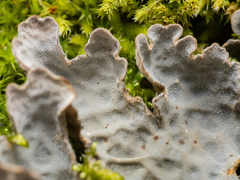 Lobarina scrobiculatae0other
- Outcome
- preferred scattered deciduous treese0
Organisms pictured · Representative pictures of the matched species, not figures from the paper.


Verbatim
e0“L. pulmonaria, L. scrobiculata, and Nephroma spp. preferred scattered deciduous trees.”
Claim · model-written summary
Ramalina thrausta occurred more often on older trees and increased with stand age.
- Taxon
- treese0
- Interactor
- Ramalina thrausta
 Ramalina thraustae0other
- Outcome
- increased in numbere0
- Direction
- increasede0
- Setting
- older treese0
Organisms pictured · Representative pictures of the matched species, not figures from the paper.

Verbatim
e0“Ramalina thrausta and S. globosus occurred more frequently on older trees and increased in number with increasing stand age.”
Claim · model-written summary
S. globosus occurred more often on older trees and increased with stand age.
- Taxon
- treese0
- Interactor
- S. globosus
 Sphaerophorus globosuse0other
- Outcome
- increased in numbere0
- Direction
- increasede0
- Setting
- older treese0
Organisms pictured · Representative pictures of the matched species, not figures from the paper.

Verbatim
e0“Ramalina thrausta and S. globosus occurred more frequently on older trees and increased in number with increasing stand age.”
Claim · model-written summary
Lichen numbers tended to rise with tree density in ravine bottoms.
Verbatim
e0“In ravine valley bottoms lichens tended to increase in number with increasing tree density (due to increased amount of branches)”
Claim · model-written summary
Lichen numbers tended to decline with tree density on slopes and plateaus.
Not reportedDirection
Organisms pictured · Representative pictures of the matched species, not figures from the paper.
Verbatim
e0“whereas the opposite was the case on slopes and plateaus (due to higher proportion of high-branched trees)”
e1“In ravine valley bottoms lichens tended to increase in number with increasing tree density”
e2“coastal spruce (Picea abies ) forest region of central Norway”
Claim · model-written summary
All surveyed locations had been selectively cut at least twice in 100 years.
Organisms pictured · Representative pictures of the matched species, not figures from the paper.
Verbatim
e0“All locations had been selectively cut two or more times during the last 100 yr, with a total harvested volume of 31–124% of present-day standing volumes.”
e1“coastal spruce (Picea abies ) forest region of central Norway”
Claim · model-written summary
Total harvested volume was 31–124% of current standing volume.
Organisms pictured · Representative pictures of the matched species, not figures from the paper.
Verbatim
e0“with a total harvested volume of 31–124% of present-day standing volumes.”
e1“coastal spruce (Picea abies ) forest region of central Norway”
Claim · model-written summary
Logging history variables did not explain a significant share of current lichen abundance after accounting for stand structure.
- Outcome
- variation in present-day abundance of the selected lichense0
- Qualifier
- After controlling for covariation with stand structuree0
- Setting
- stand structuree0
Not reportedDirection
Organisms pictured · Representative pictures of the matched species, not figures from the paper.
Verbatim
e0“After controlling for covariation with stand structure, variables describing logging history (harvested volume, number of cuts, minimum standing volume, and years since last cut) did not explain significant parts of the variation in present-day abundance of the selected lichens.”
e1“coastal spruce (Picea abies ) forest region of central Norway”
Claim · model-written summary
The authors suggest moderate selective cutting as an option for sustaining viable lichen assemblages.
- Outcome
- moderate selective cuttings may prove an acceptable management option to sustain viable lichen assemblagese0
Organisms pictured · Representative pictures of the matched species, not figures from the paper.
Verbatim
e0“The results suggest that moderate selective cuttings may prove an acceptable management option to sustain viable lichen assemblages on private land.”
e1“coastal spruce (Picea abies ) forest region of central Norway”