Abstract
The monophyletic genus Wolffiella (Lemnaceae) comprises 10 species divided taxonomically into three sections. Relative to other genera of Lemnaceae, Wolffiella has a restricted range, with species distributed in warm temperate to tropical areas of Africa and the Americas, with only one species occurring in both areas. Sequence data from coding (rbcL and matK) and non-coding (trnK and rpl16 introns) regions of cpDNA were analyzed phylogenetically to resolve relationships within Wolffiella, and these results were compared to earlier allozyme and morphological studies. Allozymes, cpDNA and morphology all supported the recognition of three sections. Relationships among species were similar in most respects between the allozyme and cpDNA trees, as well as among the different plastid partitions. In Wolffiella, both non-synonymous and synonymous substitutions were greater in matK than in rbcL, as observed in other taxa. The synonymous substitution rate in matK was similar to the substitution rate of the non-coding regions. All partitions, including coding regions, exhibited some homoplasy. Biogeographical reconstructions from a combination of cpDNA partitions indicated that Wolffiella originated in Africa with early movement to and radiation in the Americas. The one species found in both Africa and the Americas, W. welwitschii, likely originated in the Americas and subsequently dispersed to Africa. Using the SOWH test, the cpDNA data could reject two alternative biogeographical hypotheses suggested from analyses of morphological and allozyme data. The present distribution of Wolffiella can be explained by two major dispersal events and this contrasts with the more complex species distributions in other Lemnaceae genera. Limited dispersal in Wolffiella relative to other Lemnaceae genera may be due to more recent origins of species, lower dispersibility and poorer colonizing ability.
Abstract from the paper’s OpenAlex record, shown for indexing and research. Copyright remains with the authors or the publisher. Read at the source ↗
The text the model read, with the source record’s inline markup (italics, sub- and superscripts) rendered and its character entities decoded; quote offsets refer to the raw text.
Claims 10
Claim · model-written summary
Allozyme, cpDNA and morphological evidence supported three Wolffiella sections.
Not reportedTaxon
Verbatim
e0“Allozymes, cpDNA and morphology all supported the recognition of three sections”
Claim · model-written summary
Species relationships were broadly similar across allozyme and cpDNA trees and plastid partitions.
Not reportedTaxon
Verbatim
e0“Relationships among species were similar in most respects between the allozyme and cpDNA trees, as well as among the different plastid partitions”
Claim · model-written summary
Both nonsynonymous and synonymous substitutions were greater in matK than rbcL.
Not reportedTaxon
Verbatim
e0“both non-synonymous and synonymous substitutions were greater in matK than in rbcL”
Claim · model-written summary
The synonymous substitution rate in matK was similar to the noncoding region rate.
Not reportedTaxon
Verbatim
e0“The synonymous substitution rate in matK was similar to the substitution rate of the non-coding regions”
Claim · model-written summary
All partitions, including coding regions, showed some homoplasy.
- Outcome
- some homoplasye0
Not reportedTaxon
Verbatim
e0“All partitions, including coding regions, exhibited some homoplasy”
Claim · model-written summary
Biogeographical reconstruction placed Wolffiella origin in Africa followed by movement and radiation in the Americas.
- Taxon
- WolffiellaWolffiellae0
- Outcome
- originated in Africa with early movement to and radiation in the Americase0
Verbatim
e0“Wolffiella originated in Africa with early movement to and radiation in the Americas”
Claim · model-written summary
W. welwitschii likely originated in the Americas and dispersed to Africa.
- Taxon
- W. welwitschii
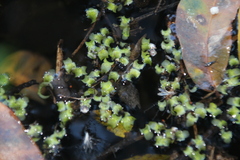 Wolffiella welwitschiie0
- Outcome
- originated in the Americas and subsequently dispersed to Africae0
Organisms pictured · Representative pictures of the matched species, not figures from the paper.

Verbatim
e0“W. welwitschii, likely originated in the Americas and subsequently dispersed to Africa”
Claim · model-written summary
cpDNA data rejected two alternative biogeographical hypotheses.
- Outcome
- reject two alternative biogeographical hypothesese0
- Value
- two alternative biogeographical hypothesese0
Not reportedTaxon
Verbatim
e0“the cpDNA data could reject two alternative biogeographical hypotheses suggested from analyses of morphological and allozyme data”
Claim · model-written summary
Two major dispersal events could explain the present Wolffiella distribution.
- Taxon
- WolffiellaWolffiellae0
- Outcome
- present distributione0
- Value
- two major dispersal eventse0
Verbatim
e0“The present distribution of Wolffiella can be explained by two major dispersal events”
Claim · model-written summary
Wolffiella dispersal was limited relative to other Lemnaceae genera.
- Taxon
- WolffiellaWolffiellae0
- Outcome
- Limited dispersale0
- Comparator
- other Lemnaceae generae0
Verbatim
e0“Limited dispersal in Wolffiella relative to other Lemnaceae genera”