Abstract
SUMMARY Field surveys from 1967 to 1970 of a Ribes species collection comprising ninety‐five plants representing fifty‐six species and fourteen sections of the genus, revealed moderate or severe aphid infestations as follows: Hyperomyzus lactucae (L.) on ten species included in five sections; H. pallidus H.R.L. ten species, two sections; Nasonovia ribisnigri (Mosley) twenty‐eight species, seven sections; Aphis grossulariae Kltb. twenty‐two species, ten sections; Cryptomyzus ribis (L.) four species, two sections; C. korschelti Börner three species, two sections. Cut shoot tests suggested that c. 50% of sixty‐three field‐resistant accessions were tissue‐susceptible to H. lactucae , and about 70% of fifteen field‐resistant types were tissue‐susceptible to N. ribisnigri . Possible field escape mechanisms are discussed. In breeding black‐currants resistant to H. lactucae and gooseberries resistant to N. ribisnigri , the donors R. sanguineum and R. cereum , and R. roezlii , respectively, were chosen for their high field and tissue resistance and for the known, or expected, fertility of their F 1 hybrids with black‐currant and gooseberry.
Abstract from the paper’s OpenAlex record, shown for indexing and research. Copyright remains with the authors or the publisher. Read at the source ↗
The text the model read, with the source record’s inline markup (italics, sub- and superscripts) rendered and its character entities decoded; quote offsets refer to the raw text.
Claims 10
Claim · model-written summary
Hyperomyzus lactucae moderately or severely infested ten Ribes species in five sections.
- Interactor
- Hyperomyzus lactucae
 Hyperomyzus lactucaee0pest
- Outcome
- Hyperomyzus lactucae (L.) on ten species included in five sectionse0
- Value
- ten speciese0
 Ribes
Organisms pictured · Representative pictures of the matched species, not figures from the paper.


Verbatim
e0“Hyperomyzus lactucae (L.) on ten species included in five sections”
t0“Ribes species”
Claim · model-written summary
H. pallidus infested ten species in two sections.
- Interactor
- H. pallidus
 Hyperomyzus palliduse0pest
- Outcome
- H. pallidus H.R.L. ten species, two sectionse0
- Value
- ten speciese0
Organisms pictured · Representative pictures of the matched species, not figures from the paper.

Verbatim
e0“H. pallidus H.R.L. ten species, two sections”
t0“Ribes species”
Claim · model-written summary
Nasonovia ribisnigri infested twenty-eight species in seven sections.
- Interactor
- Nasonovia ribisnigri
 Nasonovia ribisnigrie0pest
- Outcome
- Nasonovia ribisnigri (Mosley) twenty‐eight species, seven sectionse0
- Value
- twenty‐eight speciese0
Organisms pictured · Representative pictures of the matched species, not figures from the paper.

Verbatim
e0“Nasonovia ribisnigri (Mosley) twenty‐eight species, seven sections”
t0“Ribes species”
Claim · model-written summary
Aphis grossulariae infested twenty-two species in ten sections.
- Interactor
- Aphis grossulariae
 Aphis grossulariaee0pest
- Outcome
- Aphis grossulariae Kltb. twenty‐two species, ten sectionse0
- Value
- twenty‐two speciese0
Organisms pictured · Representative pictures of the matched species, not figures from the paper.
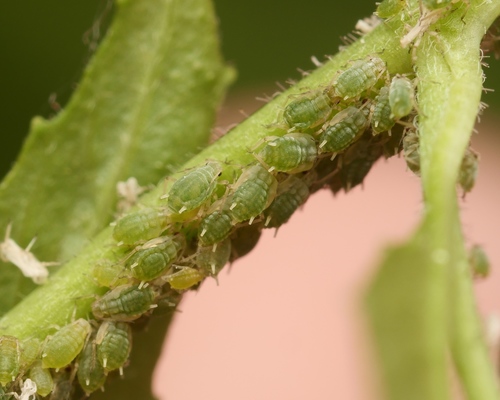
Verbatim
e0“Aphis grossulariae Kltb. twenty‐two species, ten sections”
t0“Ribes species”
Claim · model-written summary
Cryptomyzus ribis infested four species in two sections.
- Interactor
- Cryptomyzus ribis
 Cryptomyzus ribise0pest
- Outcome
- Cryptomyzus ribis (L.) four species, two sectionse0
- Value
- four speciese0
Organisms pictured · Representative pictures of the matched species, not figures from the paper.

Verbatim
e0“Cryptomyzus ribis (L.) four species, two sections”
t0“Ribes species”
Claim · model-written summary
C. korschelti infested three species in two sections.
- Interactor
- C. korscheltie0pest
- Outcome
- C. korschelti Börner three species, two sectionse0
- Value
- three speciese0
Organisms pictured · Representative pictures of the matched species, not figures from the paper.
Verbatim
e0“C. korschelti Börner three species, two sections”
t0“Ribes species”
Claim · model-written summary
About half of 63 field-resistant Ribes accessions were tissue-susceptible to H. lactucae.
- Material
- field‐resistant accessionse0
- Interactor
- H. lactucaeHyperomyzus lactucaee0pest
- Outcome
- tissue‐susceptible to H. lactucaee0
- Value
- c. 50%e0
Organisms pictured · Representative pictures of the matched species, not figures from the paper.
Verbatim
e0“c. 50% of sixty‐three field‐resistant accessions were tissue‐susceptible to H. lactucae”
t0“Ribes species”
Claim · model-written summary
About 70% of 15 field-resistant Ribes types were tissue-susceptible to N. ribisnigri.
- Material
- field‐resistant typese0
- Interactor
- N. ribisnigriNasonovia ribisnigrie0pest
- Outcome
- tissue‐susceptible to N. ribisnigrie0
- Value
- about 70%e0
Organisms pictured · Representative pictures of the matched species, not figures from the paper.
Verbatim
e0“about 70% of fifteen field‐resistant types were tissue‐susceptible to N. ribisnigri”
t0“Ribes species”
Claim · model-written summary
R. sanguineum and R. cereum were chosen as donors for H. lactucae resistant black-currants.
- Taxon
- black‐currantse0
- Interactor
- H. lactucaeHyperomyzus lactucaee0pest
- Outcome
- R. sanguineum and R. cereume0
Organisms pictured · Representative pictures of the matched species, not figures from the paper.
Verbatim
e0“In breeding black‐currants resistant to H. lactucae and gooseberries resistant to N. ribisnigri , the donors R. sanguineum and R. cereum , and R. roezlii , respectively, were chosen for their high field and tissue resistance”
Claim · model-written summary
R. roezlii was chosen as a donor for N. ribisnigri resistant gooseberries.
- Taxon
- gooseberriese0
- Interactor
- N. ribisnigriNasonovia ribisnigrie0pest
- Outcome
- R. roezliie0
Organisms pictured · Representative pictures of the matched species, not figures from the paper.
Verbatim
e0“In breeding black‐currants resistant to H. lactucae and gooseberries resistant to N. ribisnigri , the donors R. sanguineum and R. cereum , and R. roezlii , respectively, were chosen for their high field and tissue resistance”