Abstract
One hundred seventy-five plant introductions of Cucurbita were evaluated in a series of field experiments for resistance to the pickleworm, Diaphania nitidalis (Stoll). Distinct differences were detected in degree of pickleworm damage among 3 species tested, C. maxima, C. moschata, and C. pepo. The plant introductions of C. maxima and C. moschata were generally more resistant than C. pepo although certain accessions of C. pepo sustained very little damage by pickleworm and appear to be a promising source of resistant germ plasm.
Abstract from the paper’s OpenAlex record, shown for indexing and research. Copyright remains with the authors or the publisher. Read at the source ↗
The text the model read, with the source record’s inline markup (italics, sub- and superscripts) rendered and its character entities decoded; quote offsets refer to the raw text.
Claims 5
Claim · model-written summary
Pickleworm damage differed among the three Cucurbita species.
- Taxon
- C. maxima
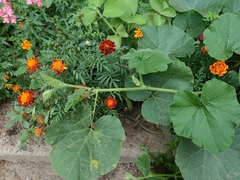 Cucurbita maximae0
- Interactor
- pickleworme0pest
- Outcome
- pickleworm damagee0
Organisms pictured · Representative pictures of the matched species, not figures from the paper.

Verbatim
e0“Distinct differences were detected in degree of pickleworm damage among 3 species tested, C. maxima, C. moschata, and C. pepo”
Claim · model-written summary
C. maxima introductions were generally more resistant than C. pepo.
- Taxon
- C. maximaCucurbita maximae0
- Material
- plant introductionse0
- Outcome
- resistante0
- Direction
- more resistante0
- Comparator
- C. pepoe0
Organisms pictured · Representative pictures of the matched species, not figures from the paper.
Verbatim
e0“The plant introductions of C. maxima and C. moschata were generally more resistant than C. pepo”
Claim · model-written summary
C. moschata introductions were generally more resistant than C. pepo.
- Taxon
- C. moschata
 Cucurbita moschatae0
- Material
- plant introductionse0
- Outcome
- resistante0
- Direction
- more resistante0
- Comparator
- C. pepoe0
Organisms pictured · Representative pictures of the matched species, not figures from the paper.

Verbatim
e0“The plant introductions of C. maxima and C. moschata were generally more resistant than C. pepo”
Claim · model-written summary
Certain C. pepo accessions sustained very little pickleworm damage.
- Taxon
- C. pepo
 Cucurbita pepoe0
- Material
- accessionse0
- Interactor
- pickleworme0pest
- Outcome
- damage by pickleworme0
- Direction
- very littlee0
Organisms pictured · Representative pictures of the matched species, not figures from the paper.

Verbatim
e0“certain accessions of C. pepo sustained very little damage by pickleworm”
Claim · model-written summary
The authors identified certain C. pepo accessions as promising resistant germ plasm.
- Taxon
- C. pepoCucurbita pepoe0
- Material
- accessionse0
- Interactor
- pickleworme0pest
- Outcome
- promising source of resistant germ plasme0
Organisms pictured · Representative pictures of the matched species, not figures from the paper.
Verbatim
e0“certain accessions of C. pepo sustained very little damage by pickleworm and appear to be a promising source of resistant germ plasm”