Abstract
Current methods for screening for reaction of Mycosphaerella fijiensis are mostly field based and subject to variability caused by weather conditions. The objective of this study was to develop an efficient screening procedure for black sigatoka disease in order to provide a reliable controlled environment screening method. A fragmented mycelia-based infection system was developed using weighed mycelia suspensions, in 0.18% water agar. Consistent and repeatable black sigatoka infection was achieved in cv. Gross Michel as a reference susceptible cultivar. The infection system developed was used to validate screenhouse reaction of banana genotypes to M. fijiensis. Three East African highland genotypes (AAA-EA), one plantain genotype (ABB), two dessert (AAB and AAA) and one hybrid genotype (AAAA) were tested. Inoculum of M. fijiensis was adjusted to 15 mg ml-1 fragmented mycelium and applied to the abaxial surfaces of the first two open leaves. Plants were evaluated for 6 weeks post inoculation (PI). Significant differences in the response of the different genotypes, to M. fijiensis infection were observed at 3, 4, 5 and 6 weeks PI. All East African highland and dessert genotypes were susceptible. M9 hybrid and Psang awak (ABB) expressed resistance, characterised by high disease incubation period and slow rate of symptom development, with Psanag awak being the most resistant. Artificial inoculation of in vitro plants with weighed fragmented mycelial suspension, was practicable for determining resistance to M. fijiensis. This is the first report demonstrating that use of weighed fragmented mycelial inoculum spread over the entire leaf surface, can be used to quantitatively assess reaction of banana genotypes to M. fijiensis under screenhouse conditions.Keywords: Ascomycete, Black leaf streak, Mycosphaerella fijiensis Musa sp.
Abstract from the paper’s OpenAlex record, shown for indexing and research. Copyright remains with the authors or the publisher. Read at the source ↗
The text the model read, with the source record’s inline markup (italics, sub- and superscripts) rendered and its character entities decoded; quote offsets refer to the raw text.
Claims 7
Claim · model-written summary
The fragmented mycelia system produced consistent, repeatable black sigatoka infection in Gross Michel.
Not reportedTaxonValue
Verbatim
e0“Consistent and repeatable black sigatoka infection was achieved in cv. Gross Michel as a reference susceptible cultivar.”
Claim · model-written summary
Banana genotypes differed significantly in response to M. fijiensis at weeks 3 to 6 after inoculation.
- Material
- different genotypese0
- Interactor
- M. fijiensis
 Pseudocercospora fijiensise0pathogen
- Outcome
- responsee0
- Qualifier
- 3, 4, 5 and 6 weeks PIe0
Not reportedTaxon
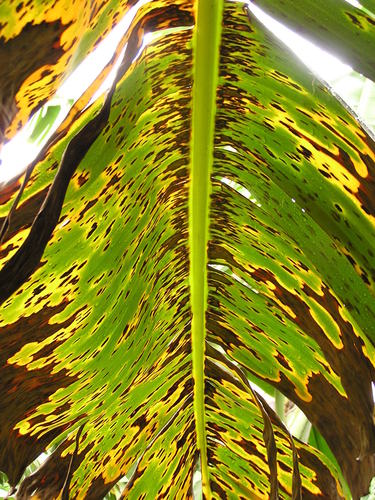
Organisms pictured · Representative pictures of the matched species, not figures from the paper.
Verbatim
e0“Significant differences in the response of the different genotypes, to M. fijiensis infection were observed at 3, 4, 5 and 6 weeks PI.”
Claim · model-written summary
East African highland banana genotypes were susceptible.
Not reportedTaxon
Verbatim
e0“All East African highland and dessert genotypes were susceptible.”
Claim · model-written summary
Dessert banana genotypes were susceptible.
Not reportedTaxon
Verbatim
e0“All East African highland and dessert genotypes were susceptible.”
Claim · model-written summary
M9 hybrid expressed resistance with delayed and slow disease development.
- Material
- M9 hybride0
- Outcome
- resistancee0
- Direction
- high disease incubation period and slow rate of symptom developmente0
Not reportedTaxon
Verbatim
e0“M9 hybrid and Psang awak (ABB) expressed resistance, characterised by high disease incubation period and slow rate of symptom development, with Psanag awak being the most resistant.”
Claim · model-written summary
Psang awak expressed resistance and was the most resistant genotype.
Not reportedTaxon
Verbatim
e0“M9 hybrid and Psang awak (ABB) expressed resistance, characterised by high disease incubation period and slow rate of symptom development, with Psanag awak being the most resistant.”
Claim · model-written summary
Weighed fragmented mycelial inoculation was practical for assessing banana resistance under screenhouse conditions.
- Treatment
- weighed fragmented mycelial suspensione0
- Interactor
- M. fijiensisPseudocercospora fijiensise0pathogen
- Outcome
- determining resistancee0
Not reportedTaxonValue
Organisms pictured · Representative pictures of the matched species, not figures from the paper.
Verbatim
e0“Artificial inoculation of in vitro plants with weighed fragmented mycelial suspension, was practicable for determining resistance to M. fijiensis.”