Abstract
Santen, K. 2007. Pathogenesis-related proteins in barley. Localization and accumulation patterns in response to infection by Bipolaris sorokiniana. Doctoral dissertation. ISSN 1652-6880, ISBN 978-91-576-7385-5 Plants in nature are generally resistant to most of the pathogens they encounter. However, many fungal pathogens can cause severe diseases and significant yield losses in crops. Plants defend themselves against pathogens through a combination of constitutive and inducible defenses. The induced plant defense is particularly characterized by an increased accumulation of pathogenesis-related proteins (PRs). Since the discovery of PRs in 1970, several PR families have been identified. The specific function of many PRs is still unknown, although several are postulated to play a role in preventing pathogen invasion. The aim of my research was to study spatial and temporal localization of PRs and accumulation of their corresponding mRNAs to better understand the role and possible function of PRs in plant defense. As a model system I studied the interaction between barley and the hemibiotrophic fungus Bipolaris sorokiniana, which causes severe yield losses worldwide. The studies are mainly focused on three PRs (PR-1, PR-3 and PR-5). These PRs accumulated in both leaves and roots of barley seedlings as a response to infection of the respective tissues. However, the accumulation of PRs in roots was dependent on whether young or old root segments were infected. A stronger response was found when young root segments were inoculated in comparison to old roots. All three PRs appear to be part of a preformed defense since both PR-1 and PR-5 were constitutively present in both xylem and phloem tissues and the root epidermis, and PR-3 showed a high constitutive presence mainly in the epidermis of leaves and to some extent in the phloem. In response to infection, all three proteins were highly induced in the ground tissues and to some extent in the vascular tissues. PR-1, PR-3 and PR-5 mRNAs accumulated in a biphasic pattern in leaves from both leafand root-infected seedlings. This biphasic accumulation pattern of transcripts was not detectable in roots. These results suggest that different induction strategies may be active in barley seedlings depending on the primary site of infection by B. sorokiniana. PR-1, PR-3 and PR-5 were all recovered over the cell walls of interand intracellular hyphae of B. sorokiniana indicating that they may influence fungal growth.
Abstract from the paper’s OpenAlex record, shown for indexing and research. Copyright remains with the authors or the publisher. Read at the source ↗
The text the model read, with the source record’s inline markup (italics, sub- and superscripts) rendered and its character entities decoded; quote offsets refer to the raw text.
Claims 8
Claim · model-written summary
PR-1, PR-3 and PR-5 accumulated in infected barley leaves and roots.
- Taxon
- barley
 Hordeum vulgaree0
- Organ / stage
- leaves and rootse0
- Treatment
- infection of the respective tissuese0
- Interactor
- Bipolaris sorokiniana
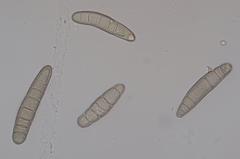 Bipolaris sorokinianat0pathogen
- Outcome
- PRs accumulatede0
- Direction
- accumulatede0
Not reportedComparator
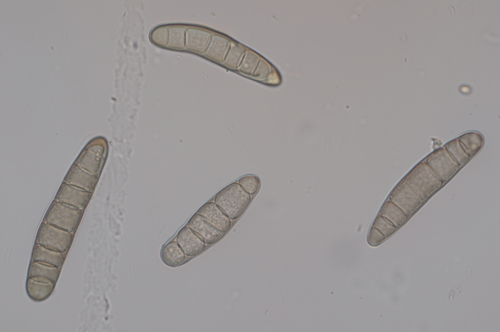
Organisms pictured · Representative pictures of the matched species, not figures from the paper.

Verbatim
e0“These PRs accumulated in both leaves and roots of barley seedlings as a response to infection of the respective tissues”
t0“Bipolaris sorokiniana”
Claim · model-written summary
Young infected root segments showed a stronger PR response than old roots.
- Taxon
- barleyHordeum vulgaret0
- Organ / stage
- young root segmentse0
- Interactor
- Bipolaris sorokinianaBipolaris sorokinianat0pathogen
- Outcome
- stronger responsee0
- Direction
- strongere0
- Comparator
- old rootse0
Organisms pictured · Representative pictures of the matched species, not figures from the paper.
Verbatim
e0“A stronger response was found when young root segments were inoculated in comparison to old roots”
t0“Barley Localization and accumulation patterns in response to infection by Bipolaris sorokiniana”
Claim · model-written summary
PR-1 and PR-5 were constitutively present in xylem, phloem and root epidermis.
- Taxon
- barleyHordeum vulgaret0
- Organ / stage
- xylem and phloem tissues and the root epidermise0
- Gene
- PR-1 and PR-5e0
- Outcome
- constitutively presente0
Organisms pictured · Representative pictures of the matched species, not figures from the paper.
Verbatim
e0“both PR-1 and PR-5 were constitutively present in both xylem and phloem tissues and the root epidermis”
t0“Barley”
Claim · model-written summary
PR-3 was constitutively abundant chiefly in leaf epidermis and partly in phloem.
- Taxon
- barleyHordeum vulgaret0
- Organ / stage
- epidermis of leavese0
- Gene
- PR-3e0
- Outcome
- high constitutive presencee0
Organisms pictured · Representative pictures of the matched species, not figures from the paper.
Verbatim
e0“PR-3 showed a high constitutive presence mainly in the epidermis of leaves and to some extent in the phloem”
t0“Barley”
Claim · model-written summary
Infection strongly induced all three PR proteins in ground tissue and somewhat in vascular tissue.
- Taxon
- barleyHordeum vulgaret0
- Organ / stage
- ground tissuese0
- Treatment
- infectione0
- Interactor
- Bipolaris sorokinianaBipolaris sorokinianat0pathogen
- Outcome
- all three proteinse0
- Direction
- highly inducede0
Not reportedComparator
Organisms pictured · Representative pictures of the matched species, not figures from the paper.
Verbatim
e0“In response to infection, all three proteins were highly induced in the ground tissues and to some extent in the vascular tissues”
t0“Barley Localization and accumulation patterns in response to infection by Bipolaris sorokiniana”
Claim · model-written summary
PR-1, PR-3 and PR-5 transcripts accumulated biphasically in leaves after leaf or root infection.
- Taxon
- barleyHordeum vulgaret0
- Organ / stage
- leavese0
- Gene
- PR-1, PR-3 and PR-5e0
- Outcome
- mRNAs accumulated in a biphasic patterne0
Organisms pictured · Representative pictures of the matched species, not figures from the paper.
Verbatim
e0“PR-1, PR-3 and PR-5 mRNAs accumulated in a biphasic pattern in leaves from both leafand root-infected seedlings”
t0“Barley”
Claim · model-written summary
The biphasic transcript pattern was undetectable in roots.
- Taxon
- barleyHordeum vulgaret0
- Organ / stage
- rootse0
- Outcome
- biphasic accumulation pattern of transcripts was not detectablee0
Organisms pictured · Representative pictures of the matched species, not figures from the paper.
Verbatim
e0“This biphasic accumulation pattern of transcripts was not detectable in roots”
t0“Barley”
Claim · model-written summary
PR-1, PR-3 and PR-5 occurred over fungal hyphal cell walls.
- Taxon
- barleyHordeum vulgaret0
- Interactor
- B. sorokinianaBipolaris sorokinianae0pathogen
- Gene
- PR-1, PR-3 and PR-5e0
- Outcome
- recovered over the cell wallse0
Organisms pictured · Representative pictures of the matched species, not figures from the paper.
Verbatim
e0“PR-1, PR-3 and PR-5 were all recovered over the cell walls of interand intracellular hyphae of B. sorokiniana”
t0“Barley”
The same questions in other papers
infection · Bipolaris sorokiniana · Hordeum vulgare (barley)Positive and negative results
1 paper in the same direction as this paper · 2 in the opposite direction
- negative
- negative
- positive
Claims are grouped by organism, treatment and what was measured or targeted. A paper counts as positive when any of its claims in the group is positive.