Abstract
The present study was undertaken with the goal to evaluate the initial growth of five forest species, after direct sowing in a riparian area at the lower San Francisco River, Sergipe. The experiment was carried out in Santana San Francisco County, SE (10º18”56’ S e 36º52”58’ W), in a randomized block design, with line plantings, alternating pioneer and climax species. The evaluated parameters were: seedlings’ emergence, survival and initial growth by height, base diameter and relative growth. Enterolobium contortisiliquum, Hymenaea courbaril and Cassia grandis showed the best percentages of seedling emergence, while Schinus terebinthifolius and Caesalpinia leiostachya were in the lower percentages. Seedling establishment was affected by specific mass and length of seeds. E. contortisiliquum and H. courbaril were superior to other species in survival at 30 months. C. leiostachya and E. contortisiliquum presented the best growth in height, while S. terebinthifolius had the largest base diameter. S. terebinthifolius had the best relative growth in height and base diameter. The studied species showed potential for the use in the restoration of riparian forests by direct sowing.
Abstract from the paper’s OpenAlex record; open copy licensed other-oa. Read at the source ↗
The text the model read, with the source record’s inline markup (italics, sub- and superscripts) rendered and its character entities decoded; quote offsets refer to the raw text.
Claims 8
Claim · model-written summary
Enterolobium contortisiliquum, Hymenaea courbaril and Cassia grandis had the best seedling emergence.
- Taxon
- Enterolobium contortisiliquum, Hymenaea courbaril and Cassia grandis
 Hymenaea courbaril
 Enterolobium contortisiliquum
 Cassia grandise0
- Outcome
- percentages of seedling emergencee0
- Direction
- beste0
Organisms pictured · Representative pictures of the matched species, not figures from the paper.


Verbatim
e0“Enterolobium contortisiliquum, Hymenaea courbaril and Cassia grandis showed the best percentages of seedling emergence”
Claim · model-written summary
Schinus terebinthifolius and Caesalpinia leiostachya had lower seedling emergence.
Verbatim
e0“Schinus terebinthifolius and Caesalpinia leiostachya were in the lower percentages”
Claim · model-written summary
Seedling establishment varied with seed specific mass and length.
Not reportedTaxonDirection
Verbatim
e0“Seedling establishment was affected by specific mass and length of seeds.”
Claim · model-written summary
E. contortisiliquum and H. courbaril had superior survival at 30 months.
- Taxon
- E. contortisiliquum and H. courbarilHymenaea courbarilEnterolobium contortisiliquume0
- Outcome
- survivale0
- Direction
- superiore0
- Qualifier
- at 30 monthse0
- Comparator
- other speciese0
Organisms pictured · Representative pictures of the matched species, not figures from the paper.
Verbatim
e0“E. contortisiliquum and H. courbaril were superior to other species in survival at 30 months.”
Claim · model-written summary
C. leiostachya and E. contortisiliquum had the best height growth.
- Taxon
- C. leiostachya and E. contortisiliquumEnterolobium contortisiliquum
 Libidibia leiostachyae0
- Outcome
- growth in heighte0
- Direction
- beste0
Organisms pictured · Representative pictures of the matched species, not figures from the paper.
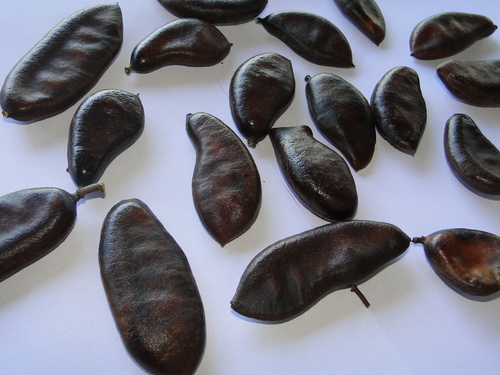
Verbatim
e0“C. leiostachya and E. contortisiliquum presented the best growth in height”
Claim · model-written summary
S. terebinthifolius had the largest base diameter.
Verbatim
e0“S. terebinthifolius had the largest base diameter”
Claim · model-written summary
S. terebinthifolius had the best relative growth in height and base diameter.
Verbatim
e0“S. terebinthifolius had the best relative growth in height and base diameter.”
Claim · model-written summary
The studied species had potential for riparian forest restoration through direct sowing.
Verbatim
e0“The studied species showed potential for the use in the restoration of riparian forests by direct sowing.”