Abstract
Abstract Tomato leaf curl New Delhi virus ( ToLCNDV ) is a bipartite begomovirus (family Geminiviridae ) first reported in India and its neighbouring countries. ToLCNDV severely affects zucchini crop ( Cucurbita pepo ) in the main production areas of Southern Spain since 2012. This emerging begomovirus is a serious threat to this and other cucurbit crops. Breeding resistant cultivars is the most promising method for disease control, but requires the identification of sources of resistance in the Cucurbita genus. In this work, we screened for ToLCNDV resistance a large collection of Cucurbita spp. accessions, including landraces and commercial cultivars of the main cultivated species, C. pepo , Cucurbita moschata and Cucurbita maxima and wild species. The screening was performed using mechanical and whitefly inoculation. The level of resistance was assessed by scoring symptom severity and by measuring the virus content with quantitative polymerase chain reaction in selected genotypes. Diversity in the response was observed within and among species. Severe symptoms and high viral amounts were found at 30 days after mechanical and whitefly inoculation in C. pepo , in all accessions belonging to the Zucchini morphotype and to other morphotypes of both subspecies, pepo and ovifera , and even in the wild relative Cucurbita fraterna . C. maxima was also highly susceptible. This species showed characteristic symptoms of leaf decay and intense yellowing, different from those of mosaic, curling and internode shortening found in C. pepo . The only species showing resistance was C. moschata . Four accessions were symptomless or had some plants with only mild symptoms after three independent rounds of mechanical inoculation with different inoculum sources. Two of them also remained symptomless after virus inoculation with viruliferous whiteflies. ToLCNDV was detected in these asymptomatic accessions at 15 and 30 days post inoculation, but viral amounts were much lower than those found in susceptible genotypes, suggesting a high level of resistance. The symptoms in the susceptible accessions of this species were also different, with a characteristic leaf mottling, evolving to a severe mosaic. The newly identified C. moschata resistant accessions are good candidates for breeding programmes to avoid the damage caused by ToLCNDV .
Abstract from the paper’s OpenAlex record; open copy licensed cc-by-nc-nd. Read at the source ↗
The text the model read, with the source record’s inline markup (italics, sub- and superscripts) rendered and its character entities decoded; quote offsets refer to the raw text.
Claims 13
Claim · model-written summary
Cucurbita responses to ToLCNDV varied within and among species.
- Outcome
- Diversity in the responsee0
 Cucurbita
Organisms pictured · Representative pictures of the matched species, not figures from the paper.

Verbatim
e0“Diversity in the response was observed within and among species.”
e1“Cucurbita spp. accessions”
Claim · model-written summary
C. pepo accessions had severe symptoms and high viral amounts 30 days after inoculation.
- Taxon
- C. pepo
 Cucurbita pepoe0
- Treatment
- mechanical and whitefly inoculatione0
- Interactor
- Tomato leaf curl New Delhi virusTomato leaf curl New Delhi viruse1pathogen
- Outcome
- Severe symptoms and high viral amountse0
- Qualifier
- 30 dayse0
Organisms pictured · Representative pictures of the matched species, not figures from the paper.

Verbatim
e0“Severe symptoms and high viral amounts were found at 30 days after mechanical and whitefly inoculation in C. pepo”
e1“Tomato leaf curl New Delhi virus ( ToLCNDV )”
Claim · model-written summary
Cucurbita fraterna had severe symptoms and high viral amounts after inoculation.
- Taxon
- Cucurbita fraternaCucurbita melopepo var. fraternae0
- Treatment
- mechanical and whitefly inoculatione0
- Outcome
- Severe symptoms and high viral amountse0
Verbatim
e0“Severe symptoms and high viral amounts were found at 30 days after mechanical and whitefly inoculation in C. pepo , in all accessions belonging to the Zucchini morphotype and to other morphotypes of both subspecies, pepo and ovifera , and even in the wild relative Cucurbita fraterna .”
Claim · model-written summary
C. maxima was highly susceptible to ToLCNDV.
- Taxon
- C. maxima
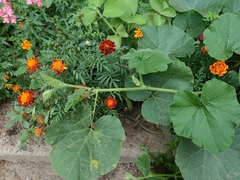 Cucurbita maximae0
- Outcome
- highly susceptiblee0
Organisms pictured · Representative pictures of the matched species, not figures from the paper.

Verbatim
e0“C. maxima was also highly susceptible.”
Claim · model-written summary
C. maxima showed leaf decay and intense yellowing.
- Taxon
- C. maximaCucurbita maximae1
- Outcome
- leaf decay and intense yellowinge0
Organisms pictured · Representative pictures of the matched species, not figures from the paper.
Verbatim
e0“This species showed characteristic symptoms of leaf decay and intense yellowing”
e1“C. maxima was also highly susceptible.”
Claim · model-written summary
C. pepo showed mosaic, curling and internode shortening.
- Taxon
- C. pepoCucurbita pepoe0
- Outcome
- mosaic, curling and internode shorteninge0
Organisms pictured · Representative pictures of the matched species, not figures from the paper.
Verbatim
e0“mosaic, curling and internode shortening found in C. pepo”
Claim · model-written summary
C. moschata was the only species showing resistance.
- Taxon
- C. moschata
 Cucurbita moschatae0
- Outcome
- resistancee0
Organisms pictured · Representative pictures of the matched species, not figures from the paper.

Verbatim
e0“The only species showing resistance was C. moschata .”
Claim · model-written summary
Four C. moschata accessions were symptomless or mildly symptomatic after three mechanical inoculations.
- Taxon
- C. moschataCucurbita moschatae1
- Treatment
- mechanical inoculatione0
- Outcome
- symptomless or had some plants with only mild symptomse0
- Value
- Four accessionse0
Organisms pictured · Representative pictures of the matched species, not figures from the paper.
Verbatim
e0“Four accessions were symptomless or had some plants with only mild symptoms after three independent rounds of mechanical inoculation with different inoculum sources.”
e1“The only species showing resistance was C. moschata .”
Claim · model-written summary
Two resistant accessions remained symptomless after viruliferous whitefly inoculation.
- Taxon
- C. moschataCucurbita moschatae1
- Treatment
- virus inoculation with viruliferous whitefliese0
- Outcome
- remained symptomlesse0
- Value
- Twoe0
Organisms pictured · Representative pictures of the matched species, not figures from the paper.
Verbatim
e0“Two of them also remained symptomless after virus inoculation with viruliferous whiteflies.”
e1“The only species showing resistance was C. moschata .”
Claim · model-written summary
ToLCNDV was detected in asymptomatic C. moschata at 15 and 30 days after inoculation.
- Taxon
- C. moschataCucurbita moschatae1
- Interactor
- ToLCNDVe0pathogen
- Outcome
- ToLCNDV was detectede0
- Qualifier
- 15 and 30 days post inoculatione0
Organisms pictured · Representative pictures of the matched species, not figures from the paper.
Verbatim
e0“ToLCNDV was detected in these asymptomatic accessions at 15 and 30 days post inoculation”
e1“The only species showing resistance was C. moschata .”
Claim · model-written summary
Viral amounts in asymptomatic C. moschata were much lower than in susceptible genotypes.
- Taxon
- C. moschataCucurbita moschatae1
- Interactor
- ToLCNDVe2pathogen
- Outcome
- viral amountse0
- Direction
- much lowere0
- Comparator
- susceptible genotypese0
Organisms pictured · Representative pictures of the matched species, not figures from the paper.
Verbatim
e0“viral amounts were much lower than those found in susceptible genotypes”
e1“The only species showing resistance was C. moschata .”
e2“ToLCNDV was detected in these asymptomatic accessions”
Claim · model-written summary
Susceptible C. moschata developed leaf mottling that progressed to severe mosaic.
- Taxon
- C. moschataCucurbita moschatae1
- Outcome
- leaf mottling, evolving to a severe mosaice0
Organisms pictured · Representative pictures of the matched species, not figures from the paper.
Verbatim
e0“The symptoms in the susceptible accessions of this species were also different, with a characteristic leaf mottling, evolving to a severe mosaic.”
e1“The only species showing resistance was C. moschata .”
Claim · model-written summary
The authors recommend resistant C. moschata accessions for breeding.
- Taxon
- C. moschataCucurbita moschatae0
- Interactor
- ToLCNDVe0pathogen
- Outcome
- good candidates for breeding programmese0
Organisms pictured · Representative pictures of the matched species, not figures from the paper.
Verbatim
e0“The newly identified C. moschata resistant accessions are good candidates for breeding programmes to avoid the damage caused by ToLCNDV .”