Abstract
To explore the association between dominant plant populations,the interspecific associations of dominant tree and shrub populations together with niche plants in an evergreen broadleaf forest of Shiyang Forestry Center,Zhejiang Province were studied based on a 2×2 contingency table using percentage of co-occurrence(C) and association coefficient(D).Results showed that in the tree layer Schima superba,Cyclobalanopsis glauca,Rhododendron ovatum,and Rhododendron latoucheae had higher associations with a majority of the other populations,whereas as Carpinus viminea,Symplocos stellaris,Choerospondias axillaris,Neolitsea aurata,Castanopsis tibetana,and other species had relatively weak associations.Nevertheless,the entire community was relatively stable.In the shrub layer 83.4% of the total 253 species pairs,had a co-occurrence of less than 10%,while 59.3% had association coefficients(D) less than-30%.Most of the shrub species pairs showed weak or no interspecific association.Also,greater intensities of association had larger niche overlap values,whereas weaker associations had smaller niche overlaps.
Abstract from the paper’s OpenAlex record, shown for indexing and research. Copyright remains with the authors or the publisher. Read at the source ↗
The text the model read, with the source record’s inline markup (italics, sub- and superscripts) rendered and its character entities decoded; quote offsets refer to the raw text.
Claims 14
Claim · model-written summary
Schima superba had higher associations with a majority of the other tree-layer populations.
- Taxon
- Schima superba
 Schima superbae1
- Organ / stage
- tree layere1
- Outcome
- associationse1
- Direction
- highere1
Organisms pictured · Representative pictures of the matched species, not figures from the paper.

Verbatim
e1“Results showed that in the tree layer Schima superba,Cyclobalanopsis glauca,Rhododendron ovatum,and Rhododendron latoucheae had higher associations with a majority of the other populations”
Claim · model-written summary
Cyclobalanopsis glauca had higher associations with a majority of the other tree-layer populations.
- Taxon
- Cyclobalanopsis glauca
 Quercus glaucae1
- Organ / stage
- tree layere1
- Outcome
- associationse1
- Direction
- highere1
Organisms pictured · Representative pictures of the matched species, not figures from the paper.

Verbatim
e1“Results showed that in the tree layer Schima superba,Cyclobalanopsis glauca,Rhododendron ovatum,and Rhododendron latoucheae had higher associations with a majority of the other populations”
Claim · model-written summary
Rhododendron ovatum had higher associations with a majority of the other tree-layer populations.
- Taxon
- Rhododendron ovatum
 Rhododendron ovatume1
- Organ / stage
- tree layere1
- Outcome
- associationse1
- Direction
- highere1
Organisms pictured · Representative pictures of the matched species, not figures from the paper.

Verbatim
e1“Results showed that in the tree layer Schima superba,Cyclobalanopsis glauca,Rhododendron ovatum,and Rhododendron latoucheae had higher associations with a majority of the other populations”
Claim · model-written summary
Rhododendron latoucheae had higher associations with a majority of the other tree-layer populations.
- Taxon
- Rhododendron latoucheae
 Rhododendron latoucheaee1
- Organ / stage
- tree layere1
- Outcome
- associationse1
- Direction
- highere1
Organisms pictured · Representative pictures of the matched species, not figures from the paper.

Verbatim
e1“Results showed that in the tree layer Schima superba,Cyclobalanopsis glauca,Rhododendron ovatum,and Rhododendron latoucheae had higher associations with a majority of the other populations”
Claim · model-written summary
Carpinus viminea had relatively weak associations with other tree-layer populations.
- Taxon
- Carpinus viminea
 Carpinus vimineae3
- Organ / stage
- tree layere1
- Outcome
- associationse3
- Direction
- relatively weake3
Organisms pictured · Representative pictures of the matched species, not figures from the paper.

Verbatim
e1“Results showed that in the tree layer Schima superba,Cyclobalanopsis glauca,Rhododendron ovatum,and Rhododendron latoucheae had higher associations with a majority of the other populations”
e3“whereas as Carpinus viminea,Symplocos stellaris,Choerospondias axillaris,Neolitsea aurata,Castanopsis tibetana,and other species had relatively weak associations”
Claim · model-written summary
Symplocos stellaris had relatively weak associations with other tree-layer populations.
- Taxon
- Symplocos stellaris
 Symplocos stellarise3
- Organ / stage
- tree layere1
- Outcome
- associationse3
- Direction
- relatively weake3
Organisms pictured · Representative pictures of the matched species, not figures from the paper.

Verbatim
e1“Results showed that in the tree layer Schima superba,Cyclobalanopsis glauca,Rhododendron ovatum,and Rhododendron latoucheae had higher associations with a majority of the other populations”
e3“whereas as Carpinus viminea,Symplocos stellaris,Choerospondias axillaris,Neolitsea aurata,Castanopsis tibetana,and other species had relatively weak associations”
Claim · model-written summary
Choerospondias axillaris had relatively weak associations with other tree-layer populations.
- Taxon
- Choerospondias axillaris
 Choerospondias axillarise3
- Organ / stage
- tree layere1
- Outcome
- associationse3
- Direction
- relatively weake3
Organisms pictured · Representative pictures of the matched species, not figures from the paper.

Verbatim
e1“Results showed that in the tree layer Schima superba,Cyclobalanopsis glauca,Rhododendron ovatum,and Rhododendron latoucheae had higher associations with a majority of the other populations”
e3“whereas as Carpinus viminea,Symplocos stellaris,Choerospondias axillaris,Neolitsea aurata,Castanopsis tibetana,and other species had relatively weak associations”
Claim · model-written summary
Neolitsea aurata had relatively weak associations with other tree-layer populations.
- Taxon
- Neolitsea aurata
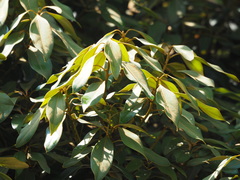 Neolitsea auratae3
- Organ / stage
- tree layere1
- Outcome
- associationse3
- Direction
- relatively weake3
Organisms pictured · Representative pictures of the matched species, not figures from the paper.
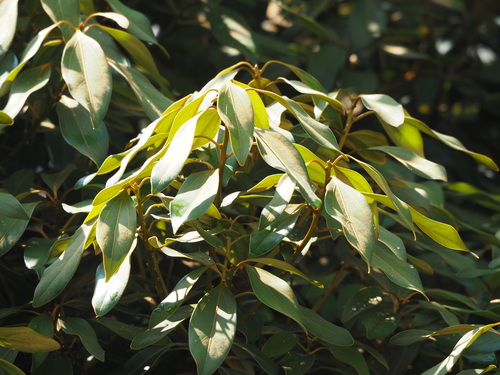
Verbatim
e1“Results showed that in the tree layer Schima superba,Cyclobalanopsis glauca,Rhododendron ovatum,and Rhododendron latoucheae had higher associations with a majority of the other populations”
e3“whereas as Carpinus viminea,Symplocos stellaris,Choerospondias axillaris,Neolitsea aurata,Castanopsis tibetana,and other species had relatively weak associations”
Claim · model-written summary
Castanopsis tibetana had relatively weak associations with other tree-layer populations.
- Taxon
- Castanopsis tibetanaCastanopsis tibetanae3
- Organ / stage
- tree layere1
- Outcome
- associationse3
- Direction
- relatively weake3
Verbatim
e1“Results showed that in the tree layer Schima superba,Cyclobalanopsis glauca,Rhododendron ovatum,and Rhododendron latoucheae had higher associations with a majority of the other populations”
e3“whereas as Carpinus viminea,Symplocos stellaris,Choerospondias axillaris,Neolitsea aurata,Castanopsis tibetana,and other species had relatively weak associations”
Claim · model-written summary
The entire plant community of dominant tree and shrub populations was relatively stable.
Not reportedDirection
Verbatim
e2“the interspecific associations of dominant tree and shrub populations together with niche plants in an evergreen broadleaf forest of Shiyang Forestry Center”
e4“Nevertheless,the entire community was relatively stable”
Claim · model-written summary
In the shrub layer, 83.4% of the 253 species pairs had co-occurrence below 10%.
Not reportedDirection
Verbatim
e5“In the shrub layer 83.4% of the total 253 species pairs,had a co-occurrence of less than 10%”
Claim · model-written summary
In the shrub layer, 59.3% of species pairs had association coefficients (D) below -30%.
Verbatim
e5“In the shrub layer 83.4% of the total 253 species pairs,had a co-occurrence of less than 10%”
e6“while 59.3% had association coefficients(D) less than-30%”
Claim · model-written summary
Most shrub species pairs showed weak or no interspecific association.
Not reportedDirection
Verbatim
e7“Most of the shrub species pairs showed weak or no interspecific association”
Claim · model-written summary
Stronger interspecific associations were linked to larger niche overlap values.
Verbatim
e2“the interspecific associations of dominant tree and shrub populations together with niche plants in an evergreen broadleaf forest of Shiyang Forestry Center”
e3“greater intensities of association had larger niche overlap values”