Abstract
[EN] Tomato leaf curl New Delhi virus (ToLCNDV) is a bipartite begomovirus (Geminiviridae) firstly reported in India and neighboring countries. A severe outbreak of ToLCNDV in Zucchini (Cucurbita pepo) occurred in southern Spain in 2012. Mechanical inoculation and natural infection with Bemisia tabaci, in Almeria, were used to screen part of the COMAV's Cucurbita core collection. The tolerance was assessed by symptomatology and by a PCR-based diagnostic method that allows the detection of the two viral components in a single reaction. Mechanical transmission of ToLCNDV was confirmed in all the species. Severe symptoms were found 30 and 35 days after mechanical and natural inoculation, respectively, in C. pepo, in all accessions belonging to the Zucchini morphotype and to other morphotypes of the subsp. pepo, subsp. ovifera and even in the wild relative C. fraterna. Cucurbita maxima and C. ficifolia were also highly susceptible. The only species showing tolerance was C. moschata. Instead of curling, which was typically observed in most Cucurbita species, in C. moschata we observed mosaic and mottling, which suggest a differential response of this species. Under natural infection, a few C. moschata accessions remained asymptomatic and no virus was detected in the plant apex. Under mechanical inoculation, ToLCNDV symptoms were mild and delayed in these accessions and they were PCR positive. Some of the more tolerant accessions came from India.
Abstract from the paper’s OpenAlex record; open copy licensed cc-by-nc-nd. Read at the source ↗
The text the model read, with the source record’s inline markup (italics, sub- and superscripts) rendered and its character entities decoded; quote offsets refer to the raw text.
Claims 12
Claim · model-written summary
Mechanical transmission of ToLCNDV was confirmed in all Cucurbita species tested.
 Cucurbita
Organisms pictured · Representative pictures of the matched species, not figures from the paper.

Verbatim
t0“Tolerance to ToLCNDV in Cucurbita spp.”
e1“Mechanical transmission of ToLCNDV was confirmed in all the species”
Claim · model-written summary
Severe symptoms appeared 30 and 35 days after mechanical and natural inoculation in C. pepo.
- Taxon
- C. pepo
 Cucurbita pepoe2
- Treatment
- mechanical and natural inoculatione2
- Outcome
- Severe symptomse2
- Value
- 30 and 35 dayse2
Organisms pictured · Representative pictures of the matched species, not figures from the paper.

Verbatim
e2“Severe symptoms were found 30 and 35 days after mechanical and natural inoculation, respectively, in C. pepo”
Claim · model-written summary
Severe symptoms were found in the wild relative C. fraterna.
- Taxon
- C. fraternaCucurbita melopepo var. fraternae3
- Outcome
- Severe symptomse3
Verbatim
e3“Severe symptoms were found 30 and 35 days after mechanical and natural inoculation, respectively, in C. pepo, in all accessions belonging to the Zucchini morphotype and to other morphotypes of the subsp. pepo, subsp. ovifera and even in the wild relative C. fraterna”
Claim · model-written summary
Cucurbita maxima was highly susceptible to ToLCNDV.
- Taxon
- Cucurbita maxima
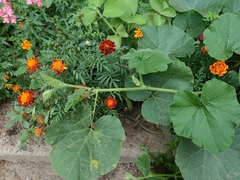 Cucurbita maximae4
- Outcome
- highly susceptiblee4
Organisms pictured · Representative pictures of the matched species, not figures from the paper.

Verbatim
e4“Cucurbita maxima and C. ficifolia were also highly susceptible”
Claim · model-written summary
C. ficifolia was highly susceptible to ToLCNDV.
- Taxon
- C. ficifolia
 Cucurbita ficifoliae4
- Outcome
- highly susceptiblee4
Organisms pictured · Representative pictures of the matched species, not figures from the paper.

Verbatim
e4“Cucurbita maxima and C. ficifolia were also highly susceptible”
Claim · model-written summary
C. moschata was the only species showing tolerance to ToLCNDV.
- Taxon
- C. moschata
 Cucurbita moschatae5
- Outcome
- tolerancee5
Organisms pictured · Representative pictures of the matched species, not figures from the paper.

Verbatim
e5“The only species showing tolerance was C. moschata”
Claim · model-written summary
In C. moschata, ToLCNDV infection produced mosaic and mottling instead of curling.
- Taxon
- C. moschataCucurbita moschatae6
- Outcome
- mosaic and mottlinge6
- Qualifier
- Instead of curlinge6
Organisms pictured · Representative pictures of the matched species, not figures from the paper.
Verbatim
e6“Instead of curling, which was typically observed in most Cucurbita species, in C. moschata we observed mosaic and mottling”
Claim · model-written summary
Under natural infection, a few C. moschata accessions remained asymptomatic.
- Taxon
- C. moschataCucurbita moschatae7
- Treatment
- natural infectione7
- Outcome
- remained asymptomatice7
Organisms pictured · Representative pictures of the matched species, not figures from the paper.
Verbatim
e7“Under natural infection, a few C. moschata accessions remained asymptomatic and no virus was detected in the plant apex. Under mechanical inoculation, ToLCNDV symptoms were mild and delayed in these accessions and they were PCR positive”
Claim · model-written summary
Under natural infection, no virus was detected in the apex of the asymptomatic C. moschata accessions.
- Taxon
- C. moschataCucurbita moschatae7
- Organ / stage
- plant apexe7
- Treatment
- natural infectione7
- Outcome
- no virus was detectede7
Organisms pictured · Representative pictures of the matched species, not figures from the paper.
Verbatim
e7“Under natural infection, a few C. moschata accessions remained asymptomatic and no virus was detected in the plant apex. Under mechanical inoculation, ToLCNDV symptoms were mild and delayed in these accessions and they were PCR positive”
Claim · model-written summary
Under mechanical inoculation, ToLCNDV symptoms in C. moschata accessions were mild and delayed.
- Taxon
- C. moschataCucurbita moschatae7
- Treatment
- mechanical inoculatione7
- Outcome
- symptomse7
- Qualifier
- mild and delayede7
Organisms pictured · Representative pictures of the matched species, not figures from the paper.
Verbatim
e7“Under natural infection, a few C. moschata accessions remained asymptomatic and no virus was detected in the plant apex. Under mechanical inoculation, ToLCNDV symptoms were mild and delayed in these accessions and they were PCR positive”
Claim · model-written summary
Under mechanical inoculation, the C. moschata accessions with mild symptoms were PCR positive.
- Taxon
- C. moschataCucurbita moschatae7
- Treatment
- mechanical inoculatione7
- Outcome
- PCR positivee7
Organisms pictured · Representative pictures of the matched species, not figures from the paper.
Verbatim
e7“Under natural infection, a few C. moschata accessions remained asymptomatic and no virus was detected in the plant apex. Under mechanical inoculation, ToLCNDV symptoms were mild and delayed in these accessions and they were PCR positive”
Claim · model-written summary
Some of the more tolerant Cucurbita accessions came from India.
Organisms pictured · Representative pictures of the matched species, not figures from the paper.
Verbatim
t0“Tolerance to ToLCNDV in Cucurbita spp.”
e0“Some of the more tolerant accessions came from India”