Abstract
The study of the potential of Congo's spontaneous flora in biofuel resources is based on the parameters of ecological structure. 11 species (22.9%) are present on the 48 main retained by PROTA 14. The spatial distribution of the species shows that only the Bétou UFA gathers all the species. The best represented in the different forest areas are Ongokea gore, Pentaclethra eetveldeana, Pentaclethra macrophylla and Pycnanthus angolensis. Except for the Conkouati-Douli National Park, the Lossi Sanctuary and the Aubeville Forest, where there are some peculiarities, these species are characterized by low densities ranging from 0.001 to 5 individuals.ha-1 and basal areas generally less than 1 m².ha-1. The diametric structure is on the whole erratic type, marker of insufficient regeneration. Phytoecological data reveal that this forest cannot support sustained industrial exploitation in the production of second-generation biofuels. These species, which constitute an energy source for the disseminating agents, are 73% nutritive and 82% phytotherapeutic to humans. These multi-purpose species are at the same time of interest to the wood and craft industries, while being non-timber forest products of prime choice.
Abstract from the paper’s OpenAlex record; open copy licensed cc-by-nc-sa. Read at the source ↗
The text the model read, with the source record’s inline markup (italics, sub- and superscripts) rendered and its character entities decoded; quote offsets refer to the raw text.
Claims 8
Claim · model-written summary
Eleven species (22.9%) are among the 48 main species retained by PROTA 14.
Verbatim
e0“11 species (22.9%) are present on the 48 main retained by PROTA 14”
Claim · model-written summary
Ongokea gore, Pentaclethra eetveldeana, Pentaclethra macrophylla and Pycnanthus angolensis are the best represented species across the forest areas.
- Taxon
- Ongokea gore, Pentaclethra eetveldeana, Pentaclethra macrophylla and Pycnanthus angolensis
 Pentaclethra macrophyllaPentaclethra eetveldeana
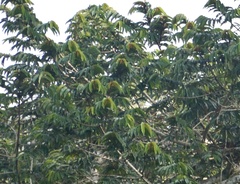 Pycnanthus angolensisOngokea goree0
- Outcome
- best represented in the different forest arease0
Organisms pictured · Representative pictures of the matched species, not figures from the paper.


Verbatim
e0“The best represented in the different forest areas are Ongokea gore, Pentaclethra eetveldeana, Pentaclethra macrophylla and Pycnanthus angolensis”
Claim · model-written summary
The species have low densities ranging from 0.001 to 5 individuals per hectare.
Verbatim
e0“these species are characterized by low densities ranging from 0.001 to 5 individuals.ha-1 and basal areas generally less than 1 m².ha-1”
Claim · model-written summary
The species have basal areas generally less than 1 m2 per hectare.
Verbatim
e0“these species are characterized by low densities ranging from 0.001 to 5 individuals.ha-1 and basal areas generally less than 1 m².ha-1”
Claim · model-written summary
The diametric structure is on the whole erratic, a marker of insufficient regeneration.
Not reportedTaxon
Verbatim
e0“The diametric structure is on the whole erratic type, marker of insufficient regeneration”
Claim · model-written summary
The forest cannot support sustained industrial exploitation for second-generation biofuel production.
- Outcome
- sustained industrial exploitation in the production of second-generation biofuelse0
Not reportedTaxon
Verbatim
e0“Phytoecological data reveal that this forest cannot support sustained industrial exploitation in the production of second-generation biofuels”
Claim · model-written summary
The species are 73% nutritive to humans.
Verbatim
e0“These species, which constitute an energy source for the disseminating agents, are 73% nutritive and 82% phytotherapeutic to humans”
Claim · model-written summary
The species are 82% phytotherapeutic to humans.
Verbatim
e0“These species, which constitute an energy source for the disseminating agents, are 73% nutritive and 82% phytotherapeutic to humans”