Abstract
Sasa borealis (Hack.) Makino, a clonal dwarf bamboo, is widespread in Korean forests. Although S . borealis is native to that country, its growth habit can cause considerable harm when occupying particular areas where it dominates and influences those forested communities. However, few reports have described the extent of its inhibitory effects on the vigor of co-existing plant species. Therefore, we investigated the distribution, abundance, and diversity of other plant species in the communities where this plant occurs in the east-central forests on the Korean Peninsula. S . borealis was most commonly found at an elevational range of 800 to 1,200 m, on gentle, usually lower, and near valley northern slopes. Out of the 13 forest communities based on 447 forest stands that we surveyed, S . borealis was detected in eight communities, mostly where Quercus mongolica dominates. In particular, it was more common in late-successional mixed stands of Q . mongolica , other deciduous species, and the coniferous Abies holophylla . Because of their ability to expand rapidly in the forest, this plant covered more than 50% of the surface in most of our research plots. Species diversity declined significantly ( F = 78.7, p = 0.000) as the abundance of S . borealis increased in the herb stratum. The same trend was noted for the total number of species ( F = 18.1, p = 0.000) and species evenness ( F = 91.5, p = 0.000). These findings clearly demonstrate that S . borealis is a weed pest and severely hinders species diversity. Authorities should be implementing various measures for ecological control to take advantage of declining chance after the recent synchronized massive flowering of S . borealis .
Abstract from the paper’s OpenAlex record; open copy licensed cc-by. Read at the source ↗
The text the model read, with the source record’s inline markup (italics, sub- and superscripts) rendered and its character entities decoded; quote offsets refer to the raw text.
Claims 8
Claim · model-written summary
Sasa borealis was most common at 800 to 1,200 m on gentle northern lower valley slopes.
- Taxon
- Sasa borealis
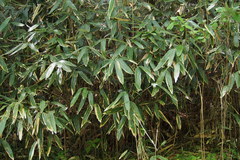 Sasamorpha borealist0
- Outcome
- most commonly founde0
- Value
- 800 to 1,200 me0
- Setting
- near valley northern slopese0
Organisms pictured · Representative pictures of the matched species, not figures from the paper.
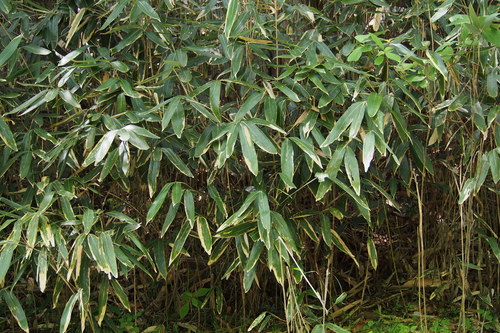
Verbatim
e0“S . borealis was most commonly found at an elevational range of 800 to 1,200 m, on gentle, usually lower, and near valley northern slopes”
t0“Sasa borealis”
Claim · model-written summary
Sasa borealis occurred in eight of thirteen forest communities, mainly with Quercus mongolica.
- Taxon
- Sasa borealisSasamorpha borealist0
- Outcome
- detected in eight communitiese0
- Value
- eight communitiese0
- Qualifier
- where Quercus mongolica dominatese0
Organisms pictured · Representative pictures of the matched species, not figures from the paper.
Verbatim
e0“S . borealis was detected in eight communities, mostly where Quercus mongolica dominates”
t0“Sasa borealis”
Claim · model-written summary
Sasa borealis was more common in late successional mixed stands.
- Taxon
- Sasa borealisSasamorpha borealist0
- Outcome
- more commone0
- Setting
- late-successional mixed standse0
Organisms pictured · Representative pictures of the matched species, not figures from the paper.
Verbatim
e0“it was more common in late-successional mixed stands of Q . mongolica , other deciduous species, and the coniferous Abies holophylla”
t0“Sasa borealis”
Claim · model-written summary
Sasa borealis covered over half the surface in most plots.
- Taxon
- Sasa borealisSasamorpha borealist0
- Outcome
- covered more than 50% of the surfacee0
- Value
- more than 50%e0
Organisms pictured · Representative pictures of the matched species, not figures from the paper.
Verbatim
e0“this plant covered more than 50% of the surface in most of our research plots”
t0“Sasa borealis”
Claim · model-written summary
Species diversity declined as Sasa borealis abundance rose.
- Taxon
- Sasa borealisSasamorpha borealist0
- Material
- S . borealise0
- Organ / stage
- herb stratume0
- Outcome
- Species diversitye0
- Direction
- declinede0
Organisms pictured · Representative pictures of the matched species, not figures from the paper.
Verbatim
e0“Species diversity declined significantly ( F = 78.7, p = 0.000) as the abundance of S . borealis increased in the herb stratum”
t0“Sasa borealis”
Claim · model-written summary
Total species number declined with Sasa borealis abundance.
- Taxon
- Sasa borealisSasamorpha borealist0
- Outcome
- total number of speciese0
- Direction
- same trende0
- Setting
- Korean forestst0
Organisms pictured · Representative pictures of the matched species, not figures from the paper.
Verbatim
e0“The same trend was noted for the total number of species ( F = 18.1, p = 0.000)”
t0“Sasa borealis in Korean forests”
Claim · model-written summary
Species evenness declined with Sasa borealis abundance.
- Taxon
- Sasa borealisSasamorpha borealist0
- Outcome
- species evennesse0
- Setting
- Korean forestst0
Not reportedDirection
Organisms pictured · Representative pictures of the matched species, not figures from the paper.
Verbatim
e0“species evenness ( F = 91.5, p = 0.000)”
t0“Sasa borealis in Korean forests”
Claim · model-written summary
Authors recommend ecological control following synchronized mass flowering.
- Taxon
- S . borealisSasamorpha borealise0
- Outcome
- various measures for ecological controle0
Organisms pictured · Representative pictures of the matched species, not figures from the paper.
Verbatim
e0“Authorities should be implementing various measures for ecological control to take advantage of declining chance after the recent synchronized massive flowering of S . borealis”