Abstract
The detection of plant diseases, including fungi, is a major challenge for reducing yield gaps of crops across the world. We explored the potential of the PROCOSINE radiative transfer model to assess the effect of the fungus Pseudocercospora fijiensis on leaf tissues using laboratory-acquired submillimetre-scale hyperspectral images in the visible and near-infrared spectral range. The objectives were (i) to assess the dynamics of leaf biochemical and biophysical parameters estimated using PROCOSINE inversion as a function of the disease stages, and (ii) to discriminate the disease stages by using a Linear Discriminant Analysis model built from the inversion results. The inversion results show that most of the parameter dynamics are consistent with expectations: for example, the chlorophyll content progressively decreased as the disease spreads, and the brown pigments content increased. An overall accuracy of 78.7% was obtained for the discrimination of the six disease stages, with errors mainly occurring between asymptomatic samples and first visible disease stages. PROCOSINE inversion provides relevant ecophysiological information to better understand how P. fijiensis affects the leaf at each disease stage. More particularly, the results suggest that monitoring anthocyanins may be critical for the early detection of this disease.
Abstract from the paper’s OpenAlex record; open copy licensed cc-by. Read at the source ↗
The text the model read, with the source record’s inline markup (italics, sub- and superscripts) rendered and its character entities decoded; quote offsets refer to the raw text.
Claims 5
Claim · model-written summary
Estimated chlorophyll content progressively decreased as disease spread.
Verbatim
e0“the chlorophyll content progressively decreased as the disease spreads”
t0“leaf”
Claim · model-written summary
Estimated brown pigment content increased as disease spread.
- Interactor
- Pseudocercospora fijiensis
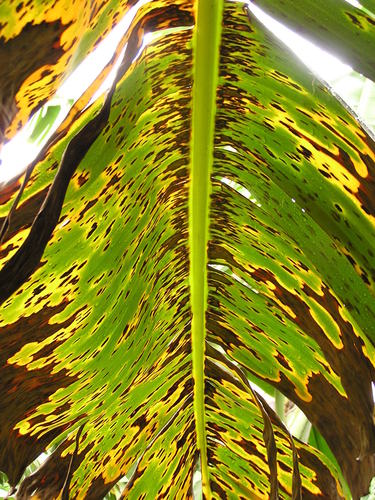
 Pseudocercospora fijiensise0e1
- Outcome
- brown pigments contente0
- Direction
- increasede0
Organisms pictured · Representative pictures of the matched species, not figures from the paper.
Verbatim
e0“the brown pigments content increased”
t0“leaf”
e1“Pseudocercospora fijiensis”
Claim · model-written summary
Disease-stage discrimination achieved 78.7% overall accuracy.
Verbatim
e0“An overall accuracy of 78.7% was obtained for the discrimination of the six disease stages”
Claim · model-written summary
Discrimination errors mainly occurred between asymptomatic and first visible disease stages.
Verbatim
e0“errors mainly occurring between asymptomatic samples and first visible disease stages”
Claim · model-written summary
The authors suggest monitoring anthocyanins for early detection.
Verbatim
e0“the results suggest that monitoring anthocyanins may be critical for the early detection of this disease”
t0“leaf”