Abstract
Beljai M, Worabai MS. 2018. The structure and composition of vegetation and amphibian diversity in Arfak Mountain, West Papua. Pros Sem Nas Masy Biodiv Indon 4: 1-12. The forest formation around Didouhu River, Arfak Mountain District, West Papua Province, Indonesia is a habitat for a number of species of plants and animals of the class of amphibians that are not yet known scientifically. Therefore, information and data on vegetation structure and composition and amphibian diversity in the area are needed. The purpose of this research is to know the structure and composition of vegetation and the diversity of amphibian species in the forest area around Didouhu River. Vegetation data were collected using a combination method of path method and line plot systematic method, while amphibian type data were collected using visual encounter survey method. Vegetation data were analyzed using vegetation analysis method, while amphibian diversity was analyzed by using Shannon-Wiener index (index of species diversity), evenness index, and Jaccard similarity index (similarity index). From the result of vegetation analysis, there are 65 types of vegetation covering 50 types of seedlings with a density of 17,500 individuals/ha, 50 types of sapling with a density of 4,085 individuals/ha, 42 types of pole with density of 506 individuals/ha, and 28 species of tree level with a density of 108 individuals/ha. There were eight types of vegetation with the highest importance value index (IVi) which dominates between three and four growth phases, namely Dodonaea viscosa (IVi=166,80%), Lithocarpus ruvofilosus (IVi=83,68%), Lithocarpus aspericulata (IVi=69,47%), Rhus lamprocarpa (IVi=54.44%), Melicope sp. (IVi=40,41%), Drimys piperita (IVi=39,91%), Pouteria sp. (IVi=34.29%), and Galbulimima belgraveana (IVi=31.85%). The eight types of vegetation are the principal founders of plant communities in forest ecosystems around the Didouhu River. Amphibians are found in four types, namely Litoria arfakiana, Asterophrys sp., Rana grisea, and Lechriodus platyceps. The diversity of amphibian species in the study sites was moderate (H '= 3.14) with low species inter-species similarity (S = 0.17). The level of evenness is high (E = 0.91), where there is one type of L. arfakiana found in two research sites (locations A and B). Overall, the location of the study is quite damp, lots of puddles, riparian vegetation quite dense, and has rocky soil conditions and litter, making it a suitable habitat for amphibians of the Order of Anura.
Abstract from the paper’s OpenAlex record, shown for indexing and research. Copyright remains with the authors or the publisher. Read at the source ↗
The text the model read, with the source record’s inline markup (italics, sub- and superscripts) rendered and its character entities decoded; quote offsets refer to the raw text.
Claims 14
Claim · model-written summary
The forest had 65 vegetation types.
Verbatim
e0“there are 65 types of vegetation”
Claim · model-written summary
Seedlings included 50 types at 17,500 individuals/ha.
Verbatim
e0“50 types of seedlings with a density of 17,500 individuals/ha”
Claim · model-written summary
Saplings included 50 types at 4,085 individuals/ha.
Verbatim
e0“50 types of sapling with a density of 4,085 individuals/ha”
Claim · model-written summary
Pole vegetation included 42 types at 506 individuals/ha.
Verbatim
e0“42 types of pole with density of 506 individuals/ha”
Claim · model-written summary
Tree vegetation included 28 species at 108 individuals/ha.
Verbatim
e0“28 species of tree level with a density of 108 individuals/ha”
Claim · model-written summary
Dodonaea viscosa had IVi 166,80%.
- Taxon
- Dodonaea viscosa
 Dodonaea viscosae0
- Outcome
- IVie0
- Value
- 166,80%e0
Organisms pictured · Representative pictures of the matched species, not figures from the paper.

Verbatim
e0“Dodonaea viscosa (IVi=166,80%)”
Claim · model-written summary
Lithocarpus ruvofilosus had IVi 83,68%.
Verbatim
e0“Lithocarpus ruvofilosus (IVi=83,68%)”
Claim · model-written summary
Lithocarpus aspericulata had IVi 69,47%.
Verbatim
e0“Lithocarpus aspericulata (IVi=69,47%)”
Claim · model-written summary
Rhus lamprocarpa had IVi 54.44%.
- Taxon
- Rhus lamprocarpaRhus lamprocarpae0
- Outcome
- IVie0
- Value
- 54.44%e0
Verbatim
e0“Rhus lamprocarpa (IVi=54.44%)”
Claim · model-written summary
Melicope sp. had IVi 40,41%.
 Melicope
Organisms pictured · Representative pictures of the matched species, not figures from the paper.

Verbatim
e0“Melicope sp. (IVi=40,41%)”
Claim · model-written summary
Drimys piperita had IVi 39,91%.
- Taxon
- Drimys piperita
 Tasmannia piperitae0
- Outcome
- IVie0
- Value
- 39,91%e0
Organisms pictured · Representative pictures of the matched species, not figures from the paper.

Verbatim
e0“Drimys piperita (IVi=39,91%)”
Claim · model-written summary
Pouteria sp. had IVi 34.29%.
 Pouteria
Organisms pictured · Representative pictures of the matched species, not figures from the paper.

Verbatim
e0“Pouteria sp. (IVi=34.29%)”
Claim · model-written summary
Galbulimima belgraveana had IVi 31.85%.
- Taxon
- Galbulimima belgraveana
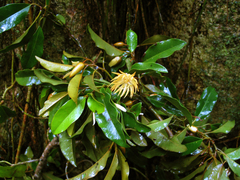 Galbulimima belgraveanae0
- Outcome
- IVie0
- Value
- 31.85%e0
Organisms pictured · Representative pictures of the matched species, not figures from the paper.

Verbatim
e0“Galbulimima belgraveana (IVi=31.85%)”
Claim · model-written summary
Eight vegetation types were principal founders of plant communities around Didouhu River.
Verbatim
e0“The eight types of vegetation are the principal founders of plant communities in forest ecosystems around the Didouhu River.”