Abstract
Mycorrhizal fungi are very diverse, including those that produce truffle-like fruiting bodies. Truffle-like fungi are hypogeous and sequestrate (produced below-ground, with an enclosed hymenophore) and rely on animal consumption, mainly by mammals, for spore dispersal. This dependence links mycophagous mammals to mycorrhizal diversity and, assuming truffle-like fungi are important components of mycorrhizal communities, to plant nutrient cycling and ecosystem health. These links are largely untested as currently little is known about mycorrhizal fungal community structure and its dependence on mycophagous mammals. We quantified the mycorrhizal fungal community in the north-east Australian woodland, including the portion interacting with ten species of mycophagous mammals. The study area is core habitat of an endangered fungal specialist marsupial, Bettongia tropica, and as such provides baseline data on mycorrhizal fungi-mammal interactions in an area with no known mammal declines. We examined the mycorrhizal fungi in root and soil samples via high-throughput sequencing and compared the observed taxa to those dispersed by mycophagous mammals at the same locations. We found that the dominant root-associating ectomycorrhizal fungal taxa (> 90% sequence abundance) included the truffle-like taxa Mesophellia, Hysterangium and Chondrogaster. These same taxa were also present in mycophagous mammalian diets, with Mesophellia often dominating. Altogether, 88% of truffle-like taxa from root samples were shared with the fungal specialist diet and 52% with diets from generalist mammals. Our data suggest that changes in mammal communities, particularly the loss of fungal specialists, could, over time, induce reductions to truffle-like fungal diversity, causing ectomycorrhizal fungal communities to shift with unknown impacts on plant and ecosystem health.
Abstract from the paper’s OpenAlex record; open copy licensed cc-by. Read at the source ↗
The text the model read, with the source record’s inline markup (italics, sub- and superscripts) rendered and its character entities decoded; quote offsets refer to the raw text.
Claims 6
Claim · model-written summary
Mesophellia, Hysterangium, and Chondrogaster dominated root associated ectomycorrhizal fungi at over 90% sequence abundance.
- Taxon
- woodlandst0
- Interactor
- Mesophellia, Hysterangium and Chondrogaster
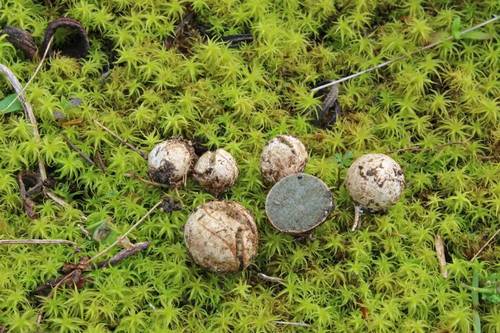
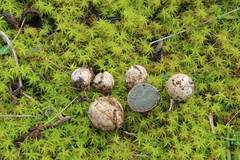 HysterangiumChondrogasterMesophelliae0symbiont
- Outcome
- root-associating ectomycorrhizal fungal taxae0
- Value
- > 90% sequence abundancee0
Organisms pictured · Representative pictures of the matched species, not figures from the paper.
Verbatim
e0“the dominant root-associating ectomycorrhizal fungal taxa (> 90% sequence abundance) included the truffle-like taxa Mesophellia, Hysterangium and Chondrogaster.”
t0“Australian woodlands”
Claim · model-written summary
The same taxa occurred in mammal diets, with Mesophellia often dominant.
- Taxon
- woodlandst0
- Interactor
- MesophelliaMesophelliae0symbiont
- Outcome
- Mesophellia often dominatinge0
Verbatim
e0“These same taxa were also present in mycophagous mammalian diets, with Mesophellia often dominating.”
t0“Australian woodlands”
Claim · model-written summary
Eighty eight percent of root sample truffle like taxa were shared with the fungal specialist diet.
Verbatim
e0“Altogether, 88% of truffle-like taxa from root samples were shared with the fungal specialist diet and 52% with diets from generalist mammals.”
t0“Australian woodlands”
Claim · model-written summary
Fifty two percent of root sample truffle like taxa were shared with generalist mammal diets.
Verbatim
e0“Altogether, 88% of truffle-like taxa from root samples were shared with the fungal specialist diet and 52% with diets from generalist mammals.”
t0“Australian woodlands”
Claim · model-written summary
The authors suggest loss of fungal specialist mammals could reduce truffle like fungal diversity over time.
Verbatim
e0“changes in mammal communities, particularly the loss of fungal specialists, could, over time, induce reductions to truffle-like fungal diversity”
t0“Australian woodlands”
Claim · model-written summary
The authors suggest resulting ectomycorrhizal fungal communities could shift, with unknown plant impacts.
Verbatim
e0“causing ectomycorrhizal fungal communities to shift with unknown impacts on plant and ecosystem health.”
t0“Australian woodlands”