Abstract
Abstract Aim Plant phylogeographic data from the Patagonian Channels are scant and it is largely unknown how the extensive Quaternary glaciations affected the population dynamics of the region's major vegetation component, that is cushion peat bogs (Magellanic moorland). Whether ice‐age glaciers wiped out all terrestrial plant life or whether some populations persisted in situ remains unclear. We reconstructed the phylogeography of two dominant Patagonian cushion peat bog species, Astelia pumila (G.Forst.) Gaudich. (Asteliaceae) and Donatia fascicularis J.R.Forst. & G.Forst. (Stylidiaceae), to test (a) the hypothesis of a glacial refugium for moorland plants in south‐central Chile and (b) the tabula rasa scenario for the Patagonian Channels. The retrieved phylogeographic patterns were compared with those reported previously for a further cushion peat bog species (Pfanzelt et al., Molecular Ecology 26 , 4027–4044), with the objective to provide a broader picture of how West Patagonian moorland plants responded to the Quaternary ice‐ages. Location West and Fuegian Patagonia, and the Falkland Islands (Islas Malvinas), southern South America. Methods DNA sequence data from seven and fourteen, respectively, nuclear loci containing Simple Sequence Repeats of 371 and 328 individuals of the two study species were analysed using population genetic summary statistics, phylogenetic networks and Bayesian and multivariate methods to determine genetic structure. Ecological niche modelling was used to reconstruct the spatial distribution of suitable habitat at the Last Glacial Maximum. Results All A. pumila populations belong to a single population genetic cluster. In the case of D. fascicularis , only the northernmost sampled population from Nahuelbuta (Chile) is genetically distinct, whereas the remainder forms a cluster without much further substructure. According to palaeodistribution models, south‐central Chile offered suitable habitat during the last glacial. Main conclusion Both ecological niche modelling and the very low genetic subdifferentiation are congruent with a tabula rasa scenario for the Patagonian Channels. Populations survived the last glacial in south‐central Chile, in an area to the northwest of the ice sheet. From there, southern regions were recolonized through highly bottlenecked source populations. Other, non‐mutually exclusive factors may have further shaped the population genetic patterns, among them high gene flow mediated by the strong westerly winds.
Abstract from the paper’s OpenAlex record, shown for indexing and research. Copyright remains with the authors or the publisher. Read at the source ↗
The text the model read, with the source record’s inline markup (italics, sub- and superscripts) rendered and its character entities decoded; quote offsets refer to the raw text.
Claims 8
Claim · model-written summary
A. pumila populations formed one genetic cluster.
- Taxon
- A. pumila
 Astelia pumilae0
- Outcome
- single population genetic clustere0
Organisms pictured · Representative pictures of the matched species, not figures from the paper.

Verbatim
e0“All A. pumila populations belong to a single population genetic cluster.”
Claim · model-written summary
The Nahuelbuta D. fascicularis population was genetically distinct.
- Taxon
- D. fascicularis
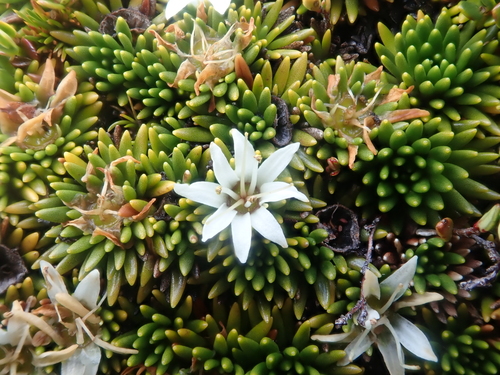
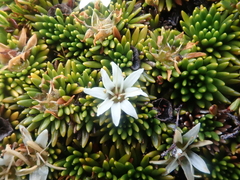 Donatia fascicularise0
- Outcome
- genetically distincte0
- Setting
- Nahuelbuta (Chile)e0
Organisms pictured · Representative pictures of the matched species, not figures from the paper.
Verbatim
e0“In the case of D. fascicularis , only the northernmost sampled population from Nahuelbuta (Chile) is genetically distinct”
Claim · model-written summary
Other D. fascicularis populations formed a cluster with little substructure.
- Taxon
- D. fascicularisDonatia fascicularise1
- Outcome
- cluster without much further substructuree0
Organisms pictured · Representative pictures of the matched species, not figures from the paper.
Verbatim
e0“whereas the remainder forms a cluster without much further substructure.”
e1“In the case of D. fascicularis”
Claim · model-written summary
Models indicated suitable glacial habitat in south-central Chile.
- Taxon
- Astelia pumilaAstelia pumilae1
- Outcome
- suitable habitate0
- Setting
- south‐central Chilee0
Organisms pictured · Representative pictures of the matched species, not figures from the paper.
Verbatim
e0“According to palaeodistribution models, south‐central Chile offered suitable habitat during the last glacial.”
e1“two dominant Patagonian cushion peat bog species, Astelia pumila (G.Forst.) Gaudich. (Asteliaceae) and Donatia fascicularis J.R.Forst. & G.Forst. (Stylidiaceae)”
Claim · model-written summary
Genetic and modelling evidence supports a tabula rasa scenario for the Patagonian Channels.
- Taxon
- Astelia pumilaAstelia pumilae1
- Outcome
- tabula rasa scenarioe0
- Setting
- Patagonian Channelse0
Organisms pictured · Representative pictures of the matched species, not figures from the paper.
Verbatim
e0“Both ecological niche modelling and the very low genetic subdifferentiation are congruent with a tabula rasa scenario for the Patagonian Channels.”
e1“Astelia pumila (G.Forst.) Gaudich. (Asteliaceae) and Donatia fascicularis J.R.Forst. & G.Forst. (Stylidiaceae)”
Claim · model-written summary
The populations survived the last glacial northwest of the ice sheet in south-central Chile.
- Taxon
- Astelia pumilaAstelia pumilae1
- Outcome
- survived the last glaciale0
- Setting
- south‐central Chilee0
Organisms pictured · Representative pictures of the matched species, not figures from the paper.
Verbatim
e0“Populations survived the last glacial in south‐central Chile, in an area to the northwest of the ice sheet.”
e1“Astelia pumila (G.Forst.) Gaudich. (Asteliaceae) and Donatia fascicularis J.R.Forst. & G.Forst. (Stylidiaceae)”
Claim · model-written summary
Southern regions were recolonized from highly bottlenecked source populations.
- Taxon
- Astelia pumilaAstelia pumilae1
- Outcome
- recolonized through highly bottlenecked source populationse0
- Setting
- southern regionse0
Organisms pictured · Representative pictures of the matched species, not figures from the paper.
Verbatim
e0“From there, southern regions were recolonized through highly bottlenecked source populations.”
e1“Astelia pumila (G.Forst.) Gaudich. (Asteliaceae) and Donatia fascicularis J.R.Forst. & G.Forst. (Stylidiaceae)”
Claim · model-written summary
Wind-mediated gene flow may also have shaped population genetic patterns.
- Taxon
- Astelia pumilaAstelia pumilae1
- Outcome
- population genetic patternse0
- Qualifier
- high gene flow mediated by the strong westerly windse0
Organisms pictured · Representative pictures of the matched species, not figures from the paper.
Verbatim
e0“Other, non‐mutually exclusive factors may have further shaped the population genetic patterns, among them high gene flow mediated by the strong westerly winds.”
e1“Astelia pumila (G.Forst.) Gaudich. (Asteliaceae) and Donatia fascicularis J.R.Forst. & G.Forst. (Stylidiaceae)”