Abstract
The tropical moist deciduous forests of India are largely dominated by the dipterocarp tree Shorea robusta (also known as sal). Ectomycorrhizal (ECM) fungi form symbiotic association with sal trees and play an important role in the stability of the sal forests. A study was carried out to determine the occurrence and distribution of ECM fungi in tropical sal forests at the Shiwalik mountain range, north-west India. The genus Russula was the dominant fungi. In this paper the morphoanatomical details of mycorrhizal roots of S. robusta associated with three Russula species, namely, R. cremeoavallanea, R. romagnesiana and R. nigricans were investigated for the first time. The ECM colonised roots were distinguished by differences in the shape and colour of mycorrhizal system, surface texture, shape and size of cystidia, cell shape of mantle, as well as the differing chemical reactions. ECM roots of sal associated with R. cremeoavallanea were mostly greyish brown and have almost plectenchymatous outer mantle layers having subcylindrical to awl-shaped cystidia. Ectomycorrhizal roots of R. romagnesiana were reddish brown with silvery patches, and have purely plectenchymatous outer mantle layers having obpyriform to obclavate cystidia. Russula nigricans-associated ectomycorrhizal roots have greyish brown to black mycorrhizal system and have almost pseudoparenchymatous dark brown mantle with capitate cystidial elements.
Abstract from the paper’s OpenAlex record, shown for indexing and research. Copyright remains with the authors or the publisher. Read at the source ↗
The text the model read, with the source record’s inline markup (italics, sub- and superscripts) rendered and its character entities decoded; quote offsets refer to the raw text.
Claims 4
Claim · model-written summary
Russula was the dominant fungus in sal forests.
- Outcome
- dominant fungie0
 Russula
Not reportedTaxon
Organisms pictured · Representative pictures of the matched species, not figures from the paper.

Verbatim
e0“The genus Russula was the dominant fungi.”
Claim · model-written summary
R. cremeoavallanea associated roots were greyish brown with plectenchymatous mantle and awl shaped cystidia.
Verbatim
e0“ECM roots of sal associated with R. cremeoavallanea were mostly greyish brown and have almost plectenchymatous outer mantle layers having subcylindrical to awl-shaped cystidia.”
Claim · model-written summary
R. romagnesiana associated roots were reddish brown with silvery patches and obpyriform to obclavate cystidia.
- Interactor
- R. romagnesianae0symbiont
- Outcome
- reddish brown with silvery patches, and have purely plectenchymatous outer mantle layers having obpyriform to obclavate cystidiae0
Not reportedTaxon
Verbatim
e0“Ectomycorrhizal roots of R. romagnesiana were reddish brown with silvery patches, and have purely plectenchymatous outer mantle layers having obpyriform to obclavate cystidia.”
Claim · model-written summary
R. nigricans associated roots had dark mycorrhizal systems and capitate cystidia.
- Interactor
- Russula nigricans
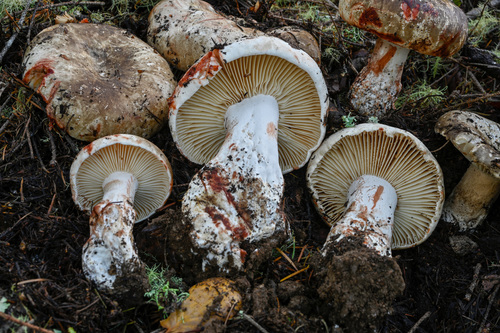
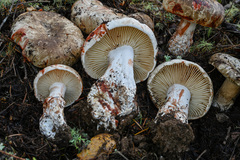 Russula nigricanse0symbiont
- Outcome
- greyish brown to black mycorrhizal system and have almost pseudoparenchymatous dark brown mantle with capitate cystidial elementse0
Not reportedTaxon
Organisms pictured · Representative pictures of the matched species, not figures from the paper.
Verbatim
e0“Russula nigricans-associated ectomycorrhizal roots have greyish brown to black mycorrhizal system and have almost pseudoparenchymatous dark brown mantle with capitate cystidial elements.”