Abstract
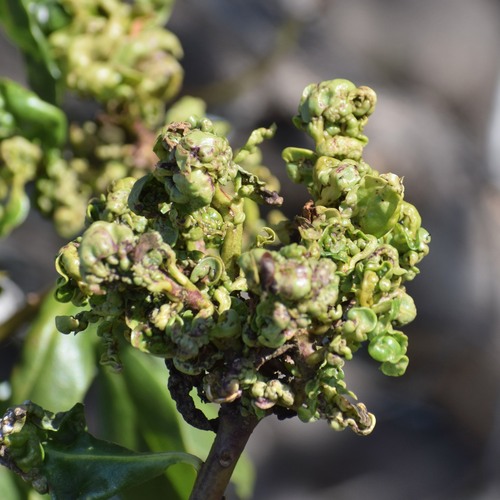
To identify the predator complex of the invasive thrips, Klambothrips myopori, on its ornamental host plant Myoporum laetum, field surveys were conducted at three sites in southern California over the period of 1 y. Five insect orders and five spider families were represented in the survey. Although the most abundant groups differed among collection sites, syrphid larvae, anthocorids, Chrysoperla spp., Franklinothrips orizabensis Johansen (Thysanoptera: Aeolothripidae), and one spider family (Salticidae) were all collected at each site. Based on the field surveys, Orius spp. and Chrysoperla spp. were identified as possible key natural enemies of K. myopori. Laboratory studies were then conducted to determine the consumption rates of Orius insidiosus Say (Hemiptera: Anthocoridae) and Chrysoperla rufilabris Burmeister (Neuroptera: Chrysopidae) at constant densities of K. myopori and to define the functional responses of the predators. Both predators consumed more second-instar larvae than other prey stages. Orius insidious displayed a type II functional response, while C. rufilabris displayed both type II and type III depending on prey stage. Generally speaking, O. insidiosus and C. rufilabris consumed a higher proportion of prey at lower pest densities, implying that in an augmentative control program using these commercially available natural enemies, predators could be released early in the year when host plants begin to flush and thrips populations are low to suppress population growth.
Abstract from the paper’s OpenAlex record, shown for indexing and research. Copyright remains with the authors or the publisher. Read at the source ↗
The text the model read, with the source record’s inline markup (italics, sub- and superscripts) rendered and its character entities decoded; quote offsets refer to the raw text.
Claims 11
Claim · model-written summary
Five insect orders and five spider families were found.
- Taxon
- Myoporum laetum
 Myoporum laetumt0
- Outcome
- Five insect orders and five spider familiese0
Organisms pictured · Representative pictures of the matched species, not figures from the paper.

Verbatim
e0“Five insect orders and five spider families were represented in the survey”
t0“on its ornamental host plant Myoporum laetum”
Claim · model-written summary
Dominant predator groups differed among sites.
- Taxon
- Myoporum laetumMyoporum laetumt0
- Outcome
- most abundant groupse0
- Direction
- differede0
Organisms pictured · Representative pictures of the matched species, not figures from the paper.
Verbatim
e0“most abundant groups differed among collection sites”
t0“on its ornamental host plant Myoporum laetum”
Claim · model-written summary
Several predator groups were collected at each site.
- Taxon
- Myoporum laetumMyoporum laetumt0
- Outcome
- were all collected at each sitee0
Organisms pictured · Representative pictures of the matched species, not figures from the paper.
Verbatim
e0“syrphid larvae, anthocorids, Chrysoperla spp., Franklinothrips orizabensis Johansen (Thysanoptera: Aeolothripidae), and one spider family (Salticidae) were all collected at each site”
t0“on its ornamental host plant Myoporum laetum”
Claim · model-written summary
Orius species were identified as possible key natural enemies of K. myopori.
- Taxon
- Myoporum laetumMyoporum laetumt0
- Interactor
- K. myopori
 Klambothrips myoporie0pest
- Outcome
- possible key natural enemiese0
 Orius
Organisms pictured · Representative pictures of the matched species, not figures from the paper.

Verbatim
e0“Orius spp. and Chrysoperla spp. were identified as possible key natural enemies of K. myopori”
t0“on its ornamental host plant Myoporum laetum”
Claim · model-written summary
Chrysoperla species were identified as possible key natural enemies of K. myopori.
- Taxon
- Myoporum laetumMyoporum laetumt0
- Interactor
- K. myoporiKlambothrips myoporie0pest
- Second interactor
- Chrysoperla spp.
 Chrysoperlae0biocontrol_agent
- Outcome
- possible key natural enemiese0
Organisms pictured · Representative pictures of the matched species, not figures from the paper.

Verbatim
e0“Orius spp. and Chrysoperla spp. were identified as possible key natural enemies of K. myopori”
t0“on its ornamental host plant Myoporum laetum”
Claim · model-written summary
Both predators ate more second-instar larvae than other prey stages.
- Taxon
- Myoporum laetumMyoporum laetumt0
- Outcome
- second-instar larvaee0
- Direction
- moree0
- Comparator
- other prey stagese0
Organisms pictured · Representative pictures of the matched species, not figures from the paper.
Verbatim
e0“Both predators consumed more second-instar larvae than other prey stages”
t0“on its ornamental host plant Myoporum laetum”
Claim · model-written summary
Orius insidious had a type II functional response.
- Taxon
- Myoporum laetumMyoporum laetumt0
- Interactor
- Orius insidiouse0biocontrol_agent
- Outcome
- type II functional responsee0
Organisms pictured · Representative pictures of the matched species, not figures from the paper.
Verbatim
e0“Orius insidious displayed a type II functional response”
t0“on its ornamental host plant Myoporum laetum”
Claim · model-written summary
C. rufilabris had type II and III responses depending on prey stage.
- Taxon
- Myoporum laetumMyoporum laetumt0
- Interactor
- C. rufilabris
 Chrysoperla rufilabrise0biocontrol_agent
- Outcome
- both type II and type IIIe0
Organisms pictured · Representative pictures of the matched species, not figures from the paper.

Verbatim
e0“C. rufilabris displayed both type II and type III depending on prey stage”
t0“on its ornamental host plant Myoporum laetum”
Claim · model-written summary
O. insidiosus ate a higher prey proportion at lower pest density.
- Taxon
- Myoporum laetumMyoporum laetumt0
- Interactor
- O. insidiosus
 Orius insidiosuse0biocontrol_agent
- Outcome
- proportion of preye0
- Direction
- highere0
Organisms pictured · Representative pictures of the matched species, not figures from the paper.

Verbatim
e0“O. insidiosus and C. rufilabris consumed a higher proportion of prey at lower pest densities”
t0“on its ornamental host plant Myoporum laetum”
Claim · model-written summary
C. rufilabris ate a higher prey proportion at lower pest density.
- Taxon
- Myoporum laetumMyoporum laetumt0
- Interactor
- C. rufilabrisChrysoperla rufilabrise0biocontrol_agent
- Outcome
- proportion of preye0
- Direction
- highere0
Organisms pictured · Representative pictures of the matched species, not figures from the paper.
Verbatim
e0“O. insidiosus and C. rufilabris consumed a higher proportion of prey at lower pest densities”
t0“on its ornamental host plant Myoporum laetum”
Claim · model-written summary
The authors suggest early predator releases when plants flush and thrips are scarce.
- Taxon
- Myoporum laetumMyoporum laetumt0
- Outcome
- predators could be released early in the yeare0
Organisms pictured · Representative pictures of the matched species, not figures from the paper.
Verbatim
e0“predators could be released early in the year when host plants begin to flush and thrips populations are low”
t0“on its ornamental host plant Myoporum laetum”