Abstract
Members of family Cucurbitaceae are collectively called melon; they are mainly found in the warmer parts of all continents. A germplasm collection was undertaken in Nigeria between April and August, 2015 which corresponded to the periods of harvesting of the crop across major growing regions of the country. Eighteen states including Federal Capital Territory, which are the major growing areas of the crop, were visited. The collections were done in collaboration with Agricultural Development Projects (ADP) extension officers. Fifty five farmers were interviewed and a total of 60 accessions were collected. The accessions collected were identified to species level. All the 60 accessions fall into 5 genera and 7 species; Colocynthis citrullus (45), Cucurbita moschata (3), Cucurbita maxima (3), Lagenaria siceraria (2), Lagenaria sphaerica (2), Cucumeropsis mannii (4) and Cucumis melo (1). All the farmers interviewed preferred cultivation of Colocynthis citrullus due its high oil content, demand and more acceptance by consumers all over the regions. Niger state had highest number (8) of Egusi melon (Colocynthis citrullus) while Nasarawa and Kogi had same number (5) each. The high number of egusi melon encountered might be due to fact that it is the most cultivated member of Cucurbitaceae in the country. This collection had boasted the baseline information of diversity of family Cucurbitaceae. Also it has generated source of genetic variability for members like Colocynthis citrullus which can be aid in improvement of the crop.
Abstract from the paper’s OpenAlex record; open copy licensed cc-by-nc. Read at the source ↗
The text the model read, with the source record’s inline markup (italics, sub- and superscripts) rendered and its character entities decoded; quote offsets refer to the raw text.
Claims 13
Claim · model-written summary
A germplasm collection in Nigeria yielded 60 melon accessions.
- Taxon
- MELON
 Cucumis melot0
- Outcome
- accessionse1
- Value
- 60e1
Organisms pictured · Representative pictures of the matched species, not figures from the paper.

Verbatim
e1“a total of 60 accessions were collected”
t0“MELON”
Claim · model-written summary
The 60 collected accessions fell into 5 genera and 7 species.
- Taxon
- MELONCucumis melot0
- Outcome
- 5 genera and 7 speciese1
Organisms pictured · Representative pictures of the matched species, not figures from the paper.
Verbatim
e1“All the 60 accessions fall into 5 genera and 7 species”
t0“MELON”
Claim · model-written summary
Among the 60 collected accessions, 45 were Colocynthis citrullus.
Verbatim
e1“All the 60 accessions”
e2“Colocynthis citrullus (45)”
Claim · model-written summary
Among the 60 collected accessions, 3 were Cucurbita moschata.
- Taxon
- Cucurbita moschata
 Cucurbita moschatae2
- Outcome
- accessionse1
- Value
- 3e2
Organisms pictured · Representative pictures of the matched species, not figures from the paper.

Verbatim
e1“All the 60 accessions”
e2“Cucurbita moschata (3)”
Claim · model-written summary
Among the 60 collected accessions, 3 were Cucurbita maxima.
- Taxon
- Cucurbita maxima
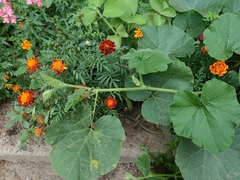 Cucurbita maximae2
- Outcome
- accessionse1
- Value
- 3e2
Organisms pictured · Representative pictures of the matched species, not figures from the paper.

Verbatim
e1“All the 60 accessions”
e2“Cucurbita maxima (3)”
Claim · model-written summary
Among the 60 collected accessions, 2 were Lagenaria siceraria.
- Taxon
- Lagenaria siceraria
 Lagenaria sicerariae2
- Outcome
- accessionse1
- Value
- 2e2
Organisms pictured · Representative pictures of the matched species, not figures from the paper.

Verbatim
e1“All the 60 accessions”
e2“Lagenaria siceraria (2)”
Claim · model-written summary
Among the 60 collected accessions, 2 were Lagenaria sphaerica.
- Taxon
- Lagenaria sphaerica
 Lagenaria sphaericae2
- Outcome
- accessionse1
- Value
- 2e2
Organisms pictured · Representative pictures of the matched species, not figures from the paper.

Verbatim
e1“All the 60 accessions”
e2“Lagenaria sphaerica (2)”
Claim · model-written summary
Among the 60 collected accessions, 4 were Cucumeropsis mannii.
- Taxon
- Cucumeropsis mannii
 Melothria sphaerocarpae2
- Outcome
- accessionse1
- Value
- 4e2
Organisms pictured · Representative pictures of the matched species, not figures from the paper.

Verbatim
e1“All the 60 accessions”
e2“Cucumeropsis mannii (4)”
Claim · model-written summary
Among the 60 collected accessions, 1 were Cucumis melo.
- Taxon
- Cucumis meloCucumis meloe2
- Outcome
- accessionse1
- Value
- 1e2
Organisms pictured · Representative pictures of the matched species, not figures from the paper.
Verbatim
e1“All the 60 accessions”
e2“Cucumis melo (1)”
Claim · model-written summary
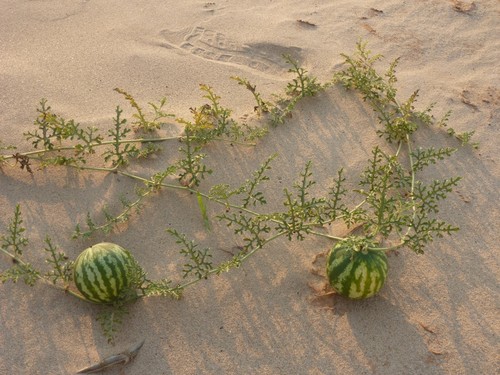
Niger state had the highest number of egusi melon (Colocynthis citrullus) accessions, 8.
- Taxon
- Egusi melon
 Citrullus mucosospermuse1
- Outcome
- highest numbere1
- Value
- 8e1
- Setting
- Niger statee1
Organisms pictured · Representative pictures of the matched species, not figures from the paper.
Verbatim
e1“Niger state had highest number (8) of Egusi melon (Colocynthis citrullus) while Nasarawa and Kogi had same number (5) each”
Claim · model-written summary
Nasarawa and Kogi states each had the same number of egusi melon accessions, 5.
- Taxon
- Egusi melonCitrullus mucosospermuse1
- Outcome
- same numbere1
- Value
- 5e1
- Setting
- Nasarawa and Kogie1
Organisms pictured · Representative pictures of the matched species, not figures from the paper.
Verbatim
e1“Niger state had highest number (8) of Egusi melon (Colocynthis citrullus) while Nasarawa and Kogi had same number (5) each”
Claim · model-written summary
All interviewed farmers preferred cultivating Colocynthis citrullus because of its high oil content, demand and consumer acceptance.
Verbatim
e1“All the farmers interviewed preferred cultivation of Colocynthis citrullus due its high oil content, demand and more acceptance by consumers”
Claim · model-written summary
The authors suggest the high number of egusi melon accessions encountered might be because it is the most cultivated member of Cucurbitaceae in the country.
- Taxon
- egusi melonCitrullus mucosospermuse1
- Outcome
- high number of egusi melon encounterede1
- Qualifier
- most cultivated member of Cucurbitaceaee1
Organisms pictured · Representative pictures of the matched species, not figures from the paper.
Verbatim
e1“The high number of egusi melon encountered might be due to fact that it is the most cultivated member of Cucurbitaceae in the country”