Abstract
The fungal genus Cochliobolus describes necrotrophic pathogens that give rise to significant losses on rice, wheat, and maize. Revealing plant mechanisms of non-host resistance (NHR) against Cochliobolus will help to uncover strategies that can be exploited in engineered cereals. Therefore, we developed a heterogeneous pathosystem and studied the ability of Cochliobolus to infect dicotyledons. We report here that C. miyabeanus and C. heterostrophus infect Arabidopsis accessions and produce functional conidia, thereby demonstrating the ability to accept Brassica spp. as host plants. Some ecotypes exhibited a high susceptibility, whereas others hindered the necrotrophic disease progression of the Cochliobolus strains. Natural variation in NHR among the tested Arabidopsis accessions can advance the identification of genetic loci that prime the plant's defence repertoire. We found that applied phytotoxin-containing conidial fluid extracts of C. miyabeanus caused necrotic lesions on rice leaves but provoked only minor irritations on Arabidopsis. This result implies that C. miyabeanus phytotoxins are insufficiently adapted to promote dicot colonization, which corresponds to a retarded infection progression. Previous studies on rice demonstrated that ethylene (ET) promotes C. miyabeanus infection, whereas salicylic acid (SA) and jasmonic acid (JA) exert a minor function. However, in Arabidopsis, we revealed that the genetic disruption of the ET and JA signalling pathways compromises basal resistance against Cochliobolus, whereas SA biosynthesis mutants showed a reduced susceptibility. Our results refer to the synergistic action of ET/JA and indicate distinct defence systems between Arabidopsis and rice to confine Cochliobolus propagation. Moreover, this heterogeneous pathosystem may help to reveal mechanisms of NHR and associated defensive genes against Cochliobolus infection.
Abstract from the paper’s OpenAlex record, shown for indexing and research. Copyright remains with the authors or the publisher. Read at the source ↗
The text the model read, with the source record’s inline markup (italics, sub- and superscripts) rendered and its character entities decoded; quote offsets refer to the raw text.
Claims 8
Claim · model-written summary
C. miyabeanus infected Arabidopsis accessions and produced functional conidia.
- Taxon
- Arabidopsis
 Arabidopsise0
- Interactor
- C. miyabeanus
 Bipolaris oryzaee0pathogen
- Outcome
- infect Arabidopsis accessions and produce functional conidiae0
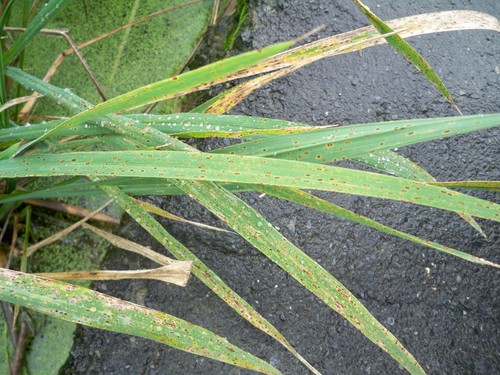
Organisms pictured · Representative pictures of the matched species, not figures from the paper.

Verbatim
e0“C. miyabeanus and C. heterostrophus infect Arabidopsis accessions and produce functional conidia”
Claim · model-written summary
C. heterostrophus infected Arabidopsis accessions and produced functional conidia.
- Taxon
- ArabidopsisArabidopsise0
- Interactor
- C. heterostrophus
 Bipolaris maydise0pathogen
- Outcome
- infect Arabidopsis accessions and produce functional conidiae0
Organisms pictured · Representative pictures of the matched species, not figures from the paper.

Verbatim
e0“C. miyabeanus and C. heterostrophus infect Arabidopsis accessions and produce functional conidia”
Claim · model-written summary
Arabidopsis ecotypes differed in susceptibility to Cochliobolus.
- Outcome
- high susceptibilitye0
Not reportedTaxon
Organisms pictured · Representative pictures of the matched species, not figures from the paper.
Verbatim
e0“Some ecotypes exhibited a high susceptibility, whereas others hindered the necrotrophic disease progression of the Cochliobolus strains.”
Claim · model-written summary
C. miyabeanus conidial extracts caused necrotic lesions on rice leaves.
- Taxon
- rice
 Oryza sativae0
- Organ / stage
- leavese0
- Treatment
- applied phytotoxin-containing conidial fluid extracts of C. miyabeanuse0
- Interactor
- C. miyabeanusBipolaris oryzaee0pathogen
- Outcome
- necrotic lesionse0
Not reportedComparatorDirection
Organisms pictured · Representative pictures of the matched species, not figures from the paper.

Verbatim
e0“applied phytotoxin-containing conidial fluid extracts of C. miyabeanus caused necrotic lesions on rice leaves”
Claim · model-written summary
The same extracts provoked only minor irritation on Arabidopsis.
- Taxon
- ArabidopsisArabidopsise0
- Outcome
- minor irritationse0
Not reportedTreatmentComparatorDirection
Organisms pictured · Representative pictures of the matched species, not figures from the paper.
Verbatim
e0“but provoked only minor irritations on Arabidopsis.”
Claim · model-written summary
Disruption of ethylene signaling compromised Arabidopsis resistance to Cochliobolus.
- Taxon
- ArabidopsisArabidopsise0
- Treatment
- genetic disruption of the ETe0
- Outcome
- basal resistance against Cochlioboluse0
- Direction
- compromisese0
Not reportedComparator
Organisms pictured · Representative pictures of the matched species, not figures from the paper.
Verbatim
e0“in Arabidopsis, we revealed that the genetic disruption of the ET and JA signalling pathways compromises basal resistance against Cochliobolus”
Claim · model-written summary
Disruption of jasmonic acid signaling compromised Arabidopsis resistance to Cochliobolus.
- Taxon
- ArabidopsisArabidopsise0
- Treatment
- JA signalling pathwayse0
- Outcome
- basal resistance against Cochlioboluse0
- Direction
- compromisese0
Not reportedComparator
Organisms pictured · Representative pictures of the matched species, not figures from the paper.
Verbatim
e0“in Arabidopsis, we revealed that the genetic disruption of the ET and JA signalling pathways compromises basal resistance against Cochliobolus”
Claim · model-written summary
Salicylic acid biosynthesis mutants had reduced susceptibility to Cochliobolus.
Not reportedTaxon
Verbatim
e0“SA biosynthesis mutants showed a reduced susceptibility.”
The same questions in other papers
Bipolaris oryzae · disease · Oryza sativa (rice)Results agree
2 papers in the same direction as this paper
- negative
- negative
pathogen product · disease · Oryza sativa (rice)Positive and negative results
7 papers in the same direction as this paper · 15 in the opposite direction
- positive
- positive
- positive
19 papers more in this group
See all 23 papers →botanical · disease · Oryza sativa (rice)Positive and negative results
7 papers in the same direction as this paper · 74 in the opposite direction
- positive
- positive
- positive
78 papers more in this group
See all 82 papers →Claims are grouped by organism, treatment and what was measured or targeted. A paper counts as positive when any of its claims in the group is positive.