Abstract
Melon (Cucumis melo L.) is a member of the Cucurbitaceae family, an important economical and horticultural crop, which is widely grown in China. In May 2020, fruit rot disease with water-soaked lesions and pink molds on cantaloupe melons was observed in several greenhouses with 50% disease incidence in Ningbo, Zhejiang Province in China. In order to know the causal agent, diseased fruits were cut into pieces, surface sterilized for 1 min with 1% sodium hypochlorite (NaClO), 2 min with 75% ethyl alcohol, rinsed in sterile distilled water three times (Zhou et al. 2018), and then placed on potato dextrose agar (PDA) medium amended with streptomycin sulfate (100 μg/ml) plates at 25°C for 4 days. The growing hyphae were transferred to new PDA plates using the hyphal tip method, putative Fusarium colonies were purified by single-sporing. Twenty-five fungal isolates were obtained and formed red colonies with white aerial mycelia at 25°C for 7 days, which were identified as Fusarium isolates based on the morphological characteristics and microscopic examination. The average radial mycelial growth rate of Fusarium isolate Fa-25 was 11.44 mm/day at 25°C in the dark on PDA. Macroconidia were stout with curved apical and basal cells, usually with 4 to 6 septa, and 29.5 to 44.2 × 3.7 to 5.2 μm on Spezieller Nährstoffarmer agar (SNA) medium at 25°C for 10 days (Leslie and Summerell 2006). To identify the species, the internal transcribed spacer (ITS) region and translational elongation factor 1-alpha (TEF1-α) gene of the isolates were amplified and cloned. ITS and TEF1-α was amplified using primers ITS1/ITS4 and EF1/EF2 (O'Donnell et al. 1998), respectively. Sequences of ITS (545 bp, GenBank Accession No. MT811812) and TEF1-α (707 bp, GenBank Acc. No. MT856659) for isolate Fa-25 were 100% and 99.72% identical to those of F. asiaticum strains MSBL-4 (ITS, GenBank Acc. MT322117.1) and Daya350-3 (TEF1-α, GenBank Acc. KT380124.1) in GenBank, respectively. A phylogenetic tree was established based on the TEF1-α sequences of Fa-25 and other Fusarium spp., and Fa-25 was clustered with F. asiaticum. Thus, both morphological and molecular characterizations supported the isolate as F. asiaticum. To confirm the pathogenicity, mycelium agar plugs (6 mm in diameter) removed from the colony margin of a 2-day-old culture of strain Fa-25 were used to inoculate melon fruits. Before inoculation, healthy melon fruits were selected, soaked in 2% NaClO solution for 2 min, and washed in sterile water. After wounding the melon fruits with a sterile needle, the fruits were inoculated by placing mycelium agar plugs on the wounds, and mock inoculation with mycelium-free PDA plugs was used as control. Five fruits were used in each treatment. The inoculated and mock-inoculated fruits were incubated at 25°C with high relative humidity. Symptoms were observed on all inoculated melon fruits 10 days post inoculation, which were similar to those naturally infected fruits, whereas the mock-inoculated fruits remained symptomless. The fungus re-isolated from the diseased fruits resembled colony morphology of the original isolate. The experiment was conducted three times and produced the same results. To our knowledge, this is the first report of fruit rot of melon caused by F. asiaticum in China.
Abstract from the paper’s OpenAlex record, shown for indexing and research. Copyright remains with the authors or the publisher. Read at the source ↗
The text the model read, with the source record’s inline markup (italics, sub- and superscripts) rendered and its character entities decoded; quote offsets refer to the raw text.
Claims 7
Claim · model-written summary
Fruit rot affected 50% of cantaloupe melons in Ningbo greenhouses.
- Taxon
- Melon
 Cucumis melot0
- Organ / stage
- cantaloupe melonse0
- Outcome
- fruit rot diseasee0
- Value
- 50%e0
- Setting
- Ningbo, Zhejiang Province in Chinae0
Not reportedDirection
Organisms pictured · Representative pictures of the matched species, not figures from the paper.

Verbatim
e0“fruit rot disease with water-soaked lesions and pink molds on cantaloupe melons was observed in several greenhouses with 50% disease incidence in Ningbo, Zhejiang Province in China”
t0“Melon”
Claim · model-written summary
Twenty-five fungal isolates from diseased melon fruits formed red colonies with white mycelia.
- Taxon
- MelonCucumis melot0
- Outcome
- fungal isolatese0
- Value
- Twenty-fivee0
 Fusarium
Not reportedDirection
Organisms pictured · Representative pictures of the matched species, not figures from the paper.

Verbatim
e0“Twenty-five fungal isolates were obtained and formed red colonies with white aerial mycelia”
t0“Melon”
e1“The average radial mycelial growth rate of Fusarium isolate Fa-25 was 11.44 mm/day at 25°C in the dark on PDA”
Claim · model-written summary
Fusarium isolate Fa-25 grew at 11.44 mm/day on PDA.
- Taxon
- MelonCucumis melot0
- Outcome
- radial mycelial growth rate of Fusarium isolate Fa-25e0
- Value
- 11.44 mm/daye0
Not reportedDirection
Organisms pictured · Representative pictures of the matched species, not figures from the paper.
Verbatim
e0“The average radial mycelial growth rate of Fusarium isolate Fa-25 was 11.44 mm/day at 25°C in the dark on PDA”
t0“Melon”
Claim · model-written summary
Isolate Fa-25 clustered with F. asiaticum.
- Taxon
- MelonCucumis melot0
- Interactor
- F. asiaticum
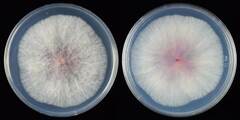 Fusarium asiaticume0pathogen
- Outcome
- Fa-25 was clustered with F. asiaticume0
Not reportedDirection
Organisms pictured · Representative pictures of the matched species, not figures from the paper.
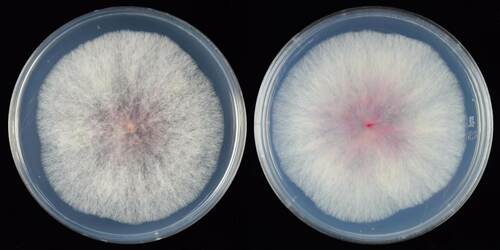
Verbatim
e0“Fa-25 was clustered with F. asiaticum”
t0“Melon”
Claim · model-written summary
All inoculated melon fruits developed symptoms, whereas mock inoculated fruits remained symptomless.
- Taxon
- MelonCucumis melot0
- Organ / stage
- melon fruitse0
- Treatment
- inoculatede0
- Outcome
- Symptomse0
- Comparator
- mock-inoculated fruitse0
Not reportedDirection
Organisms pictured · Representative pictures of the matched species, not figures from the paper.
Verbatim
e0“Symptoms were observed on all inoculated melon fruits 10 days post inoculation, which were similar to those naturally infected fruits, whereas the mock-inoculated fruits remained symptomless”
t0“Melon”
Claim · model-written summary
The fungus was re-isolated from diseased melon fruits.
- Taxon
- MelonCucumis melot0
- Outcome
- fungus re-isolated from the diseased fruitse0
Not reportedDirection
Organisms pictured · Representative pictures of the matched species, not figures from the paper.
Verbatim
e0“The fungus re-isolated from the diseased fruits resembled colony morphology of the original isolate”
t0“Melon”
Claim · model-written summary
This is the first report of melon fruit rot caused by F. asiaticum in China.
- Taxon
- MelonCucumis melot0
- Interactor
- F. asiaticumFusarium asiaticume0pathogen
- Outcome
- fruit rot of melon caused by F. asiaticume0
- Setting
- Chinae0
Not reportedDirection
Organisms pictured · Representative pictures of the matched species, not figures from the paper.
Verbatim
e0“this is the first report of fruit rot of melon caused by F. asiaticum in China”
t0“Melon”
The same questions in other papers
inoculation · disease · Cucumis melo (muskmelon)Positive and negative results
26 papers in the same direction as this paper · 13 in the opposite direction
- negative
- positive
- positive
36 papers more in this group
See all 40 papers →Claims are grouped by organism, treatment and what was measured or targeted. A paper counts as positive when any of its claims in the group is positive.