Abstract
Grain legumes of the Vigna genus are important crops in Asia, although their origins and history of domestication and cultivation are less known than that of rice and millet. Azuki (V. angularis var. angularis) is widely cultivated and consumed across East Asia, especially in China, Korea and Japan, which are considered independent centres of azuki domestication. This study presents the first directly dated archaeobotanical record of V. angularis from Taiwan recovered from prehistoric cultural layers at the Sanbaopi 5 archaeological site (23°07′03″N, 120°15′32″E, 3 m above sea level) located in the Tainan Science Park, south-western Taiwan. The archaeological dataset is compared with charred modern reference material and records from other prehistoric sites in East Asia and then discussed in context of cultivation and domestication. The obtained results suggest that V. angularis was used in the study area between the first half of the 1st millennium BCE (Wushantou phase) and 6th century CE (Niaosong phase) and that it was an important part of the diet of local populations. The younger specimens appear on average larger than the older ones. It is possibly that during this period the pulse underwent selection for size increase so that at least the specimens dating to the 6th century CE may be addressed as azuki (V. angularis var. angularis), the domesticated form of V. angularis var. nipponensis. This indicates that prehistoric Taiwan may have been an independent centre of azuki cultivation/domestication in addition to the previously suggested regions. However, compared to evidence for azuki domestication in Japan, Korea and China, which dates to between ca. 4000 and 1000 BCE, the larger pulses from Taiwan appear quite late (about 4500–1500 years later). An alternative scenario to regional domestication is that azuki was introduced to the island by immigrating farmers or through exchange across the Taiwan Strait.
Abstract from the paper’s OpenAlex record; open copy licensed cc-by-nc-nd. Read at the source ↗
The text the model read, with the source record’s inline markup (italics, sub- and superscripts) rendered and its character entities decoded; quote offsets refer to the raw text.
Claims 9
Claim · model-written summary
The study presents the first directly dated archaeobotanical record of V. angularis from Taiwan.
- Taxon
- V. angularis
 Vigna angularise0
- Outcome
- first directly dated archaeobotanical recorde0
- Setting
- Taiwane0
Organisms pictured · Representative pictures of the matched species, not figures from the paper.

Verbatim
e0“the first directly dated archaeobotanical record of V. angularis from Taiwan recovered from prehistoric cultural layers at the Sanbaopi 5 archaeological site”
Claim · model-written summary
Results suggest V. angularis was used locally from the first half of the first millennium BCE to the sixth century CE.
- Taxon
- V. angularisVigna angularise0
- Outcome
- used in the study areae0
- Qualifier
- between the first half of the 1st millennium BCE (Wushantou phase) and 6th century CE (Niaosong phase)e0
Organisms pictured · Representative pictures of the matched species, not figures from the paper.
Verbatim
e0“V. angularis was used in the study area between the first half of the 1st millennium BCE (Wushantou phase) and 6th century CE (Niaosong phase)”
Claim · model-written summary
The authors infer that V. angularis was an important part of the local diet.
- Taxon
- V. angularisVigna angularise0
- Outcome
- important part of the diet of local populationse0
Organisms pictured · Representative pictures of the matched species, not figures from the paper.
Verbatim
e0“V. angularis was used in the study area between the first half of the 1st millennium BCE (Wushantou phase) and 6th century CE (Niaosong phase) and that it was an important part of the diet of local populations.”
Claim · model-written summary
Younger V. angularis specimens were larger on average than older ones.
- Taxon
- V. angularisVigna angularise1
- Outcome
- younger specimense0
- Direction
- largere0
- Comparator
- older onese0
Organisms pictured · Representative pictures of the matched species, not figures from the paper.
Verbatim
e0“The younger specimens appear on average larger than the older ones.”
e1“V. angularis from Taiwan”
Claim · model-written summary
The authors suggest that the pulse may have undergone selection for increased size.
- Taxon
- V. angularisVigna angularise1
- Organ / stage
- pulsee0
- Outcome
- size increasee0
- Direction
- increasee0
- Qualifier
- selectione0
Organisms pictured · Representative pictures of the matched species, not figures from the paper.
Verbatim
e0“during this period the pulse underwent selection for size increase”
e1“V. angularis from Taiwan”
Claim · model-written summary
The authors suggest that at least the sixth-century specimens may be classified as domesticated azuki.
- Taxon
- V. angularis var. angularis
 Vigna angularis var. angularise0
- Outcome
- may be addressed as azukie0
- Qualifier
- specimens dating to the 6th century CEe0
Organisms pictured · Representative pictures of the matched species, not figures from the paper.
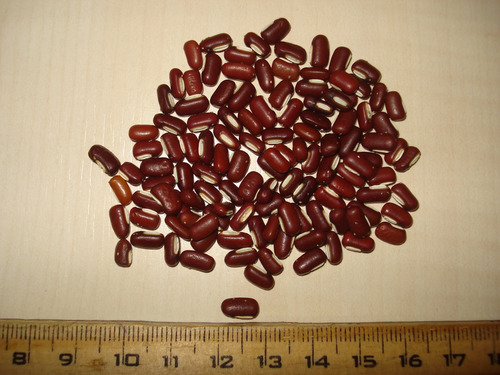
Verbatim
e0“at least the specimens dating to the 6th century CE may be addressed as azuki (V. angularis var. angularis), the domesticated form of V. angularis var. nipponensis”
Claim · model-written summary
Prehistoric Taiwan may have been an independent center of azuki cultivation or domestication.
Verbatim
e0“prehistoric Taiwan may have been an independent centre of azuki cultivation/domestication”
e1“Azuki (V. angularis var. angularis)”
Claim · model-written summary
The larger pulses from Taiwan appeared 4500–1500 years later than comparative domestication evidence from Japan, Korea and China.
Verbatim
e0“the larger pulses from Taiwan appear quite late (about 4500–1500 years later)”
e1“evidence for azuki domestication in Japan, Korea and China”
e2“Azuki (V. angularis var. angularis)”
Claim · model-written summary
The authors offer introduction by immigrating farmers or exchange across the Taiwan Strait as an alternative explanation for azuki on Taiwan.
Verbatim
e0“azuki was introduced to the island by immigrating farmers or through exchange across the Taiwan Strait”