Abstract
The tomato red spider mite, Tetranychus evansi Baker and Pritchard, has emerged as a destructive invasive pest of solanaceous crops worldwide. It was first recorded in Syria in 2011, in Latakia governorate, in the coastal region. Successful management of T. evansi in a given region benefits from information about its distribution, host plants, and associated natural enemies. Therefore, we investigated, in 2019 and 2020, the status of T. evansi on solanaceous plants in the Syrian coastal region, an important producer of solanaceous crops. A total of 237 samples were collected at 187 sites in Latakia and Tartus governorates. Tetranychus evansi was found in 34 cultivated and wild solanaceous plant samples collected at 29 sites distributed across all districts in those governorates, and in a variety of landscapes and elevations, ranging from the coastal plains to high altitudes in the Syrian Coastal Mountain Range. It was collected from three solanaceous crops, namely tomato (Solanum lycopersicum L.), eggplant (Solanum melongena L.) and potato (Solanum tuberosum L.), as well as from two wild solanaceous plants: black nightshade (Solanum nigrum L.) and red nightshade (Solanum villosum Mill.). A total of 14 species of predatory insects and mites, and five species of phytophagous mites, were identified in association with T. evansi. Predatory insects were more frequent and abundant than predatory mites. The insect predator Feltiella acarisuga (Vallot) was the most common and abundant species among the predators, followed by Stethorus gilvifrons (Mulsant) and Scolothrips longicornis Priesner. The predatory mite Phytoseiulus persimilis Athias-Henriot was the most frequent and abundant species of associated predatory mites.
Abstract from the paper’s OpenAlex record; open copy licensed cc-by. Read at the source ↗
The text the model read, with the source record’s inline markup (italics, sub- and superscripts) rendered and its character entities decoded; quote offsets refer to the raw text.
Claims 7
Claim · model-written summary
Tetranychus evansi was found in 34 cultivated and wild solanaceous plant samples collected at 29 sites across all districts of Latakia and Tartus governorates.
- Taxon
- solanaceous plante0
- Interactor
- Tetranychus evansi
 Tetranychus evansie0pest
- Outcome
- found in 34 cultivated and wild solanaceous plant samplese0
- Value
- 34e0
- Qualifier
- collected at 29 sitese0
Organisms pictured · Representative pictures of the matched species, not figures from the paper.

Verbatim
e0“Tetranychus evansi was found in 34 cultivated and wild solanaceous plant samples collected at 29 sites distributed across all districts in those governorates”
Claim · model-written summary
T. evansi was collected from three solanaceous crops (tomato, eggplant, potato) and two wild solanaceous plants (black nightshade, red nightshade).
- Taxon
- solanaceous cropse0
- Interactor
- Tetranychus evansiTetranychus evansie1pest
- Outcome
- collectede0
Organisms pictured · Representative pictures of the matched species, not figures from the paper.
Verbatim
e0“It was collected from three solanaceous crops, namely tomato (Solanum lycopersicum L.), eggplant (Solanum melongena L.) and potato (Solanum tuberosum L.), as well as from two wild solanaceous plants: black nightshade (Solanum nigrum L.) and red nightshade (Solanum villosum Mill.)”
e1“Tetranychus evansi was found”
Claim · model-written summary
Fourteen species of predatory insects and mites were identified in association with T. evansi.
- Taxon
- T. evansiTetranychus evansie0
- Interactor
- predatory insects and mitese0biocontrol_agent
- Outcome
- 14 species of predatory insects and mitese0
Organisms pictured · Representative pictures of the matched species, not figures from the paper.
Verbatim
e0“A total of 14 species of predatory insects and mites, and five species of phytophagous mites, were identified in association with T. evansi”
Claim · model-written summary
Five species of phytophagous mites were identified in association with T. evansi.
- Taxon
- T. evansiTetranychus evansie0
- Interactor
- phytophagous mitese0pest
- Outcome
- five species of phytophagous mitese0
Organisms pictured · Representative pictures of the matched species, not figures from the paper.
Verbatim
e0“A total of 14 species of predatory insects and mites, and five species of phytophagous mites, were identified in association with T. evansi”
Claim · model-written summary
Predatory insects were more frequent and abundant than predatory mites among species associated with T. evansi.
Verbatim
e0“Predatory insects were more frequent and abundant than predatory mites”
Claim · model-written summary
Feltiella acarisuga was the most common and abundant predator, followed by Stethorus gilvifrons and Scolothrips longicornis.
- Taxon
- Feltiella acarisuga
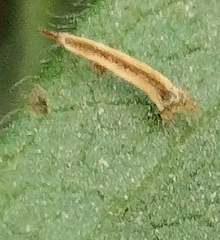 Feltiella acarisugae0
- Interactor
- Feltiella acarisugaFeltiella acarisugae0biocontrol_agent
- Outcome
- most common and abundant species among the predatorse0
Organisms pictured · Representative pictures of the matched species, not figures from the paper.
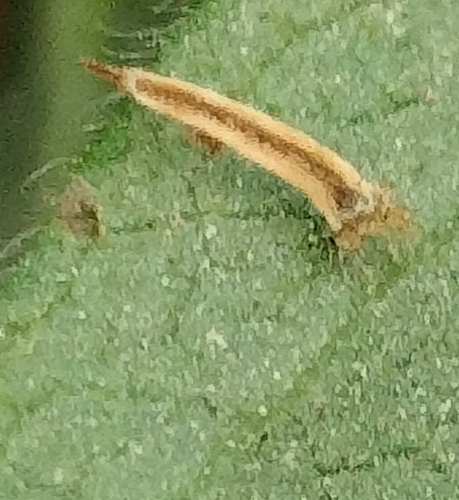
Verbatim
e0“The insect predator Feltiella acarisuga (Vallot) was the most common and abundant species among the predators, followed by Stethorus gilvifrons (Mulsant) and Scolothrips longicornis Priesner”
Claim · model-written summary
Phytoseiulus persimilis was the most frequent and abundant of the associated predatory mites.
- Taxon
- Phytoseiulus persimilis
 Phytoseiulus persimilise0
- Interactor
- Phytoseiulus persimilisPhytoseiulus persimilise0biocontrol_agent
- Outcome
- most frequent and abundant species of associated predatory mitese0
Organisms pictured · Representative pictures of the matched species, not figures from the paper.

Verbatim
e0“The predatory mite Phytoseiulus persimilis Athias-Henriot was the most frequent and abundant species of associated predatory mites”