Abstract
PREMISE: The true blueberries (Vaccinium sect. Cyanococcus; Ericaceae), endemic to North America, have been intensively studied for over a century. However, with species estimates ranging from nine to 24 and much confusion regarding species boundaries, this ecologically and economically valuable group remains inadequately understood at a basic evolutionary and taxonomic level. As a first step toward understanding the evolutionary history and taxonomy of this species complex, we present the first phylogenomic hypothesis of the known diploid blueberries. METHODS: We used flow cytometry to verify the ploidy of putative diploid taxa and a target-enrichment approach to obtain a genomic data set for phylogenetic analyses. RESULTS: Despite evidence of gene flow, we found that a primary phylogenetic signal is present. Monophyly for all morphospecies was recovered, with two notable exceptions: one sample of V. boreale was consistently nested in the V. myrtilloides clade and V. caesariense was nested in the V. fuscatum clade. One diploid taxon, Vaccinium pallidum, is implicated as having a homoploid hybrid origin. CONCLUSIONS: This foundational study represents the first attempt to elucidate evolutionary relationships of the true blueberries of North America with a phylogenomic approach and sets the stage for multiple avenues of future study such as a taxonomic revision of the group, the verification of a homoploid hybrid taxon, and the study of polyploid lineages within the context of a diploid phylogeny.
Abstract from the paper’s OpenAlex record; open copy licensed cc-by. Read at the source ↗
The text the model read, with the source record’s inline markup (italics, sub- and superscripts) rendered and its character entities decoded; quote offsets refer to the raw text.
Claims 5
Claim · model-written summary
A primary phylogenetic signal remained despite gene flow.
Verbatim
e0“Despite evidence of gene flow, we found that a primary phylogenetic signal is present”
t0“blueberries”
Claim · model-written summary
Most morphospecies were monophyletic.
Verbatim
e0“Monophyly for all morphospecies was recovered, with two notable exceptions”
t0“blueberries”
Claim · model-written summary
One V. boreale sample nested within V. myrtilloides.
- Taxon
- V. boreale
 Vaccinium borealee0
- Outcome
- nested in the V. myrtilloides cladee0
Organisms pictured · Representative pictures of the matched species, not figures from the paper.
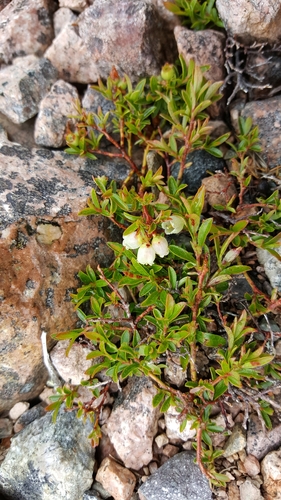
Verbatim
e0“one sample of V. boreale was consistently nested in the V. myrtilloides clade”
Claim · model-written summary
V. caesariense nested within V. fuscatum.
- Taxon
- V. caesariense
 Vaccinium caesariensee0
- Outcome
- nested in the V. fuscatum cladee0
Organisms pictured · Representative pictures of the matched species, not figures from the paper.

Verbatim
e0“V. caesariense was nested in the V. fuscatum clade”
Claim · model-written summary
Vaccinium pallidum was implicated as a homoploid hybrid.
- Taxon
- Vaccinium pallidum
 Vaccinium pallidume0
- Outcome
- homoploid hybrid origine0
Organisms pictured · Representative pictures of the matched species, not figures from the paper.

Verbatim
e0“Vaccinium pallidum, is implicated as having a homoploid hybrid origin”