Abstract
Maximum Likelihood (ML) and Bayesian analyses (BI) applied for combined plastid matrix (cpDNA trnL(UAA) intron, trnL–trnF IGS, and rpl32–trnL(UAG) IGS regions) of 124 accessions of 36 species of the genus Atraphaxis have shown new species from southern Siberia. The analysis of 112 accessions of 36 species of nrDNA ITS1–5.8S–ITS2 regions showed less clear topology. A new species A. kuvaevii endemic for Yenisey Valley in Tuva was revealed with molecular and morphological data. The plants attributed previously to A. pungens split into three cryptic species with different plastid regions. A. pungens grows in the south of Krasnoyarskii Krai, Khakassia, Tuva and Mongolia. A. ledebourii is distributed in Altai Mts, Tuva and Mongolia. It combines a functional ITS ribotype and a psedogenized ribotype, what agrees with high chromosome numbers. The third pseudogenized ribotype shared with A. ariana was found in a single sample from SE Tuva. A. ×uyukensis is a species of hybrid origin from the Uyuk ridge with the ITS ribotype of A. pungens, which probably captured cpDNA of unknown species related to A. selengensis and A. davurica by maternal lineage. Despite the differences in plastid regions, these cryptic species have no clear morphoplogical distinctions. The hybrid A. pungens × A. ledebourii from Tuva and the hybrid A. ledebourii × A. pungens from Hangay Mts in Mongolia do not differ from the parents. The eastern race of A. frutescens s.l. sub A. decipiens from Tuva and Altai Republics differs from the western race of A. frutescens with a single nucleotide substitution in cpDNA trnL–trnF IGS, a distinct ITS ribotype, a short perianth tube equal to outer tepals, herbaceous tubular ochreolas and linear-lanceolate leaf blades. The hybrids A. pungens × A. decipiens and A. decipiens × A. pungens were detected in three locations in Tuva. Cryptic hybrids A. ledebourii × A. decipiens, A. ledebourii × A. frutescens, and A. decipiens × A. ledebourii were detected in Altai and Tuva Republics. Two hybrids A. decipiens × A. ledebourii have shown the capture of cpDNA of A. decipiens. Atraphaxis laetevirens is limited by the territory of Kazakhstan, Altai Republic and Dzungaria and does not grow in Tuva and Khakassia.
Abstract from the paper’s OpenAlex record, shown for indexing and research. Copyright remains with the authors or the publisher. Read at the source ↗
The text the model read, with the source record’s inline markup (italics, sub- and superscripts) rendered and its character entities decoded; quote offsets refer to the raw text.
Claims 16
Claim · model-written summary
Plastid analysis revealed new species from southern Siberia.
- Taxon
- Atraphaxis
 Atraphaxise0
- Outcome
- new speciese0
- Setting
- southern Siberiae0
Organisms pictured · Representative pictures of the matched species, not figures from the paper.

Verbatim
e0“Maximum Likelihood (ML) and Bayesian analyses (BI) applied for combined plastid matrix (cpDNA trnL(UAA) intron, trnL–trnF IGS, and rpl32–trnL(UAG) IGS regions) of 124 accessions of 36 species of the genus Atraphaxis have shown new species from southern Siberia.”
Claim · model-written summary
ITS analysis gave a less clear topology.
- Taxon
- AtraphaxisAtraphaxist0
- Outcome
- less clear topologye0
Not reportedComparator
Organisms pictured · Representative pictures of the matched species, not figures from the paper.
Verbatim
e0“The analysis of 112 accessions of 36 species of nrDNA ITS1–5.8S–ITS2 regions showed less clear topology.”
t0“Atraphaxis”
Claim · model-written summary
Molecular and morphological data revealed A. kuvaevii as endemic to Yenisey Valley.
- Taxon
- A. kuvaeviiAtraphaxis kuvaeviie0
- Outcome
- new speciese0
- Setting
- Yenisey Valley in Tuvae0
Verbatim
e0“A new species A. kuvaevii endemic for Yenisey Valley in Tuva was revealed with molecular and morphological data.”
Claim · model-written summary
Plants formerly assigned to A. pungens split into three cryptic species.
- Taxon
- A. pungensAtraphaxis pungense0
- Outcome
- three cryptic speciese0
Verbatim
e0“The plants attributed previously to A. pungens split into three cryptic species with different plastid regions.”
Claim · model-written summary
A. pungens occurs in southern Krasnoyarskii Krai, Khakassia, Tuva and Mongolia.
- Taxon
- A. pungensAtraphaxis pungense0
- Outcome
- growse0
- Setting
- the south of Krasnoyarskii Krai, Khakassia, Tuva and Mongoliae0
Verbatim
e0“A. pungens grows in the south of Krasnoyarskii Krai, Khakassia, Tuva and Mongolia.”
Claim · model-written summary
A. ledebourii occurs in Altai Mts, Tuva and Mongolia.
- Taxon
- A. ledebouriiAtraphaxis ledebouriie0
- Outcome
- distributede0
- Setting
- Altai Mts, Tuva and Mongoliae0
Verbatim
e0“A. ledebourii is distributed in Altai Mts, Tuva and Mongolia.”
Claim · model-written summary
A. ledebourii combines functional and pseudogenized ITS ribotypes.
- Taxon
- A. ledebouriiAtraphaxis ledebouriit0
- Outcome
- a functional ITS ribotype and a psedogenized ribotypee0
Verbatim
e0“It combines a functional ITS ribotype and a psedogenized ribotype, what agrees with high chromosome numbers.”
t0“A. ledebourii is distributed in Altai Mts, Tuva and Mongolia.”
Claim · model-written summary
A third pseudogenized ribotype shared with A. ariana was found in SE Tuva.
- Taxon
- A. arianaAtraphaxis arianae0
- Outcome
- third pseudogenized ribotypee0
- Setting
- SE Tuvae0
Verbatim
e0“The third pseudogenized ribotype shared with A. ariana was found in a single sample from SE Tuva.”
Claim · model-written summary
A. ×uyukensis is a hybrid species with the ITS ribotype of A. pungens.
Verbatim
e0“A. ×uyukensis is a species of hybrid origin from the Uyuk ridge with the ITS ribotype of A. pungens, which probably captured cpDNA of unknown species related to A. selengensis and A. davurica by maternal lineage.”
Claim · model-written summary
The cryptic species lack clear morphological distinctions despite plastid differences.
- Taxon
- AtraphaxisAtraphaxist0
- Outcome
- no clear morphoplogical distinctionse0
Organisms pictured · Representative pictures of the matched species, not figures from the paper.
Verbatim
e0“Despite the differences in plastid regions, these cryptic species have no clear morphoplogical distinctions.”
t0“Atraphaxis”
Claim · model-written summary
The two named reciprocal A. pungens and A. ledebourii hybrids do not differ from their parents.
- Taxon
- A. pungensAtraphaxis pungense0
- Outcome
- do not differ from the parentse0
Verbatim
e0“The hybrid A. pungens × A. ledebourii from Tuva and the hybrid A. ledebourii × A. pungens from Hangay Mts in Mongolia do not differ from the parents.”
Claim · model-written summary
The eastern A. frutescens race differs from the western race in plastid and ITS characters and morphology.
- Taxon
- A. frutescens
 Atraphaxis frutescense0
- Outcome
- differse0
- Setting
- Tuva and Altai Republicse0
Organisms pictured · Representative pictures of the matched species, not figures from the paper.

Verbatim
e0“The eastern race of A. frutescens s.l. sub A. decipiens from Tuva and Altai Republics differs from the western race of A. frutescens with a single nucleotide substitution in cpDNA trnL–trnF IGS, a distinct ITS ribotype, a short perianth tube equal to outer tepals, herbaceous tubular ochreolas and linear-lanceolate leaf blades.”
Claim · model-written summary
Reciprocal A. pungens and A. decipiens hybrids were found at three Tuva locations.
- Taxon
- A. pungensAtraphaxis pungense0
- Outcome
- hybridse0
- Value
- three locationse0
- Setting
- Tuvae0
Verbatim
e0“The hybrids A. pungens × A. decipiens and A. decipiens × A. pungens were detected in three locations in Tuva.”
Claim · model-written summary
Three combinations of cryptic hybrids involving A. ledebourii, A. decipiens and A. frutescens were found in Altai and Tuva.
- Taxon
- A. ledebouriiAtraphaxis ledebouriie0
- Outcome
- Cryptic hybridse0
- Setting
- Altai and Tuva Republicse0
Verbatim
e0“Cryptic hybrids A. ledebourii × A. decipiens, A. ledebourii × A. frutescens, and A. decipiens × A. ledebourii were detected in Altai and Tuva Republics.”
Claim · model-written summary
Two A. decipiens × A. ledebourii hybrids captured A. decipiens cpDNA.
- Taxon
- A. decipiens
 Atraphaxis decipiense0
- Outcome
- capture of cpDNAe0
- Value
- Two hybridse0
Organisms pictured · Representative pictures of the matched species, not figures from the paper.
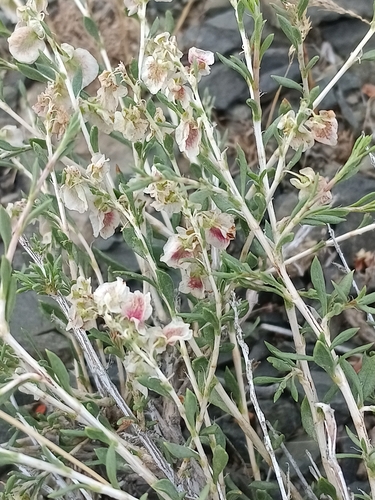
Verbatim
e0“Two hybrids A. decipiens × A. ledebourii have shown the capture of cpDNA of A. decipiens.”
Claim · model-written summary
A. laetevirens is limited to Kazakhstan, Altai Republic and Dzungaria and absent from Tuva and Khakassia.
- Taxon
- Atraphaxis laetevirensAtraphaxis laetevirense0
- Outcome
- is limitede0
- Setting
- Kazakhstan, Altai Republic and Dzungariae0
Verbatim
e0“Atraphaxis laetevirens is limited by the territory of Kazakhstan, Altai Republic and Dzungaria and does not grow in Tuva and Khakassia.”