Abstract
The first insect-targeted study of the European mistletoe, Viscum album L., was conducted in Ukraine. In total, 35 species of insects reared from mistletoe were identified to belong to 5 orders, 20 families and 34 genera. Twenty-seven identified species were reared from mistletoe for the first time, including 17 species of Hymenoptera, 8 species of Coleoptera and 2 species of Diptera. Our results revealed significant gaps in knowledge about insects associated with mistletoe. This is appeared in the fact that more than 77 % of the insects we reared have never been detected on mistletoe before. It is obviously that 70 % to 90 % of the insects associated with mistletoe remain unknown. We also found a highly probable tripartite link between the European mistletoe, parasitic fungus Sphaeropsis visci and the saproxylic and mycetophagous Coleoptera. The in[1]teraction of Coleoptera with S. visci is facultatively mutualistic, and beetles act as vectors to spread spores and mycelium among mistletoes. In addition, we found the mass breading of invasive species Leiopus femoratus on V. album. Hence, V. album might play a crucial role in the mass and rapid invasion of L. femoratus in Europe.
Abstract from the paper’s OpenAlex record; open copy licensed cc-by-nc-nd. Read at the source ↗
The text the model read, with the source record’s inline markup (italics, sub- and superscripts) rendered and its character entities decoded; quote offsets refer to the raw text.
Claims 11
Claim · model-written summary
Thirty-five insect species from five orders, 20 families and 34 genera were reared from mistletoe.
- Taxon
- Viscum album
 Viscum albumt0
- Outcome
- species of insects reared from mistletoee0
- Value
- 35 speciese0
- Setting
- Ukrainet0
Organisms pictured · Representative pictures of the matched species, not figures from the paper.

Verbatim
e0“In total, 35 species of insects reared from mistletoe were identified to belong to 5 orders, 20 families and 34 genera.”
t0“Viscum album) in Western Ukraine”
Claim · model-written summary
Twenty-seven insect species were recorded from mistletoe for the first time.
- Taxon
- Viscum albumViscum albumt0
- Outcome
- identified species were reared from mistletoe for the first timee0
- Value
- Twenty-sevene0
Organisms pictured · Representative pictures of the matched species, not figures from the paper.
Verbatim
e0“Twenty-seven identified species were reared from mistletoe for the first time, including 17 species of Hymenoptera, 8 species of Coleoptera and 2 species of Diptera.”
t0“Viscum album”
Claim · model-written summary
Seventeen Hymenoptera species were first reared from mistletoe.
- Taxon
- Viscum albumViscum albumt0
- Outcome
- species of Hymenopterae0
- Value
- 17 speciese0
Organisms pictured · Representative pictures of the matched species, not figures from the paper.
Verbatim
e0“including 17 species of Hymenoptera, 8 species of Coleoptera and 2 species of Diptera”
t0“Viscum album”
Claim · model-written summary
Eight Coleoptera species were first reared from mistletoe.
- Taxon
- Viscum albumViscum albumt0
- Outcome
- species of Coleopterae0
- Value
- 8 speciese0
Organisms pictured · Representative pictures of the matched species, not figures from the paper.
Verbatim
e0“8 species of Coleoptera and 2 species of Diptera”
t0“Viscum album”
Claim · model-written summary
Two Diptera species were first reared from mistletoe.
- Taxon
- Viscum albumViscum albumt0
- Outcome
- species of Dipterae0
- Value
- 2 speciese0
Organisms pictured · Representative pictures of the matched species, not figures from the paper.
Verbatim
e0“2 species of Diptera”
t0“Viscum album”
Claim · model-written summary
More than 77% of insects reared had not previously been detected on mistletoe.
- Taxon
- Viscum albumViscum albumt0
- Outcome
- insects we reared have never been detected on mistletoe beforee0
- Value
- 77 %e0
Organisms pictured · Representative pictures of the matched species, not figures from the paper.
Verbatim
e0“more than 77 % of the insects we reared have never been detected on mistletoe before”
t0“Viscum album”
Claim · model-written summary
The authors estimated that 70% to 90% of mistletoe-associated insects remain unknown.
- Taxon
- Viscum albumViscum albumt0
- Outcome
- insects associated with mistletoe remain unknowne0
- Value
- 70 % to 90 %e0
Organisms pictured · Representative pictures of the matched species, not figures from the paper.
Verbatim
e0“70 % to 90 % of the insects associated with mistletoe remain unknown”
t0“Viscum album”
Claim · model-written summary
A probable link connected mistletoe, Sphaeropsis visci and Coleoptera.
- Taxon
- European mistletoeViscum albumt0
- Interactor
- Sphaeropsis visci
 Sphaeropsis viscie0pathogen
- Second interactor
- ColeopteraColeopterae0other
- Outcome
- tripartite linke0
- Qualifier
- highly probablee0
Organisms pictured · Representative pictures of the matched species, not figures from the paper.
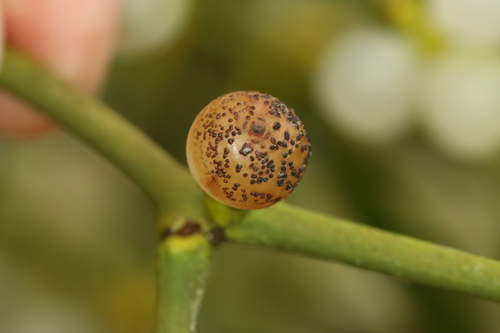
Verbatim
e0“highly probable tripartite link between the European mistletoe, parasitic fungus Sphaeropsis visci and the saproxylic and mycetophagous Coleoptera”
t0“European Mistletoe”
Claim · model-written summary
Beetles appeared to vector S. visci spores and mycelium among mistletoes.
- Taxon
- mistletoese0
- Interactor
- beetlesColeopterae0other
- Outcome
- spread spores and myceliume0
Verbatim
e0“beetles act as vectors to spread spores and mycelium among mistletoes”
Claim · model-written summary
Leiopus femoratus bred en masse on V. album.
- Taxon
- V. albumViscum albume0
- Interactor
- Leiopus femoratus
 Leiopus femoratuse0herbivore
- Outcome
- mass breadinge0
Organisms pictured · Representative pictures of the matched species, not figures from the paper.

Verbatim
e0“mass breading of invasive species Leiopus femoratus on V. album”
Claim · model-written summary
The authors suggested V. album could aid rapid invasion by L. femoratus in Europe.
- Taxon
- V. albumViscum albume0
- Interactor
- L. femoratusLeiopus femoratuse0herbivore
- Outcome
- mass and rapid invasion of L. femoratuse0
- Setting
- Europee0
Organisms pictured · Representative pictures of the matched species, not figures from the paper.
Verbatim
e0“V. album might play a crucial role in the mass and rapid invasion of L. femoratus in Europe”