Abstract
Abstract Parasitic plants have evolved independently in 12 Angiosperm orders. Nine of them (Boraginales, Cucurbitales, Ericales, Lamiales, Laurales, Malvales, Santalales, Solanales, and Zygophyllales) are represented in Colombia by 17 families, 44 genera and 246 species, including facultative (37) and obligate (187) hemiparasites, holoexoparasites (19) and holoendoparasites (3). Cladocolea coriacea (Loranthaceae) is reported for the first time in Colombia. One genus ( Sanguisuga , Cytinaceae) and 69 species (28.04%) are endemic to the country. Endemism decreases with elevation, ranging from 26 species (37.68%) below 1000 m, to one species (1.44%) above 4000 m. Speciation in Aetanthus , Psittacanthus and Tristerix (Loranthaceae), Dendrophthora and Phoradendron (Viscaceae), and Castilleja and Neobartsia (Orobanchaceae) was likely prompted by the Andean uplift. The highest number of species (169) are found in the Andean Region, whereas the Orinoco Region contains the lowest number (29). Dry forests and thickets, and coastal vegetation of the Caribbean Region are the preferred ecosystems for Krameria (Krameriaceae), Sanguisuga , Acanthosyris (Cervantesiaceae), Maracanthus (Loranthaceae), Ximenia (Ximeniaceae), Lennoa (Ehretiaceae), and Anisantherina (Orobanchaceae). Orobanche minor , recently introduced to the country, is the only potential weed for crops between 2500 and 3200 m in the Eastern Cordillera. Convergent lifeforms include: the obligate, twining stem holoparasitic Cassytha (Lauraceae) and Cuscuta (Convolvulaceae); the root holoexoparasitic Sanguisuga , Mitrastemon (Mitrastemonaceae), all Balanophoraceae, and Lennoa ; and the root obligate hemiparasitic Krameria , Gaiadendron (Loranthaceae), and all Cervantesiaceae, Opiliaceae, Schoepfiaceae, Strombosiaceae and Ximeniaceae. Holoendoparasitism occurs only in Apodanthaceae, whereas root facultative hemiparasitism is restricted to the Orobanchaceae.
Abstract from the paper’s OpenAlex record; open copy licensed cc-by. Read at the source ↗
The text the model read, with the source record’s inline markup (italics, sub- and superscripts) rendered and its character entities decoded; quote offsets refer to the raw text.
Claims 16
Claim · model-written summary
Nine orders of parasitic plants in Colombia comprise 17 families, 44 genera and 246 species.
Verbatim
e0“Nine of them (Boraginales, Cucurbitales, Ericales, Lamiales, Laurales, Malvales, Santalales, Solanales, and Zygophyllales) are represented in Colombia by 17 families, 44 genera and 246 species”
t0“Parasitic Flowering Plants”
Claim · model-written summary
Colombian parasitic flora includes 37 facultative and 187 obligate hemiparasites.
Verbatim
e0“including facultative (37) and obligate (187) hemiparasites, holoexoparasites (19) and holoendoparasites (3)”
t0“Parasitic Flowering Plants”
Claim · model-written summary
Colombian parasitic flora includes 19 holoexoparasites and three holoendoparasites.
Verbatim
e0“including facultative (37) and obligate (187) hemiparasites, holoexoparasites (19) and holoendoparasites (3)”
t0“Parasitic Flowering Plants”
Claim · model-written summary
Cladocolea coriacea is newly reported in Colombia.
- Taxon
- Cladocolea coriaceaCladocolea coriaceae0
- Outcome
- reported for the first time in Colombiae0
- Setting
- Colombiae0
Verbatim
e0“Cladocolea coriacea (Loranthaceae) is reported for the first time in Colombia”
Claim · model-written summary
One genus and 69 species are endemic to Colombia.
Verbatim
e0“One genus ( Sanguisuga , Cytinaceae) and 69 species (28.04%) are endemic to the country”
Claim · model-written summary
Endemism falls with elevation from 26 species below 1000 m to one above 4000 m.
Verbatim
e0“Endemism decreases with elevation, ranging from 26 species (37.68%) below 1000 m, to one species (1.44%) above 4000 m”
t0“Parasitic Flowering Plants”
Claim · model-written summary
Andean uplift likely prompted speciation in the named genera.
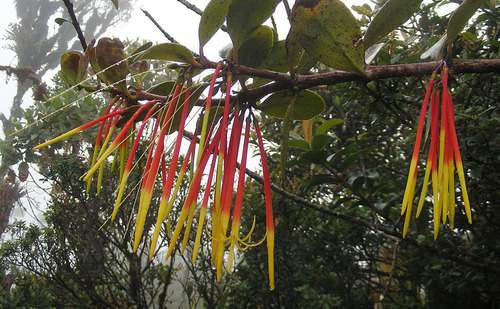
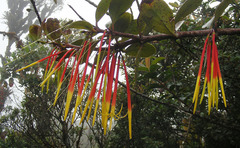 Aetanthus
Organisms pictured · Representative pictures of the matched species, not figures from the paper.
Verbatim
e0“Speciation in Aetanthus , Psittacanthus and Tristerix (Loranthaceae), Dendrophthora and Phoradendron (Viscaceae), and Castilleja and Neobartsia (Orobanchaceae) was likely prompted by the Andean uplift”
Claim · model-written summary
The Andean Region contains 169 parasitic species.
Verbatim
e0“The highest number of species (169) are found in the Andean Region, whereas the Orinoco Region contains the lowest number (29)”
t0“Parasitic Flowering Plants”
Claim · model-written summary
The Orinoco Region contains 29 parasitic species.
Verbatim
e0“The highest number of species (169) are found in the Andean Region, whereas the Orinoco Region contains the lowest number (29)”
t0“Parasitic Flowering Plants”
Claim · model-written summary
Several parasitic genera prefer Caribbean dry forests, thickets and coastal vegetation.
 Krameria
Organisms pictured · Representative pictures of the matched species, not figures from the paper.

Verbatim
e0“Dry forests and thickets, and coastal vegetation of the Caribbean Region are the preferred ecosystems for Krameria (Krameriaceae), Sanguisuga , Acanthosyris (Cervantesiaceae), Maracanthus (Loranthaceae), Ximenia (Ximeniaceae), Lennoa (Ehretiaceae), and Anisantherina (Orobanchaceae)”
Claim · model-written summary
Introduced Orobanche minor is a potential crop weed at 2500–3200 m.
- Taxon
- Orobanche minor
 Orobanche minore0
- Outcome
- only potential weed for cropse0
- Setting
- Eastern Cordillerae0
Organisms pictured · Representative pictures of the matched species, not figures from the paper.

Verbatim
e0“Orobanche minor , recently introduced to the country, is the only potential weed for crops between 2500 and 3200 m in the Eastern Cordillera”
Claim · model-written summary
Cassytha and Cuscuta share obligate twining stem holoparasitism.
- Outcome
- obligate, twining stem holoparasitice0
 Cassytha
Organisms pictured · Representative pictures of the matched species, not figures from the paper.

Verbatim
e0“the obligate, twining stem holoparasitic Cassytha (Lauraceae) and Cuscuta (Convolvulaceae)”
Claim · model-written summary
The listed lineages have root holoexoparasitism.
Verbatim
e0“the root holoexoparasitic Sanguisuga , Mitrastemon (Mitrastemonaceae), all Balanophoraceae, and Lennoa”
Claim · model-written summary
The listed lineages show obligate root hemiparasitism.
- Outcome
- root obligate hemiparasitice0
Organisms pictured · Representative pictures of the matched species, not figures from the paper.
Verbatim
e0“the root obligate hemiparasitic Krameria , Gaiadendron (Loranthaceae), and all Cervantesiaceae, Opiliaceae, Schoepfiaceae, Strombosiaceae and Ximeniaceae”
Claim · model-written summary
Holoendoparasitism occurs only in Apodanthaceae.
- Taxon
- ApodanthaceaeApodanthaceaee0
- Outcome
- Holoendoparasitism occurs onlye0
Verbatim
e0“Holoendoparasitism occurs only in Apodanthaceae”
Claim · model-written summary
Root facultative hemiparasitism is restricted to Orobanchaceae.
- Taxon
- OrobanchaceaeOrobanchaceaee0
- Outcome
- root facultative hemiparasitisme0
Verbatim
e0“root facultative hemiparasitism is restricted to the Orobanchaceae”