Abstract
Icerya seychellarum (Westwood) (Homoptera: Monophelibidae) is the most important mealybug species in Egypt which attacking guava orchards. The purpose of this study was to observe the fluctuations in population of this insect pest in guava orchards throughout two seasons of 2020/ 2021 and 2021/ 2022 in Rashed region, El-Behara governorate. The obtained results indicated that, I. seychellarum had 2-3 peaks of population density during the first and second years of the study. There was a good synchronization between nymphal population of I. seychellarum and populations of the two predators Rodalia cardinalis (Mulsant) (r= 0.69 and0.78) and Chrysoperla carnea (Stephens) (r = 0.63 and 0.61) during the previous period. The impact of weather factors (temperature and relative humidity) on population of I. seychellarum and the associated predators (R. cardinalis and C. carnea) were examined.
Abstract from the paper’s OpenAlex record, shown for indexing and research. Copyright remains with the authors or the publisher. Read at the source ↗
The text the model read, with the source record’s inline markup (italics, sub- and superscripts) rendered and its character entities decoded; quote offsets refer to the raw text.
Claims 3
Claim · model-written summary
Icerya seychellarum had two to three population density peaks in both study years.
- Taxon
- I. seychellarum
 Icerya seychellarume0
- Outcome
- peaks of population densitye0
- Value
- 2-3 peakse0
Not reportedSetting
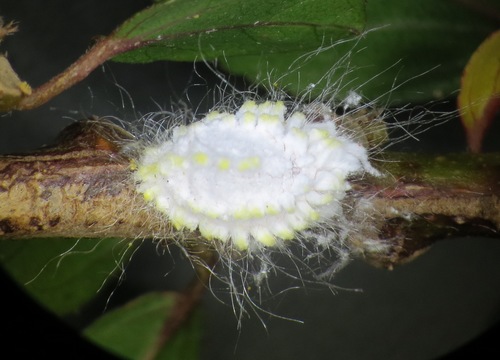
Organisms pictured · Representative pictures of the matched species, not figures from the paper.
Verbatim
t0“Guava”
e0“I. seychellarum had 2-3 peaks of population density during the first and second years of the study.”
Claim · model-written summary
Nymphal Icerya seychellarum populations were synchronized with Rodalia cardinalis populations (r= 0.69 and0.78).
- Taxon
- I. seychellarumIcerya seychellarume0
- Interactor
- Rodalia cardinalise0other
- Outcome
- nymphal population of I. seychellarume0
- Value
- r= 0.69 and0.78e0
Not reportedDirection
Organisms pictured · Representative pictures of the matched species, not figures from the paper.
Verbatim
t0“Guava”
e0“There was a good synchronization between nymphal population of I. seychellarum and populations of the two predators Rodalia cardinalis (Mulsant) (r= 0.69 and0.78) and Chrysoperla carnea (Stephens) (r = 0.63 and 0.61) during the previous period.”
Claim · model-written summary
Nymphal Icerya seychellarum populations were synchronized with Chrysoperla carnea populations (r = 0.63 and 0.61).
- Taxon
- I. seychellarumIcerya seychellarume0
- Interactor
- Chrysoperla carnea
 Chrysoperla carneae0other
- Outcome
- nymphal population of I. seychellarume0
- Value
- r = 0.63 and 0.61e0
Not reportedDirection
Organisms pictured · Representative pictures of the matched species, not figures from the paper.

Verbatim
t0“Guava”
e0“There was a good synchronization between nymphal population of I. seychellarum and populations of the two predators Rodalia cardinalis (Mulsant) (r= 0.69 and0.78) and Chrysoperla carnea (Stephens) (r = 0.63 and 0.61) during the previous period.”