Abstract
The store grain pest, T. Castaneum, presents a significant threat to global food security and storage practices within stored grain ecosystems, necessitating effective pest control measures.The present study demonstrates the potent bioactivity of various aqueous plant extracts, such as Neem, Clove, Coriander, Mint, Garlic, and Black Pepper, in preventing and reducing the mortality of red flour beetles at different concentrations and exposure durations.Laboratory experiments revealed that Azadirachta indica; Neem, Syzygium aromaticum; Clove, Coriandrum sativum; Coriander, Mentha spicata; Mint, Allium sativum; Garlic, and Piper nigrum; Black Pepper, applied at different concentrations and exposure periods against red flour beetles.Laboratory experiments revealed that A. indica, P. nigrum, and M. spicata extracts, particularly at higher concentrations and longer exposure times, caused significant repellency and mortality in T. castaneum.A. indica exhibited the highest mean repellency (up to 100%) and less mortality (up to 9.37%) after 7 days at varying concentrations.Our findings showcase the efficacy of these plant extracts as ecofriendly alternatives for managing red flour beetles, offering a promising solution to mitigate storage losses and enhance global food security within stored grain ecosystems.The potential application of these natural extracts holds great promise in addressing the challenges posed by this persistent insect pest.
Abstract from the paper’s OpenAlex record; open copy licensed cc-by. Read at the source ↗
The text the model read, with the source record’s inline markup (italics, sub- and superscripts) rendered and its character entities decoded; quote offsets refer to the raw text.
Claims 5
Claim · model-written summary
Azadirachta indica extract showed the highest mean repellency, up to 100%, against T. castaneum after 7 days at varying concentrations.
- Taxon
- A. indica
 Azadirachta indicae1
- Treatment
- extractse2
- Interactor
- T. castaneum
 Tribolium castaneume2pest
- Outcome
- mean repellencye1
- Direction
- higheste1
- Value
- up to 100%e1
- Qualifier
- after 7 dayse1
Not reportedComparator
Organisms pictured · Representative pictures of the matched species, not figures from the paper.


Verbatim
e1“A. indica exhibited the highest mean repellency (up to 100%) and less mortality (up to 9.37%) after 7 days at varying concentrations”
e2“A. indica, P. nigrum, and M. spicata extracts, particularly at higher concentrations and longer exposure times, caused significant repellency and mortality in T. castaneum”
Claim · model-written summary
Azadirachta indica extract showed less mortality of T. castaneum, up to 9.37%, after 7 days.
- Taxon
- A. indicaAzadirachta indicae1
- Treatment
- extractse2
- Interactor
- T. castaneumTribolium castaneume2pest
- Outcome
- mortalitye1
- Direction
- lesse1
- Value
- up to 9.37%e1
- Qualifier
- after 7 dayse1
Not reportedComparator
Organisms pictured · Representative pictures of the matched species, not figures from the paper.
Verbatim
e1“A. indica exhibited the highest mean repellency (up to 100%) and less mortality (up to 9.37%) after 7 days at varying concentrations”
e2“A. indica, P. nigrum, and M. spicata extracts, particularly at higher concentrations and longer exposure times, caused significant repellency and mortality in T. castaneum”
Claim · model-written summary
Azadirachta indica extract caused significant repellency and mortality in T. castaneum, particularly at higher concentrations and longer exposure times.
- Taxon
- A. indicaAzadirachta indicae2
- Treatment
- extractse2
- Interactor
- T. castaneumTribolium castaneume2pest
- Outcome
- repellency and mortalitye2
- Direction
- causede2
- Qualifier
- particularly at higher concentrations and longer exposure timese2
Not reportedComparator
Organisms pictured · Representative pictures of the matched species, not figures from the paper.
Verbatim
e2“A. indica, P. nigrum, and M. spicata extracts, particularly at higher concentrations and longer exposure times, caused significant repellency and mortality in T. castaneum”
Claim · model-written summary
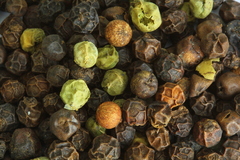
Piper nigrum extract caused significant repellency and mortality in T. castaneum, particularly at higher concentrations and longer exposure times.
- Taxon
- P. nigrum
 Piper nigrume2
- Treatment
- extractse2
- Interactor
- T. castaneumTribolium castaneume2pest
- Outcome
- repellency and mortalitye2
- Direction
- causede2
- Qualifier
- particularly at higher concentrations and longer exposure timese2
Not reportedComparator
Organisms pictured · Representative pictures of the matched species, not figures from the paper.

Verbatim
e2“A. indica, P. nigrum, and M. spicata extracts, particularly at higher concentrations and longer exposure times, caused significant repellency and mortality in T. castaneum”
Claim · model-written summary
Mentha spicata extract caused significant repellency and mortality in T. castaneum, particularly at higher concentrations and longer exposure times.
- Taxon
- M. spicata
 Mentha spicatae2
- Treatment
- extractse2
- Interactor
- T. castaneumTribolium castaneume2pest
- Outcome
- repellency and mortalitye2
- Direction
- causede2
- Qualifier
- particularly at higher concentrations and longer exposure timese2
Not reportedComparator
Organisms pictured · Representative pictures of the matched species, not figures from the paper.

Verbatim
e2“A. indica, P. nigrum, and M. spicata extracts, particularly at higher concentrations and longer exposure times, caused significant repellency and mortality in T. castaneum”
The same questions in other papers
botanical · Tribolium castaneum · Azadirachta indica (neem)Results agree
1 paper in the same direction as this paper
- positive
Claims are grouped by organism, treatment and what was measured or targeted. A paper counts as positive when any of its claims in the group is positive.