Abstract
Empetro nigri-Pinetum is a unique sea coast plant community developing along the Baltic Sea from Germany to Lithuania. Our detailed field research of bryophytes and vascular plants has highlighted the regional diversity of the Empetro nigri-Pinetum typicum plant community throughout its range in Central Europe. Our study indicated that vascular plants and mosses effectively discriminate against the described phytocoenoses, thus it was possible to distinguish three variants of the coastal forest: Calluna-Deschampsia (from Germany), Vaccinium vitis-idaea (from Poland) and Melampyrum-Deschampsia (from Lithuania). Redundancy analysis indicated that the division is related to the habitat conditions of the analyzed areas, with humidity having the greatest impact on this differentiation. Kohonen's artificial neural network (i.e. self-organising map, SOM) confirmed the heterogeneous nature of the studied phytocenoses, and combined with the IndVal index enabled identification of indicator species for respective studied patches: Deschampsia flexuosa for Calluna-Deschampsia group; Aulacomnium palustre, Calluna vulgaris, Carex nigra, Dicranum polysetum, Erica tetralix, Oxycoccus palustris, Sphagnum capillifolium, Vaccinium uliginosum and Vaccinium vitis-idaea for Vaccinium vitis-idaea group; and young specimens of Betula pendula, Lycopodium annotinum, Melampyrum pratense and Orthilia secunda for Melampyrum-Deschampsia group. Thereby, our study showed that individual groups of species can be very good bioindicators for each of the studied phytocoenoses.
Abstract from the paper’s OpenAlex record; open copy licensed cc-by. Read at the source ↗
The text the model read, with the source record’s inline markup (italics, sub- and superscripts) rendered and its character entities decoded; quote offsets refer to the raw text.
Claims 10
Claim · model-written summary
Vascular plants and mosses effectively discriminate the described phytocoenoses, distinguishing three variants of the coastal forest.
- Taxon
- vascular plants and mossesBryophytaTracheophytae1
- Outcome
- effectively discriminate against the described phytocoenosese1
- Qualifier
- three variantse1
Verbatim
e1“Our study indicated that vascular plants and mosses effectively discriminate against the described phytocoenoses, thus it was possible to distinguish three variants of the coastal forest”
Claim · model-written summary
The division of the coastal forest variants is related to habitat conditions, with humidity having the greatest impact.
- Taxon
- vascular plants and mossesBryophytaTracheophytae1
- Treatment
- humiditye2
- Outcome
- divisione2
Not reportedDirection
Verbatim
e1“Our study indicated that vascular plants and mosses effectively discriminate against the described phytocoenoses, thus it was possible to distinguish three variants of the coastal forest”
e2“Redundancy analysis indicated that the division is related to the habitat conditions of the analyzed areas, with humidity having the greatest impact on this differentiation”
Claim · model-written summary
Kohonen self-organising map analysis confirmed the heterogeneous nature of the studied phytocoenoses.
- Taxon
- vascular plants and mossesBryophytaTracheophytae1
- Outcome
- heterogeneous nature of the studied phytocenosese3
Verbatim
e1“Our study indicated that vascular plants and mosses effectively discriminate against the described phytocoenoses, thus it was possible to distinguish three variants of the coastal forest”
e3“confirmed the heterogeneous nature of the studied phytocenoses”
Claim · model-written summary
Deschampsia flexuosa is an indicator species for the Calluna-Deschampsia group.
- Taxon
- Deschampsia flexuosa
 Avenella flexuosae4
- Outcome
- indicator speciese4
- Qualifier
- for Calluna-Deschampsia groupe4
Organisms pictured · Representative pictures of the matched species, not figures from the paper.

Verbatim
e4“identification of indicator species for respective studied patches: Deschampsia flexuosa for Calluna-Deschampsia group”
Claim · model-written summary
Aulacomnium palustre, Calluna vulgaris and Carex nigra are indicator species for the Vaccinium vitis-idaea group.
- Taxon
- Aulacomnium palustre, Calluna vulgaris, Carex nigra
 Calluna vulgaris
 Aulacomnium palustre
 Carex nigrae5
- Outcome
- indicator speciese4
- Qualifier
- for Vaccinium vitis-idaea groupe5
Organisms pictured · Representative pictures of the matched species, not figures from the paper.


Verbatim
e4“identification of indicator species for respective studied patches: Deschampsia flexuosa for Calluna-Deschampsia group”
e5“Aulacomnium palustre, Calluna vulgaris, Carex nigra, Dicranum polysetum, Erica tetralix, Oxycoccus palustris, Sphagnum capillifolium, Vaccinium uliginosum and Vaccinium vitis-idaea for Vaccinium vitis-idaea group”
Claim · model-written summary
Dicranum polysetum, Erica tetralix and Oxycoccus palustris are indicator species for the Vaccinium vitis-idaea group.
- Taxon
- Dicranum polysetum, Erica tetralix, Oxycoccus palustris
 Erica tetralix
 Dicranum polysetum
 Vaccinium oxycoccose5
- Outcome
- indicator speciese4
- Qualifier
- for Vaccinium vitis-idaea groupe5
Organisms pictured · Representative pictures of the matched species, not figures from the paper.


Verbatim
e4“identification of indicator species for respective studied patches: Deschampsia flexuosa for Calluna-Deschampsia group”
e5“Aulacomnium palustre, Calluna vulgaris, Carex nigra, Dicranum polysetum, Erica tetralix, Oxycoccus palustris, Sphagnum capillifolium, Vaccinium uliginosum and Vaccinium vitis-idaea for Vaccinium vitis-idaea group”
Claim · model-written summary
Sphagnum capillifolium and Vaccinium uliginosum and Vaccinium vitis-idaea are indicator species for the Vaccinium vitis-idaea group.
- Taxon
- Sphagnum capillifolium, Vaccinium uliginosum and Vaccinium vitis-idaea
 Sphagnum capillifolium
 Vaccinium vitis-idaea
 Vaccinium uliginosume5
- Outcome
- indicator speciese4
- Qualifier
- for Vaccinium vitis-idaea groupe5
Organisms pictured · Representative pictures of the matched species, not figures from the paper.


Verbatim
e4“identification of indicator species for respective studied patches: Deschampsia flexuosa for Calluna-Deschampsia group”
e5“Aulacomnium palustre, Calluna vulgaris, Carex nigra, Dicranum polysetum, Erica tetralix, Oxycoccus palustris, Sphagnum capillifolium, Vaccinium uliginosum and Vaccinium vitis-idaea for Vaccinium vitis-idaea group”
Claim · model-written summary
Betula pendula, Lycopodium annotinum and Melampyrum pratense are young-specimen indicator species for the Melampyrum-Deschampsia group.
- Taxon
- Betula pendula, Lycopodium annotinum, Melampyrum pratense
 Betula pendula
 Spinulum annotinum
 Melampyrum pratensee6
- Outcome
- indicator speciese4
- Qualifier
- young specimense6
Organisms pictured · Representative pictures of the matched species, not figures from the paper.


Verbatim
e4“identification of indicator species for respective studied patches: Deschampsia flexuosa for Calluna-Deschampsia group”
e6“young specimens of Betula pendula, Lycopodium annotinum, Melampyrum pratense and Orthilia secunda for Melampyrum-Deschampsia group”
Claim · model-written summary
Orthilia secunda is a young-specimen indicator species for the Melampyrum-Deschampsia group.
- Taxon
- Orthilia secunda
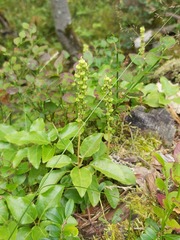 Orthilia secundae6
- Outcome
- indicator speciese4
- Qualifier
- young specimense6
Organisms pictured · Representative pictures of the matched species, not figures from the paper.

Verbatim
e4“identification of indicator species for respective studied patches: Deschampsia flexuosa for Calluna-Deschampsia group”
e6“young specimens of Betula pendula, Lycopodium annotinum, Melampyrum pratense and Orthilia secunda for Melampyrum-Deschampsia group”
Claim · model-written summary
Individual groups of species can be very good bioindicators for each of the studied phytocoenoses.
- Taxon
- vascular plants and mossesBryophytaTracheophytae1
- Outcome
- bioindicatorse7
- Qualifier
- for each of the studied phytocoenosese7
Verbatim
e1“Our study indicated that vascular plants and mosses effectively discriminate against the described phytocoenoses, thus it was possible to distinguish three variants of the coastal forest”
e7“individual groups of species can be very good bioindicators for each of the studied phytocoenoses”