Abstract
T hree well-known medicinally important plants of Solanac eae viz., Solanum nigrum, Solanum torv um and Nic otiana plumbaginifolia of Ballavpur W ildlif e Sanc tuary (BW LS) were ass es sed for determination of mycorrhizal association in terms of % root colonization, spore density, species richness and relative abundance.All three selected plants showed sufficient internal hyphae; however, the number of vesicles and arbuscules varies from plant to plant.Maximum root colonization percentage was recorded in Solanum nigrum (74%), followed by Solanum torvum (72%) and the lowest (67%) was noticed in Nicotiana plumbaginifolia.Of all three plants, spore density and species richness were noticed maximum in S. torvum, followed by S. nigrum and minimum in N. plumbaginifolia.Altogether, 15 different AM fungal species belonging to 6 genera viz., Glomus, Acaulospora,Scutellospora, Claroideglomus, Diversispora and Gigaspora,were isolated from all three selected plants; however, their isolation frequency, relative abundance and species richness were found to vary from plant to plant.Among all AM fungi, three species of Glomus viz., G. intraradices, G. fasciculatum, and G. mosseaeand three species of Acaulospora viz., A. nicolsonii, A. laevis and A. mella are commonly present in all three selected plant with high relative abundance (above 30) and is considered as dominant AM species of BW LS.The present investigation reveals that Glomus and Acaulospora predominate over Scutellospora, Claroideglomus, Diversispora and Gigaspora.A significant positive correlation between root colonization, spore density,and species richness was recorded, and the maximum mycorrhizal association supports better plant growth promotion.
Abstract from the paper’s OpenAlex record, shown for indexing and research. Copyright remains with the authors or the publisher. Read at the source ↗
The text the model read, with the source record’s inline markup (italics, sub- and superscripts) rendered and its character entities decoded; quote offsets refer to the raw text.
Claims 13
Claim · model-written summary
All three selected plants had internal mycorrhizal hyphae.
Verbatim
e0“All three selected plants showed sufficient internal hyphae”
t0“Arbuscular Mycorrhizal Fungi associated with some Solanaceous medicinal plants”
Claim · model-written summary
Vesicle and arbuscule numbers varied among the selected plants.
Verbatim
e0“the number of vesicles and arbuscules varies from plant to plant”
t0“Arbuscular Mycorrhizal Fungi associated with some Solanaceous medicinal plants”
Claim · model-written summary
Solanum nigrum had the highest root colonization, at 74%.
- Taxon
- Solanum nigrum
 Solanum nigrume0
- Interactor
- Arbuscular Mycorrhizal Fungit0symbiont
- Outcome
- root colonization percentagee0
- Direction
- Maximume0
- Value
- 74%e0
Organisms pictured · Representative pictures of the matched species, not figures from the paper.

Verbatim
e0“Maximum root colonization percentage was recorded in Solanum nigrum (74%)”
t0“Arbuscular Mycorrhizal Fungi”
Claim · model-written summary
Solanum torvum had 72% root colonization.
- Taxon
- Solanum torvum
 Solanum torvume0
- Interactor
- Arbuscular Mycorrhizal Fungit0symbiont
- Outcome
- root colonizatione1
- Direction
- followed bye0
- Value
- 72%e0
Organisms pictured · Representative pictures of the matched species, not figures from the paper.

Verbatim
e0“followed by Solanum torvum (72%)”
e1“Maximum root colonization percentage was recorded in Solanum nigrum (74%)”
t0“Arbuscular Mycorrhizal Fungi”
Claim · model-written summary
Nicotiana plumbaginifolia had the lowest root colonization, at 67%.
- Taxon
- Nicotiana plumbaginifolia
 Nicotiana plumbaginifoliae0
- Interactor
- Arbuscular Mycorrhizal Fungit0symbiont
- Outcome
- root colonization percentagee1
- Direction
- loweste0
- Value
- 67%e0
Organisms pictured · Representative pictures of the matched species, not figures from the paper.
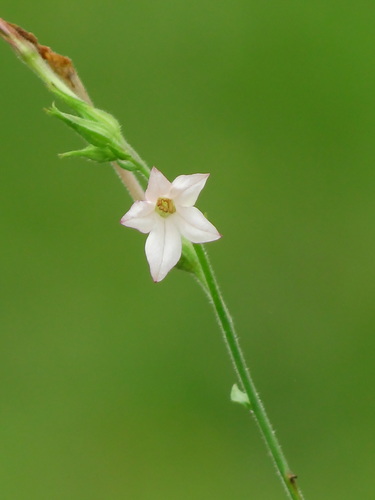
Verbatim
e0“the lowest (67%) was noticed in Nicotiana plumbaginifolia”
e1“Maximum root colonization percentage”
t0“Arbuscular Mycorrhizal Fungi”
Claim · model-written summary
Spore density and species richness were highest in S. torvum.
- Taxon
- S. torvumSolanum torvume0
- Interactor
- Arbuscular Mycorrhizal Fungit0symbiont
- Outcome
- spore density and species richnesse0
- Direction
- maximume0
Organisms pictured · Representative pictures of the matched species, not figures from the paper.
Verbatim
e0“spore density and species richness were noticed maximum in S. torvum”
t0“Arbuscular Mycorrhizal Fungi”
Claim · model-written summary
Spore density and species richness were lowest in N. plumbaginifolia.
- Taxon
- N. plumbaginifoliaNicotiana plumbaginifoliae0
- Interactor
- Arbuscular Mycorrhizal Fungit0symbiont
- Outcome
- spore density and species richnesse0
- Direction
- minimume0
Organisms pictured · Representative pictures of the matched species, not figures from the paper.
Verbatim
e0“spore density and species richness were noticed maximum in S. torvum, followed by S. nigrum and minimum in N. plumbaginifolia”
t0“Arbuscular Mycorrhizal Fungi”
Claim · model-written summary
Fifteen AM fungal species from six genera were isolated from the three plants.
Verbatim
e0“15 different AM fungal species belonging to 6 genera viz., Glomus, Acaulospora,Scutellospora, Claroideglomus, Diversispora and Gigaspora,were isolated from all three selected plants”
t0“Solanaceous medicinal plants”
Claim · model-written summary
AM fungal isolation frequency, relative abundance and species richness varied among host plants.
Verbatim
e0“their isolation frequency, relative abundance and species richness were found to vary from plant to plant”
t0“Arbuscular Mycorrhizal Fungi associated with some Solanaceous medicinal plants”
Claim · model-written summary
Three Glomus and three Acaulospora species occurred in all selected plants with high relative abundance.
- Taxon
- Solanaceous medicinal plantst0
- Second interactor
- AcaulosporaAcaulosporae0symbiont
- Outcome
- high relative abundancee0
- Value
- above 30e0
 Glomus
Organisms pictured · Representative pictures of the matched species, not figures from the paper.

Verbatim
e0“three species of Glomus viz., G. intraradices, G. fasciculatum, and G. mosseaeand three species of Acaulospora viz., A. nicolsonii, A. laevis and A. mella are commonly present in all three selected plant with high relative abundance (above 30)”
t0“Solanaceous medicinal plants”
Claim · model-written summary
Glomus and Acaulospora predominated over the other AM fungal genera.
- Taxon
- Solanaceous medicinal plantst0
- Second interactor
- AcaulosporaAcaulosporae0symbiont
- Outcome
- predominatee0
Organisms pictured · Representative pictures of the matched species, not figures from the paper.
Verbatim
e0“Glomus and Acaulospora predominate over Scutellospora, Claroideglomus, Diversispora and Gigaspora”
t0“Solanaceous medicinal plants”
Claim · model-written summary
Root colonization, spore density and species richness were significantly positively correlated.
Verbatim
e0“A significant positive correlation between root colonization, spore density,and species richness was recorded”
t0“Arbuscular Mycorrhizal Fungi associated with some Solanaceous medicinal plants”
Claim · model-written summary
The authors interpreted maximum mycorrhizal association as supporting better plant growth.
Verbatim
e0“the maximum mycorrhizal association supports better plant growth promotion”
t0“Arbuscular Mycorrhizal Fungi associated with some Solanaceous medicinal plants”