Abstract
Elephants play an important role in the forest ecosystem of Taï National Park (TNP).The survival of this emblematic animal depends on the availability of food resources.Therefore, understanding the elephant's feeding behavior is crucial for its sustainable protection.In this context, a study was undertaken to determine the variability in the diversity and availability of elephant food resources in TNP.Strips transect surveys, poop excavations and roving surveys were the main methods used for this research.The inventory carried out identified 335 plant species belonging to 176 genera and 70 families that were consumed by elephants, at least in part.These plant parts include leafy twigs, fruit, bark, roots and, in the case of other species, the whole plant.Considering the number and type of organs taken from the plants, the study reveals that they varied from species to species.Leafy twigs (228 species or 53%) and fruits (130 species or 31%) emerged as the organs most consumed by elephants in their diet.Parinari excelsa (14,46 %), Sacoglottis gabonensis (12,75 %) and Tieghemella heckelii (11,82 %) were the most consumed fruit species.Furthermore, elephant consumption of different plant items follows seasonal variations in the TNP.During the rainy season, elephants are more active and consume leafy twigs as well as fruit.In fact, fruit is one of the most sought-after components of the diet.The elephant's food repertory varies according to the phenology of the plant species in the TNP.Consequently, the movements and even distribution of this animal species are linked to the fruiting of plants whose fruits appreciated.
Abstract from the paper’s OpenAlex record, shown for indexing and research. Copyright remains with the authors or the publisher. Read at the source ↗
The text the model read, with the source record’s inline markup (italics, sub- and superscripts) rendered and its character entities decoded; quote offsets refer to the raw text.
Claims 9
Claim · model-written summary
Elephants consumed 335 plant species in Tai National Park.
- Taxon
- plant speciese1
- Interactor
- elephantsProboscideae1herbivore
- Outcome
- consumed by elephantse1
- Value
- 335 plant speciese1
Verbatim
e1“The inventory carried out identified 335 plant species belonging to 176 genera and 70 families that were consumed by elephants, at least in part”
Claim · model-written summary
Leafy twigs were the plant organ most consumed by elephants, by 228 species (53%).
Verbatim
e1“The inventory carried out identified 335 plant species belonging to 176 genera and 70 families that were consumed by elephants, at least in part”
e2“Leafy twigs (228 species or 53%) and fruits (130 species or 31%) emerged as the organs most consumed by elephants in their diet”
Claim · model-written summary
Fruits were the plant organ most consumed by elephants, by 130 species (31%).
Verbatim
e1“The inventory carried out identified 335 plant species belonging to 176 genera and 70 families that were consumed by elephants, at least in part”
e2“Leafy twigs (228 species or 53%) and fruits (130 species or 31%) emerged as the organs most consumed by elephants in their diet”
Claim · model-written summary
Parinari excelsa was among the most consumed fruit species, at 14.46%.
- Taxon
- Parinari excelsa
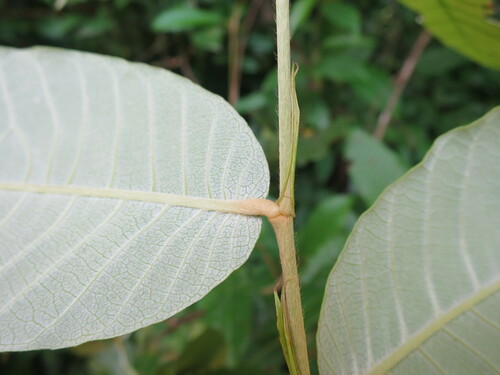
 Parinari excelsae3
- Outcome
- most consumed fruit speciese3
- Value
- 14,46 %e3
Organisms pictured · Representative pictures of the matched species, not figures from the paper.
Verbatim
e3“Parinari excelsa (14,46 %), Sacoglottis gabonensis (12,75 %) and Tieghemella heckelii (11,82 %) were the most consumed fruit species”
Claim · model-written summary
Sacoglottis gabonensis was among the most consumed fruit species, at 12.75%.
- Taxon
- Sacoglottis gabonensis
 Sacoglottis gabonensise3
- Outcome
- most consumed fruit speciese3
- Value
- 12,75 %e3
Organisms pictured · Representative pictures of the matched species, not figures from the paper.

Verbatim
e3“Parinari excelsa (14,46 %), Sacoglottis gabonensis (12,75 %) and Tieghemella heckelii (11,82 %) were the most consumed fruit species”
Claim · model-written summary
Tieghemella heckelii was among the most consumed fruit species, at 11.82%.
- Taxon
- Tieghemella heckelii
 Tieghemella heckeliie3
- Outcome
- most consumed fruit speciese3
- Value
- 11,82 %e3
Organisms pictured · Representative pictures of the matched species, not figures from the paper.

Verbatim
e3“Parinari excelsa (14,46 %), Sacoglottis gabonensis (12,75 %) and Tieghemella heckelii (11,82 %) were the most consumed fruit species”
Claim · model-written summary
In the rainy season elephants were more active and consumed leafy twigs as well as fruit.
- Taxon
- plant speciese1
- Interactor
- elephantsProboscideae4herbivore
- Outcome
- consume leafy twigs as well as fruite4
- Setting
- rainy seasone4
Verbatim
e1“The inventory carried out identified 335 plant species belonging to 176 genera and 70 families that were consumed by elephants, at least in part”
e4“During the rainy season, elephants are more active and consume leafy twigs as well as fruit”
Claim · model-written summary
The elephant food repertory varies with the phenology of plant species in the park.
Not reportedDirection
Verbatim
e5“The elephant's food repertory varies according to the phenology of the plant species in the TNP”
Claim · model-written summary
Elephant movements and distribution are linked to the fruiting of plants.
Not reportedDirection
Verbatim
e5“The elephant's food repertory varies according to the phenology of the plant species in the TNP”
e6“Consequently, the movements and even distribution of this animal species are linked to the fruiting of plants whose fruits appreciated”