Abstract
Ganoderma P. Karst. is a pathogen that causes root and stem rot in trees, ultimately leading to their death. It can be used to treat various conditions of human diseases. This fungal species often grows on economically significant trees. Its morphological' diversity and host range need to be better understood due to their similarity in morphological resemblance. This research aims to identify the phenotypic diversity of Ganoderma species and their host trees. Opportunistic sampling was used to collect samples from nine villages in Mezam Division, Northwest Region of Cameroon. Morphological identification of Ganoderma species was done based on morphological characters such as colour, length, and width, laccate or non-laccate, the type of basidiocarp, margin shape, microscopical structures, and hyphae. The morphological characters of basidiocarps collected from different host trees revealed eleven distinct Ganoderma species, including Ganoderma applanatum, G. australe, G. brownii, G. cupreum, G. gibbosum, G. lucidum, G. multipileum, G. multiplicatum, G. orbiforme, G. resinaceum and G. weberianum. This study identified nine host tree species. Ganoderma resinaceum was host specific to Elaeis guineensis. G. cupreum on Ficus sp., and Persea americana, and G. orbiforme on Cola acuminata. G. multiplicatum, G. lucidum, G. gibbosum, and G. applanatum had multiple hosts. Ganoderma typically grows on dead tree stumps based on host preferences. However, three species were collected from living trees; one on Albizia adianthifolia and two on Persea americana, confirming their nature as saprophytes and plant pathogens.
Abstract from the paper’s OpenAlex record; open copy licensed cc-by. Read at the source ↗
The text the model read, with the source record’s inline markup (italics, sub- and superscripts) rendered and its character entities decoded; quote offsets refer to the raw text.
Claims 12
Claim · model-written summary
Eleven distinct Ganoderma species were identified from host tree basidiocarps.
 Ganoderma
Organisms pictured · Representative pictures of the matched species, not figures from the paper.

Verbatim
e0“basidiocarps collected from different host trees revealed eleven distinct Ganoderma species”
Claim · model-written summary
Nine host tree species were identified.
Verbatim
e0“This study identified nine host tree species”
Claim · model-written summary
Ganoderma resinaceum was specific to Elaeis guineensis.
- Taxon
- Elaeis guineensis
 Elaeis guineensise0
- Interactor
- Ganoderma resinaceum
 Ganoderma resinaceume0pathogen
- Outcome
- host specifice0
Organisms pictured · Representative pictures of the matched species, not figures from the paper.


Verbatim
e0“Ganoderma resinaceum was host specific to Elaeis guineensis”
Claim · model-written summary
G. cupreum occurred on Ficus sp.
- Interactor
- G. cupreum
 Ganoderma cupreume0pathogen
- Outcome
- G. cupreum on Ficus sp.e0
 Ficus
Organisms pictured · Representative pictures of the matched species, not figures from the paper.


Verbatim
e0“G. cupreum on Ficus sp., and Persea americana”
Claim · model-written summary
G. cupreum occurred on Persea americana.
- Taxon
- Persea americana
 Persea americanae0
- Interactor
- G. cupreumGanoderma cupreume0pathogen
- Outcome
- G. cupreum on Ficus sp., and Persea americanae0
Organisms pictured · Representative pictures of the matched species, not figures from the paper.

Verbatim
e0“G. cupreum on Ficus sp., and Persea americana”
Claim · model-written summary
G. orbiforme occurred on Cola acuminata.
- Taxon
- Cola acuminata
 Cola acuminatae0
- Interactor
- G. orbiforme
 Ganoderma orbiformee0pathogen
- Outcome
- G. orbiforme on Cola acuminatae0
Organisms pictured · Representative pictures of the matched species, not figures from the paper.


Verbatim
e0“G. orbiforme on Cola acuminata”
Claim · model-written summary
G. multiplicatum had multiple hosts.
- Taxon
- G. multiplicatum
 Ganoderma multiplicatume0
- Outcome
- multiple hostse0
Organisms pictured · Representative pictures of the matched species, not figures from the paper.
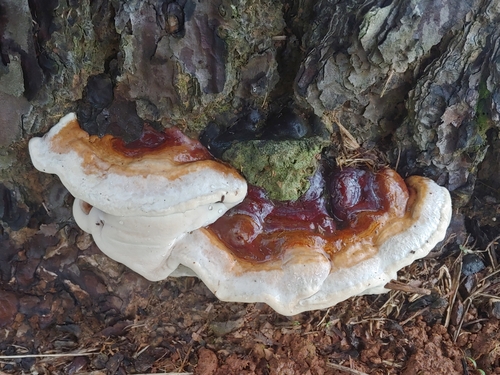
Verbatim
e0“G. multiplicatum, G. lucidum, G. gibbosum, and G. applanatum had multiple hosts”
Claim · model-written summary
G. lucidum had multiple hosts.
- Taxon
- G. lucidum
 Ganoderma lucidume0
- Outcome
- multiple hostse0
Organisms pictured · Representative pictures of the matched species, not figures from the paper.

Verbatim
e0“G. multiplicatum, G. lucidum, G. gibbosum, and G. applanatum had multiple hosts”
Claim · model-written summary
G. gibbosum had multiple hosts.
- Taxon
- G. gibbosumGanoderma gibbosume0
- Outcome
- multiple hostse0
Verbatim
e0“G. multiplicatum, G. lucidum, G. gibbosum, and G. applanatum had multiple hosts”
Claim · model-written summary
G. applanatum had multiple hosts.
- Taxon
- G. applanatum
 Ganoderma applanatume0
- Outcome
- multiple hostse0
Organisms pictured · Representative pictures of the matched species, not figures from the paper.

Verbatim
e0“G. multiplicatum, G. lucidum, G. gibbosum, and G. applanatum had multiple hosts”
Claim · model-written summary
Ganoderma was typically found on dead tree stumps.
- Outcome
- grows on dead tree stumpse0
Organisms pictured · Representative pictures of the matched species, not figures from the paper.
Verbatim
e0“Ganoderma typically grows on dead tree stumps based on host preferences”
Claim · model-written summary
Three Ganoderma species were collected from living trees.
Organisms pictured · Representative pictures of the matched species, not figures from the paper.
Verbatim
e0“three species were collected from living trees; one on Albizia adianthifolia and two on Persea americana”
t0“Ganoderma”