Abstract
During routine mycological survey in Satara district of Maharashtra, India. A powdery mildew infection was observed on Cucurbita maxima Duchesne. Microscopic examinations revealed the identity of powdery mildew as Fibroidium sp. During mycological examinations powdery mildew infection was found to be mixed with brownish intercellular pycnidia. These brown coloured pycnidia were picked up with the help of a needle under dissecting microspore and mounted in lactophenol and stained with cotton blue. Critical examinations identified it as a mycoparasite namely Ampelomyces quisquali Ces.
Abstract from the paper’s OpenAlex record, shown for indexing and research. Copyright remains with the authors or the publisher. Read at the source ↗
The text the model read, with the source record’s inline markup (italics, sub- and superscripts) rendered and its character entities decoded; quote offsets refer to the raw text.
Claims 3
Claim · model-written summary
Powdery mildew infection was observed on Cucurbita maxima.
- Taxon
- Cucurbita maxima
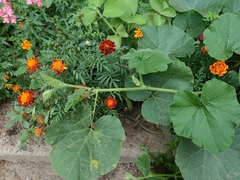 Cucurbita maximae0
- Outcome
- powdery mildew infectione0
Organisms pictured · Representative pictures of the matched species, not figures from the paper.

Verbatim
e0“A powdery mildew infection was observed on Cucurbita maxima Duchesne.”
Claim · model-written summary
The mildew was identified as Fibroidium sp.
- Taxon
- Cucucrbita maximat0
- Interactor
- Fibroidium sp.Fibroidiume0pathogen
- Outcome
- identity of powdery mildew as Fibroidium sp.e0
Verbatim
e0“Microscopic examinations revealed the identity of powdery mildew as Fibroidium sp.”
t0“Cucucrbita maxima”
Claim · model-written summary
Ampelomyces quisquali was identified as a mycoparasite in the mildew.
Verbatim
e0“Critical examinations identified it as a mycoparasite namely Ampelomyces quisquali Ces.”
t0“Cucucrbita maxima”