Abstract
Under the conditions of a model pot experiment, the effect of electron irradiation on the phytopathogenic microflora of plant roots and leaves was studied. The studies were carried out on spring barley seeds of the Vladimir variety (reproduction 1), affected by helminthosporiosis (pathogen Bipolaris sorokiniana Shoem.), (natural infectious background). This pathogen causes root rot and leaf spot. The grain was irradiated using a wide-aperture electron accelerator “Duet” with a mesh plasma cathode and the output of the generated beam of a large cross-section into the atmosphere in doses of 1, 2, 3, 4 and 5 kGy. The total administered dose was increased by changing the number of pulses. The radiation dose rate was 100 Gy/pulse, the electron energy was 130 keV (mode 1) and 160 keV (mode 2). The depth of dose absorption did not exceed 300 μm. Based on the conducted studies on the effect of electron irradiation on root rot (pathogen Bipolaris sorokiniana) of spring barley, it was noted that in the tillering and heading phases, when irradiating seed material with a dose of 2 kGy in mode 1 (130 keV), the disease incidence and prevalence decreased by more than 1.5 times compared to the non-irradiated control. In the phase of full grain maturity, the highest value of root infestation (45–50%) and prevalence (95–100%) of Bipolaris sorokiniana were recorded, but statistically significant differences between the irradiated variants and the control were absent. The records of the damage of vegetative plants showed that in the tillering phase, for all irradiation variants in mode 1, the degree of damage to leaves 1–3 increased by 23% compared to the control, and in the heading phase, the degree of damage to the upper leaves (1–3) exceeded the control when irradiated at doses of 2–5 kGy (mode 1) and 1–5 kGy (mode 2) – 2.1–2.8 times for 1 leaf, 1.9–2.0 times for 2 leaves and 1.2 times for 3 leaves.
Abstract from the paper’s OpenAlex record, shown for indexing and research. Copyright remains with the authors or the publisher. Read at the source ↗
The text the model read, with the source record’s inline markup (italics, sub- and superscripts) rendered and its character entities decoded; quote offsets refer to the raw text.
Claims 8
Claim · model-written summary
A 2 kGy seed dose in mode 1 reduced barley root rot incidence and prevalence by more than 1.5 times in tillering and heading.
- Taxon
- spring barley
 Hordeum vulgaret0
- Organ / stage
- tillering and heading phasese0
- Treatment
- irradiating seed material with a dose of 2 kGy in mode 1 (130 keV)e0
- Interactor
- Bipolaris sorokiniana
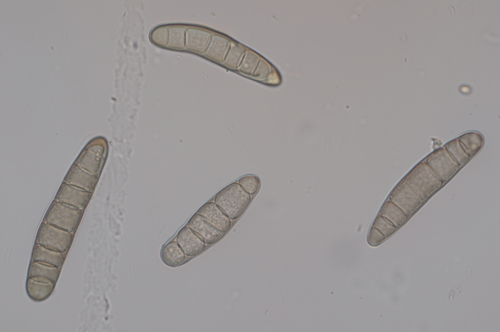
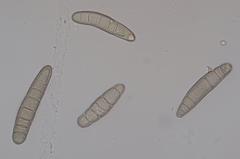 Bipolaris sorokinianae1pathogen
- Outcome
- disease incidence and prevalencee0
- Direction
- decreasede0
- Value
- more than 1.5 timese0
- Comparator
- non-irradiated controle0
Organisms pictured · Representative pictures of the matched species, not figures from the paper.

Verbatim
e0“in the tillering and heading phases, when irradiating seed material with a dose of 2 kGy in mode 1 (130 keV), the disease incidence and prevalence decreased by more than 1.5 times compared to the non-irradiated control”
e1“root rot (pathogen Bipolaris sorokiniana)”
t0“spring barley seeds”
Claim · model-written summary
At full grain maturity, barley root infestation reached 45–50%.
- Taxon
- spring barleyHordeum vulgaret0
- Organ / stage
- full grain maturitye0
- Interactor
- Bipolaris sorokinianaBipolaris sorokinianae0pathogen
- Outcome
- root infestatione0
- Direction
- higheste0
- Value
- 45–50%e0
Organisms pictured · Representative pictures of the matched species, not figures from the paper.
Verbatim
e0“In the phase of full grain maturity, the highest value of root infestation (45–50%) and prevalence (95–100%) of Bipolaris sorokiniana were recorded”
t0“spring barley seeds”
Claim · model-written summary
At full grain maturity, pathogen prevalence reached 95–100%.
- Taxon
- spring barleyHordeum vulgaret0
- Interactor
- Bipolaris sorokinianaBipolaris sorokinianae0pathogen
- Outcome
- prevalencee0
- Value
- 95–100%e0
Organisms pictured · Representative pictures of the matched species, not figures from the paper.
Verbatim
e0“prevalence (95–100%) of Bipolaris sorokiniana were recorded”
t0“spring barley seeds”
Claim · model-written summary
At grain maturity, irradiated variants did not differ significantly from controls in root disease.
- Taxon
- spring barleyHordeum vulgaret0
- Treatment
- irradiated variantse0
- Interactor
- Bipolaris sorokinianaBipolaris sorokinianae1pathogen
- Outcome
- root infestatione1
- Direction
- absente0
- Comparator
- controle0
Organisms pictured · Representative pictures of the matched species, not figures from the paper.
Verbatim
e0“statistically significant differences between the irradiated variants and the control were absent”
e1“root infestation (45–50%) and prevalence (95–100%) of Bipolaris sorokiniana”
t0“spring barley seeds”
Claim · model-written summary
Mode 1 irradiation increased damage to barley leaves 1–3 at tillering by 23%.
- Taxon
- spring barleyHordeum vulgaret0
- Organ / stage
- tillering phasee0
- Treatment
- all irradiation variants in mode 1e0
- Interactor
- Bipolaris sorokinianaBipolaris sorokinianae1pathogen
- Outcome
- degree of damage to leaves 1–3e0
- Direction
- increasede0
- Value
- 23%e0
- Comparator
- controle0
Organisms pictured · Representative pictures of the matched species, not figures from the paper.
Verbatim
e0“in the tillering phase, for all irradiation variants in mode 1, the degree of damage to leaves 1–3 increased by 23% compared to the control”
e1“root rot (pathogen Bipolaris sorokiniana)”
t0“spring barley seeds”
Claim · model-written summary
At heading, irradiation increased damage to the first upper leaf by 2.1–2.8 times.
- Taxon
- spring barleyHordeum vulgaret0
- Organ / stage
- heading phasee0
- Treatment
- 2–5 kGy (mode 1) and 1–5 kGy (mode 2)e0
- Outcome
- degree of damage to the upper leaves (1–3)e0
- Direction
- exceedede0
- Value
- 2.1–2.8 timese0
- Comparator
- controle0
Organisms pictured · Representative pictures of the matched species, not figures from the paper.
Verbatim
e0“in the heading phase, the degree of damage to the upper leaves (1–3) exceeded the control when irradiated at doses of 2–5 kGy (mode 1) and 1–5 kGy (mode 2) – 2.1–2.8 times for 1 leaf”
t0“spring barley seeds”
Claim · model-written summary
At heading, irradiation increased damage to the second upper leaf by 1.9–2.0 times.
- Taxon
- spring barleyHordeum vulgaret0
- Treatment
- 2–5 kGy (mode 1) and 1–5 kGy (mode 2)e0
- Outcome
- degree of damage to the upper leaves (1–3)e0
- Direction
- exceedede0
- Value
- 1.9–2.0 timese0
- Comparator
- controle0
Organisms pictured · Representative pictures of the matched species, not figures from the paper.
Verbatim
e0“the degree of damage to the upper leaves (1–3) exceeded the control when irradiated at doses of 2–5 kGy (mode 1) and 1–5 kGy (mode 2) – 2.1–2.8 times for 1 leaf, 1.9–2.0 times for 2 leaves”
t0“spring barley seeds”
Claim · model-written summary
At heading, irradiation increased damage to the third upper leaf by 1.2 times.
- Taxon
- spring barleyHordeum vulgaret0
- Treatment
- 2–5 kGy (mode 1) and 1–5 kGy (mode 2)e0
- Outcome
- degree of damage to the upper leaves (1–3)e0
- Direction
- exceedede0
- Value
- 1.2 timese0
- Comparator
- controle0
Organisms pictured · Representative pictures of the matched species, not figures from the paper.
Verbatim
e0“the degree of damage to the upper leaves (1–3) exceeded the control when irradiated at doses of 2–5 kGy (mode 1) and 1–5 kGy (mode 2) – 2.1–2.8 times for 1 leaf, 1.9–2.0 times for 2 leaves and 1.2 times for 3 leaves”
t0“spring barley seeds”
The same questions in other papers
radiation · Bipolaris sorokiniana · Hordeum vulgare (barley)Results agree
1 paper in the same direction as this paper
- positive
Claims are grouped by organism, treatment and what was measured or targeted. A paper counts as positive when any of its claims in the group is positive.