Abstract
Dry evergreen Afromontane forests are severely threatened due to the expansion of agriculture and overgrazing by livestock. The objective of this study was to investigate the composition of woody species, structure, regeneration status and plant communities in Seqela forest, as well as the relationship between plant community types and environmental variables. Systematic sampling was used to collect vegetation and environmental data from 52 (20 m x 20 m) (400 m2) plots. Density, Diameter at Breast Height (DBH), basal area, frequency, and importance value index (IVI) of woody species were computed to characterize the vegetation structure of the forest. Agglomerative hierarchical cluster analysis and Canonical Correspondence Analysis (CCA) with R software were used to identify plant communities and analyse the relationship between plant community types and environmental variables, respectively. A total of 68 woody plant species belonging to 63 genera and 44 families were identified. The Shannon diversity index and evenness values of the study area were 2.12 and 0.92, respectively. The total basal area and density of woody species were 27.4 m2 ha-1 and 1079.3 individual ha-1, respectively. The most frequent woody species in the Seqela forest included Albizia gummifera (51.92%), Croton macrostachyus (44.23%), Olinia rochetiana and Teclea nobilis (36.54%). Additionally, the most dominant species, as indicated by their importance value index (IVI), were Erythrina brucei (IVI = 11.24), Prunus africana (IVI=8.68), and Croton macrostachyus (IVI=7.38). Four plant community types were identified: Albizia gummifera - Ekebergia capensis, Prunus africana - Croton macrostachyus, Vachellia abyssinica - Dombeya torrida and Schefflera abyssinica - Teclea nobilis. The CCA results showed that the variation of species distribution and plant community formation were significantly (P < 0.05) related to altitude, organic matter, aspect, slope and soil available phosphorus. The regeneration status assessment of the forest revealed a good regeneration status, which was linked to diverse and abundant seed bank in the soil can ensure a continuous supply of seeds for regeneration; therefore, it is recommended to implement periodic soil seed bank assessments to monitor seed diversity and abundance and inform targeted conservation actions.
Abstract from the paper’s OpenAlex record; open copy licensed cc-by. Read at the source ↗
The text the model read, with the source record’s inline markup (italics, sub- and superscripts) rendered and its character entities decoded; quote offsets refer to the raw text.
Claims 16
Claim · model-written summary
Seqela forest contained 68 woody species, 63 genera and 44 families.
Verbatim
e0“A total of 68 woody plant species belonging to 63 genera and 44 families were identified”
Claim · model-written summary
Forest Shannon diversity was 2.12.
Verbatim
e0“The Shannon diversity index and evenness values of the study area were 2.12 and 0.92, respectively”
t0“Woody species”
Claim · model-written summary
Forest evenness was 0.92.
Verbatim
e0“The Shannon diversity index and evenness values of the study area were 2.12 and 0.92, respectively”
t0“Woody species”
Claim · model-written summary
Woody basal area was 27.4 m2 ha-1.
Verbatim
e0“The total basal area and density of woody species were 27.4 m2 ha-1 and 1079.3 individual ha-1, respectively”
Claim · model-written summary
Woody density was 1079.3 individual ha-1.
Verbatim
e0“The total basal area and density of woody species were 27.4 m2 ha-1 and 1079.3 individual ha-1, respectively”
Claim · model-written summary
Albizia gummifera was frequent at 51.92%.
- Taxon
- Albizia gummiferaAlbizia gummiferae0
- Outcome
- most frequente0
- Value
- 51.92%e0
Verbatim
e0“The most frequent woody species in the Seqela forest included Albizia gummifera (51.92%)”
Claim · model-written summary
Croton macrostachyus was frequent at 44.23%.
- Taxon
- Croton macrostachyus
 Croton macrostachyuse0
- Outcome
- most frequente0
- Value
- 44.23%e0
Organisms pictured · Representative pictures of the matched species, not figures from the paper.

Verbatim
e0“The most frequent woody species in the Seqela forest included Albizia gummifera (51.92%), Croton macrostachyus (44.23%)”
Claim · model-written summary
Olinia rochetiana and Teclea nobilis were frequent at 36.54%.
- Taxon
- Olinia rochetianaOlinia rochetianae0
- Outcome
- most frequente0
- Value
- 36.54%e0
Verbatim
e0“The most frequent woody species in the Seqela forest included Albizia gummifera (51.92%), Croton macrostachyus (44.23%), Olinia rochetiana and Teclea nobilis (36.54%)”
Claim · model-written summary
Erythrina brucei had IVI 11.24.
- Taxon
- Erythrina brucei
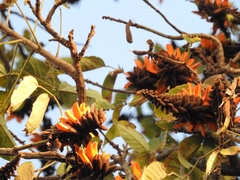 Erythrina bruceie0
- Outcome
- IVIe0
- Value
- 11.24e0
Organisms pictured · Representative pictures of the matched species, not figures from the paper.
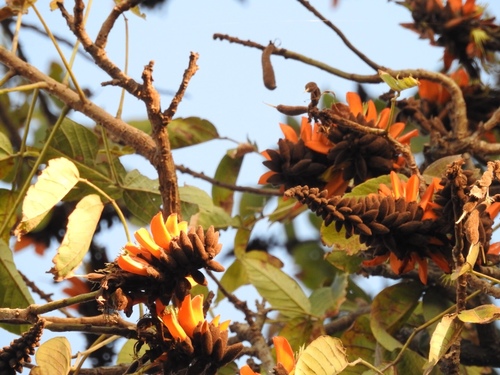
Verbatim
e0“Erythrina brucei (IVI = 11.24)”
Claim · model-written summary
Prunus africana had IVI 8.68.
- Taxon
- Prunus africana
 Prunus africanae0
- Outcome
- IVIe0
- Value
- 8.68e0
Organisms pictured · Representative pictures of the matched species, not figures from the paper.

Verbatim
e0“Prunus africana (IVI=8.68)”
Claim · model-written summary
Croton macrostachyus had IVI 7.38.
- Taxon
- Croton macrostachyusCroton macrostachyuse0
- Outcome
- IVIe0
- Value
- 7.38e0
Organisms pictured · Representative pictures of the matched species, not figures from the paper.
Verbatim
e0“Croton macrostachyus (IVI=7.38)”
Claim · model-written summary
Four forest community types were identified.
Verbatim
e0“Four plant community types were identified: Albizia gummifera - Ekebergia capensis, Prunus africana - Croton macrostachyus, Vachellia abyssinica - Dombeya torrida and Schefflera abyssinica - Teclea nobilis”
Claim · model-written summary
Community distribution and formation related significantly to altitude, organic matter, aspect, slope and available phosphorus.
- Taxon
- woody speciest0
Not reportedDirection
Verbatim
e0“variation of species distribution and plant community formation were significantly (P < 0.05) related to altitude, organic matter, aspect, slope and soil available phosphorus”
e1“plant communities in Seqela forest”
t0“Woody species”
Claim · model-written summary
The forest had good regeneration status.
Verbatim
e0“The regeneration status assessment of the forest revealed a good regeneration status”
t0“Woody species”
Claim · model-written summary
The authors linked forest regeneration to a diverse abundant soil seed bank.
Verbatim
e0“which was linked to diverse and abundant seed bank in the soil can ensure a continuous supply of seeds for regeneration”
t0“Woody species”
Claim · model-written summary
The authors recommend periodic soil seed bank assessments for conservation.
Verbatim
e0“it is recommended to implement periodic soil seed bank assessments to monitor seed diversity and abundance and inform targeted conservation actions”
t0“Woody species”