Abstract
Citrus tristeza virus (CTV) is a vector-borne virus that poses a significant threat to citrus production worldwide, inducing a variety of symptoms. Therefore, a detailed knowledge of local aphids, identification of viruliferous species, and the development of new monitoring tools are necessary to improve CTV control strategies. Herein, a 2-year survey was conducted to assess the frequency of aphid species infesting several citrus pilot orchards. Plot findings based on morphological and molecular identification revealed Aphis spiraecola (ranged from 44–100%) as the most abundant aphid species, followed by A. gossypii (<50%). Toxoptera aurantii, Myzus persicae, and A. craccivora were present in low numbers, and A. citricidus was not detected. Due to the absence of CTV detection in aphids and citrus trees from the pilot orchards, a complementary survey was conducted in CTV-infected fields. Three aphid species were identified as CTV-positive by RT-PCR, suggesting that they may be viruliferous, with A. spiraecola as predominant, followed by A. gossypii and T. aurantii. Additionally, we developed a non-invasive procedure for identifying aphid species using wingbeat analysis. This method provides a faster alternative to traditional identification techniques by taxonomic keys based on morphological features or PCR, although its accuracy is lower (approximately 95% for the two species tested). Overall, this work provides a detailed study of aphid species composition in citrus orchards, identifies the predominant local putative CTV vector, and introduces a novel sensor for aphid monitoring, contributing to improved epidemic forecasting and sustainable disease management strategies.
Abstract from the paper’s OpenAlex record; open copy licensed cc-by. Read at the source ↗
The text the model read, with the source record’s inline markup (italics, sub- and superscripts) rendered and its character entities decoded; quote offsets refer to the raw text.
Claims 11
Claim · model-written summary
Aphis spiraecola was the most abundant aphid, ranging from 44 to 100%.
- Interactor
- Aphis spiraecola
 Aphis spiraecolae0pest
- Outcome
- most abundant aphid speciese0
- Value
- 44–100%e0
 Citrus
Organisms pictured · Representative pictures of the matched species, not figures from the paper.


Verbatim
e0“Aphis spiraecola (ranged from 44–100%) as the most abundant aphid species”
t0“Aphid Species in Citrus Orchards”
Claim · model-written summary
A. gossypii followed at less than 50%.
- Interactor
- A. gossypii
 Aphis gossypiie0pest
- Outcome
- followed by A. gossypiie0
- Value
- <50%e0
Organisms pictured · Representative pictures of the matched species, not figures from the paper.

Verbatim
e0“followed by A. gossypii (<50%)”
t0“Aphid Species in Citrus Orchards”
Claim · model-written summary
Toxoptera aurantii was present in low numbers.
- Interactor
- Toxoptera aurantii
 Aphis aurantiie0pest
- Outcome
- present in low numberse0
Organisms pictured · Representative pictures of the matched species, not figures from the paper.

Verbatim
e0“Toxoptera aurantii, Myzus persicae, and A. craccivora were present in low numbers”
t0“Aphid Species in Citrus Orchards”
Claim · model-written summary
Myzus persicae was present in low numbers.
- Interactor
- Myzus persicae
 Myzus persicaee0pest
- Outcome
- present in low numberse0
Organisms pictured · Representative pictures of the matched species, not figures from the paper.

Verbatim
e0“Myzus persicae, and A. craccivora were present in low numbers”
t0“Aphid Species in Citrus Orchards”
Claim · model-written summary
A. craccivora was present in low numbers.
- Interactor
- A. craccivora
 Aphis craccivorae0pest
- Outcome
- present in low numberse0
Organisms pictured · Representative pictures of the matched species, not figures from the paper.

Verbatim
e0“A. craccivora were present in low numbers”
t0“Aphid Species in Citrus Orchards”
Claim · model-written summary
A. citricidus was not detected.
- Interactor
- A. citricidus
 Aphis citriciduse0pest
- Outcome
- A. citricidus was not detectede0
Organisms pictured · Representative pictures of the matched species, not figures from the paper.
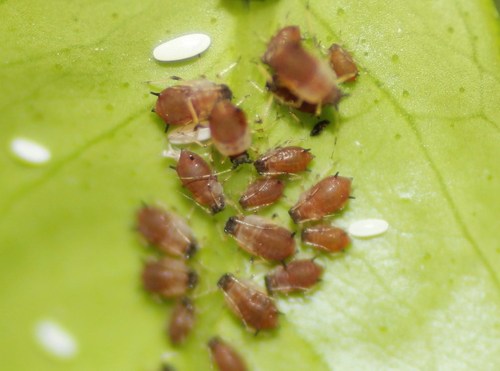
Verbatim
e0“A. citricidus was not detected”
t0“Aphid Species in Citrus Orchards”
Claim · model-written summary
CTV was absent from pilot orchard aphids and trees.
Organisms pictured · Representative pictures of the matched species, not figures from the paper.
Verbatim
e0“absence of CTV detection in aphids and citrus trees from the pilot orchards”
Claim · model-written summary
A. spiraecola was predominant among CTV-positive aphids.
- Interactor
- A. spiraecolaAphis spiraecolae0pest
- Second interactor
- CTVe0pathogen
- Outcome
- CTV-positivee0
Organisms pictured · Representative pictures of the matched species, not figures from the paper.
Verbatim
e0“Three aphid species were identified as CTV-positive by RT-PCR, suggesting that they may be viruliferous, with A. spiraecola as predominant”
t0“Aphid Species in Citrus Orchards”
Claim · model-written summary
A. gossypii was CTV-positive.
- Interactor
- A. gossypiiAphis gossypiie0pest
- Second interactor
- CTVe1pathogen
- Outcome
- CTV-positivee1
Organisms pictured · Representative pictures of the matched species, not figures from the paper.
Verbatim
e0“A. spiraecola as predominant, followed by A. gossypii and T. aurantii”
t0“Aphid Species in Citrus Orchards”
e1“Three aphid species were identified as CTV-positive”
Claim · model-written summary
T. aurantii was CTV-positive.
- Interactor
- T. aurantiiAphis aurantiie0pest
- Second interactor
- CTVe1pathogen
- Outcome
- CTV-positivee1
Organisms pictured · Representative pictures of the matched species, not figures from the paper.
Verbatim
e0“followed by A. gossypii and T. aurantii”
t0“Aphid Species in Citrus Orchards”
e1“Three aphid species were identified as CTV-positive”
Claim · model-written summary
Wingbeat identification was faster than traditional identification with about 95% accuracy for two species.
- Outcome
- accuracye0
- Direction
- lowere0
- Value
- approximately 95%e0
- Qualifier
- two species testede0
- Comparator
- traditional identification techniquese0
Organisms pictured · Representative pictures of the matched species, not figures from the paper.
Verbatim
e0“This method provides a faster alternative to traditional identification techniques by taxonomic keys based on morphological features or PCR, although its accuracy is lower (approximately 95% for the two species tested)”
t0“Aphid Species in Citrus Orchards”