Abstract
This paper provides a revision of Porella in the Korean Peninsula based mostly on a study of the collections housed in the herbaria of Jeonbuk National University (JNU) using an integrative approach to systematize the liverwort, as well as a study of the types of several species and available literature sources. In total, 17 species were recorded, including six taxa (Porella acutifolia ssp. tosana, P. platyphylla, P. perrottetiana, P. pinnata, P. spinulosa, and P. subobtusa) whose identities were not confirmed with the available materials and were suspected to be recorded by mistake. Two species are described as new to science. Porella koreana sp. nov. is morphologically similar to P. caespitans and P. densifolia; however it has an acute apex, and cells in the middle of the dorsal lobe have convex trigones. Porella chulii sp. nov. is somewhat morphologically similar to P. japonica; however, it has a dorsal leaf lobe margin that is slightly incurved, and the cells in the middle of the dorsal lobe are 20–25 μm in size. Each confirmed species is annotated by morphological descriptions based on available Korean material, data on ecology, its distribution, specimens examined, and illustrations. The identification key for Porella taxa known in Korea is provided.
Abstract from the paper’s OpenAlex record; open copy licensed cc-by. Read at the source ↗
The text the model read, with the source record’s inline markup (italics, sub- and superscripts) rendered and its character entities decoded; quote offsets refer to the raw text.
Claims 6
Claim · model-written summary
Seventeen Porella species were recorded.
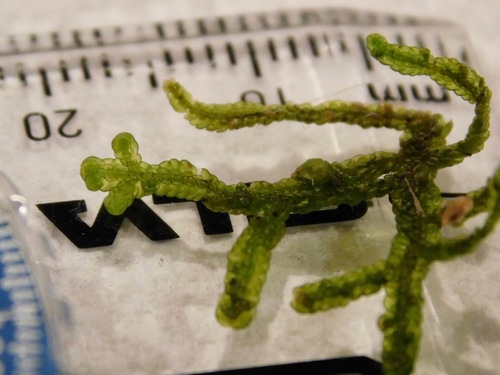
 Porella
Organisms pictured · Representative pictures of the matched species, not figures from the paper.
Verbatim
e0“In total, 17 species were recorded”
t0“Genus Porella (Porellaceae, Marchantiophyta)”
Claim · model-written summary
Six recorded taxa had unconfirmed identities and may have been erroneous records.
- Taxon
- Porella acutifolia ssp. tosanaPorella acutifoliae0
- Outcome
- identities were not confirmede0
- Value
- six taxae0
- Qualifier
- suspected to be recorded by mistakee0
Verbatim
e0“six taxa (Porella acutifolia ssp. tosana, P. platyphylla, P. perrottetiana, P. pinnata, P. spinulosa, and P. subobtusa) whose identities were not confirmed with the available materials and were suspected to be recorded by mistake.”
Claim · model-written summary
Two Porella species were described as new.
Organisms pictured · Representative pictures of the matched species, not figures from the paper.
Verbatim
e0“Two species are described as new to science.”
t0“Genus Porella (Porellaceae, Marchantiophyta)”
Claim · model-written summary
Porella koreana has an acute apex and convex dorsal-lobe cell trigones.
- Taxon
- Porella koreanaPorella koreanae0
- Outcome
- acute apex, and cells in the middle of the dorsal lobe have convex trigonese0
- Comparator
- P. caespitans and P. densifoliae0
Not reportedDirection
Verbatim
e0“Porella koreana sp. nov. is morphologically similar to P. caespitans and P. densifolia; however it has an acute apex, and cells in the middle of the dorsal lobe have convex trigones.”
Claim · model-written summary
Porella chulii has an incurved dorsal lobe margin and 20–25 μm dorsal lobe cells.
- Taxon
- Porella chuliiPorella chuliie0
- Outcome
- dorsal leaf lobe margin that is slightly incurvede0
- Value
- 20–25 μme0
- Comparator
- P. japonicae0
Not reportedDirection
Verbatim
e0“Porella chulii sp. nov. is somewhat morphologically similar to P. japonica; however, it has a dorsal leaf lobe margin that is slightly incurved, and the cells in the middle of the dorsal lobe are 20–25 μm in size.”
Claim · model-written summary
An identification key for Korean Porella was provided.
Organisms pictured · Representative pictures of the matched species, not figures from the paper.
Verbatim
e0“The identification key for Porella taxa known in Korea is provided.”