Abstract
Leafminer ( Liriomyza spp.) is a major insect pest of many important agricultural crops including lettuce ( Lactuca sativa L.). The goals of this study were to evaluate lettuce genotypes for resistance to leafminers and to estimate the heritabilities of leafminer-resistant traits in the field, to examine the association among different resistant traits, and to study the mechanism of leafminer resistance in lettuce. Seventy-eight lettuce accessions and 232 F 2 plants of crosses were evaluated for leafminer stings and the production of pupae and flies in the field in 2001 and 2002, and resistant genotypes were subjected to no-choice test. Wild species ( Lactuca serriola L., L. saligna L., and L. virosa L.) had significantly fewer stings than cultivated lettuces. Among cultivated lettuces, sting densities were lowest on leaf lettuce and highest on romaine types. The sting results from the field were highly correlated with the results from insect cages ( r = 0.770 and 0.756 for 2001 and 2002 tests, respectively), suggesting that a cage test can be used to screen for resistance in the field. Broad-sense heritability estimates for stings per unit leaf area in the field were 81.6% and 67.4% for 2001 and 2002 tests, respectively. The number of pupae produced per plant or per leaf was moderately correlated with sting density but was not correlated with leaf weight. Results suggest that both antixenosis and antibiosis exist in lettuce germplasm and resistant genotypes from choice tests remain resistant under no-choice conditions. These findings suggest that genetic improvement of cultivated lettuce for leafminer resistance is feasible.
Abstract from the paper’s OpenAlex record, shown for indexing and research. Copyright remains with the authors or the publisher. Read at the source ↗
The text the model read, with the source record’s inline markup (italics, sub- and superscripts) rendered and its character entities decoded; quote offsets refer to the raw text.
Claims 9
Claim · model-written summary
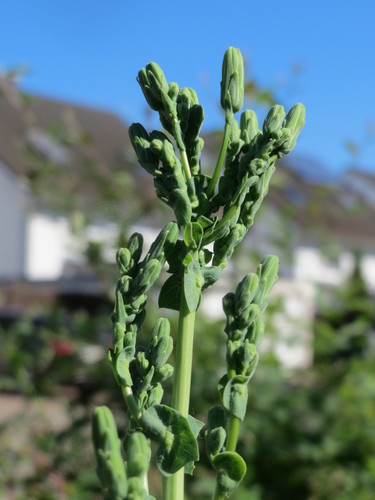
Wild Lactuca species had fewer leafminer stings than cultivated lettuce.
- Taxon
- Lactuca serriola L., L. saligna L., and L. virosa L.
 Lactuca serriola
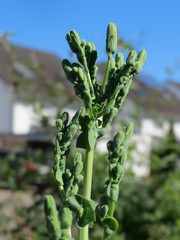 Lactuca virosa
 Lactuca salignae0
- Outcome
- stingse0
- Direction
- fewere0
- Comparator
- cultivated lettucese0
Organisms pictured · Representative pictures of the matched species, not figures from the paper.


Verbatim
e0“Wild species ( Lactuca serriola L., L. saligna L., and L. virosa L.) had significantly fewer stings than cultivated lettuces”
Claim · model-written summary
Among cultivated lettuce, leaf types had the lowest sting density and romaine the highest.
- Taxon
- cultivated lettuces
 Lactuca sativae0
- Material
- leaf lettucee0
- Outcome
- sting densitiese0
- Direction
- loweste0
- Comparator
- romaine typese0
Organisms pictured · Representative pictures of the matched species, not figures from the paper.

Verbatim
e0“Among cultivated lettuces, sting densities were lowest on leaf lettuce and highest on romaine types”
Claim · model-written summary
Field sting results correlated with cage results in 2001 and 2002.
- Taxon
- LettuceLactuca sativat0
- Outcome
- sting results from the fielde0
- Direction
- highly correlatede0
- Value
- r = 0.770 and 0.756e0
- Setting
- insect cagese0
Organisms pictured · Representative pictures of the matched species, not figures from the paper.
Verbatim
e0“The sting results from the field were highly correlated with the results from insect cages ( r = 0.770 and 0.756 for 2001 and 2002 tests, respectively)”
t0“Lettuce”
Claim · model-written summary
Field sting density broad-sense heritability was 81.6% in 2001 and 67.4% in 2002.
- Taxon
- LettuceLactuca sativat0
- Outcome
- Broad-sense heritability estimates for stings per unit leaf areae0
- Value
- 81.6% and 67.4%e0
- Setting
- in the fielde0
Organisms pictured · Representative pictures of the matched species, not figures from the paper.
Verbatim
e0“Broad-sense heritability estimates for stings per unit leaf area in the field were 81.6% and 67.4% for 2001 and 2002 tests, respectively”
t0“Lettuce”
Claim · model-written summary
Pupae per plant or leaf correlated moderately with sting density.
- Taxon
- LettuceLactuca sativat0
- Outcome
- number of pupae produced per plant or per leafe0
- Direction
- moderately correlatede0
- Comparator
- sting densitye0
Organisms pictured · Representative pictures of the matched species, not figures from the paper.
Verbatim
e0“The number of pupae produced per plant or per leaf was moderately correlated with sting density”
t0“Lettuce”
Claim · model-written summary
Pupae production did not correlate with leaf weight.
- Taxon
- LettuceLactuca sativat0
- Outcome
- number of pupae produced per plant or per leafe1
- Direction
- not correlatede0
- Comparator
- leaf weighte0
Organisms pictured · Representative pictures of the matched species, not figures from the paper.
Verbatim
e0“was not correlated with leaf weight”
e1“The number of pupae produced per plant or per leaf”
t0“Lettuce”
Claim · model-written summary
Lettuce germplasm showed antixenosis and antibiosis to leafminers.
- Taxon
- lettuceLactuca sativae0
- Material
- lettuce germplasme0
- Outcome
- antixenosis and antibiosise0
Organisms pictured · Representative pictures of the matched species, not figures from the paper.
Verbatim
e0“both antixenosis and antibiosis exist in lettuce germplasm”
Claim · model-written summary
Resistant lettuce genotypes from choice tests remained resistant without choice.
- Taxon
- LettuceLactuca sativat0
- Material
- resistant genotypese0
- Outcome
- resistante0
- Setting
- no-choice conditionse0
Organisms pictured · Representative pictures of the matched species, not figures from the paper.
Verbatim
e0“resistant genotypes from choice tests remain resistant under no-choice conditions”
t0“Lettuce”
Claim · model-written summary
The authors suggest genetic improvement of lettuce for leafminer resistance is feasible.
- Taxon
- cultivated lettuceLactuca sativae0
- Outcome
- genetic improvemente0
Organisms pictured · Representative pictures of the matched species, not figures from the paper.
Verbatim
e0“genetic improvement of cultivated lettuce for leafminer resistance is feasible”